


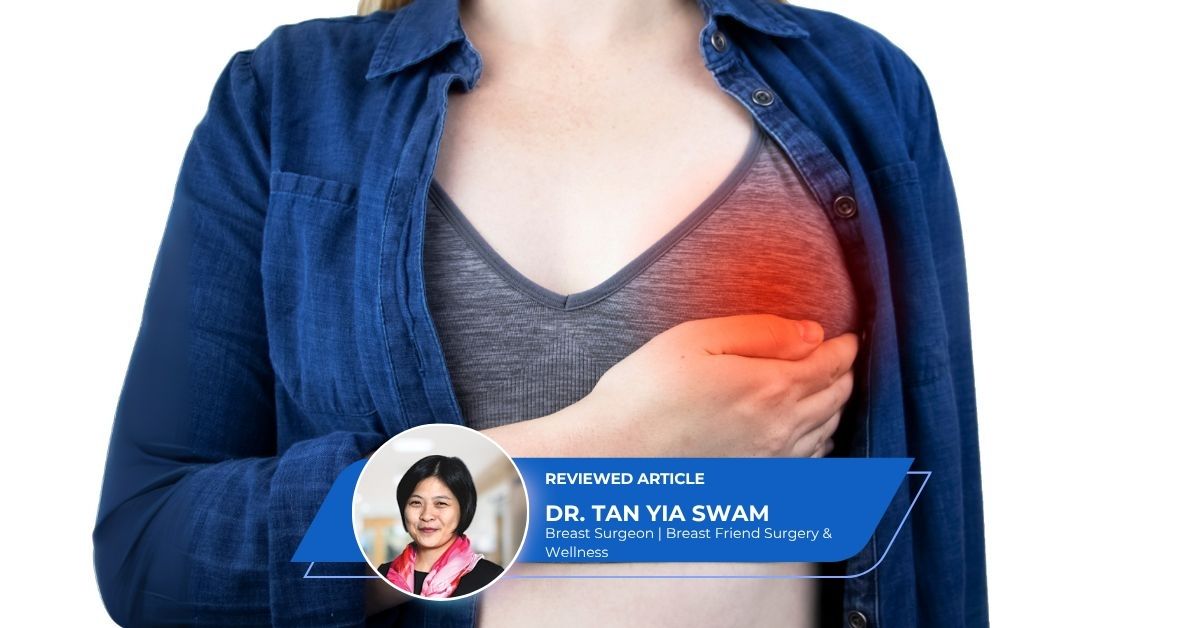
Breast cancer is the most common cancer affecting women, according to the Singapore Cancer Registry. One of the ways of screening breast cancer is self breast-examination, in addition to regular mammograms or breast ultrasounds. If a breast lump is felt during the self-examination, a visit to a doctor for further investigation is warranted. Discovering a breast lump can be an alarming experience, but it is important to remember that not every lump means cancer. In fact, many lumps are benign and caused by natural changes in breast tissue. In fact, as the texture of normal breast tissue is naturally variable, an initial challenge is to determine whether something is abnormal to begin with.
This article explores what a breast lump feels like, why self-examination can sometimes be confusing, and when you should seek medical advice.
Have Concerns? Get An Appointment With A Breast Surgeon
Contact UsBack To: Breast Cancer Main Page
What Does A Normal Breast Feel Like?
Breast tissue is not uniformly soft. In many women, it naturally feels uneven, with ridges, firmness, and nodularity. The breasts may even feel different from week to week due to hormonal changes throughout the menstrual cycle. For example, breasts can often become more tender and lumpy due to fluid retention and fibrocystic changes during the premenstrual phase. Because of this natural variability, it is not always easy to know whether what you are feeling is a genuine breast lump or simply normal tissue.
How Does A Breast Lump Feel Compared To Normal Tissue?
A true breast lump often has distinctive characteristics that sets it apart from natural breast texture:
- Harder Texture: Malignant lumps usually feel harder than the surrounding tissue.
- Irregular Shape: They may feel uneven rather than round or smooth.
- Fixed Position: Unlike benign cysts, which may move slightly under the skin, a cancerous lump is often fixed in place.
- Painless Growth: Many breast cancers are not painful in the early stages, which can make them harder to notice.
Benign lumps such as cysts or fibroadenomas tend to be smooth, mobile, and sometimes tender. However, only medical imaging and biopsy can confirm what a lump actually is.
Why Breast Self-Examination Can Be Difficult?
Breast self-examination (BSE) is encouraged as a way to become familiar with your own breast texture. However, women often find it difficult to distinguish between normal firmness and an actual breast lump. This uncertainty can lead to anxiety and, in some cases, unnecessary medical procedures.
Nonetheless, self-awareness is still valuable. If you do detecting a change, especially if it persists after your menstrual cycle, it is important to see a doctor for medical advice.
When Should You Seek Medical Advice?
If you discover a new breast lump or notice any of the following changes, you should contact your doctor promptly:
- A lump that feels different from surrounding tissue
- Thickening or hardening in one area of the breast
- Visible skin changes such as dimpling or puckering
- Nipple discharge, especially if it is bloody
- A lump in the armpit area
- Any change that persists beyond one menstrual cycle
Your doctor may recommend a clinical breast examination, mammogram, ultrasound, or biopsy to confirm the nature of the lump.
Importance Of Regular Screening
Breast self-examinations are a useful habit. However, it does not replace professional screening. Mammography remains the most reliable method of detecting breast cancer at an early stage, often before a lump can be felt. Women over 40 should go for annual mammograms, whereas those over 50 may do it once every 2 years based on the doctor’s recommendation. Those at higher risk (e.g. have a family history of breast cancer) may need one earlier, or go for more frequent checks.
Get An Appointment With A Breast Specialist
A breast lump does not always mean cancer, but it should never be ignored. Because breast tissue naturally varies in firmness and texture, self-examination can sometimes be confusing. The key is to know your normal pattern and watch for new, persistent changes. If you are uncertain, always consult a doctor for a proper diagnosis.
Contact Us
This medical content has been reviewed by Dr Tan Yia Swam, a highly experienced general surgeon with a special focus on breast conditions, offering minimally invasive breast surgery, ultrasound-guided biopsies and comprehensive cancer surgical care.
Back To: Breast Cancer Main Page
All content on this site is informative only and is not intended to be a substitute for professional medical advice, diagnosis, or treatment, and should never be relied upon for specific medical advice. If you are experiencing a medical emergency, call 995 immediately or go to the nearest Accident & Emergency department.
health365.sg is a member of Group 365Asia.