

Chronic Kidney Disease In Singapore -The Big Story

Chronic Kidney Disease In Singapore - Prevention & Management
Chronic Kidney Disease in Singapore is a public health concern, with the nation currently having one of the highest rates of kidney failure globally. Often described as a “silent killer,” Chronic Kidney Disease (CKD) progresses gradually, frequently without noticeable symptoms until the kidneys have sustained significant damage.
In this Big Story, we focus in particular on:
- Understanding Chronic Kidney Disease – Exploring how impaired kidney function affects overall health and the specific risks faced by the Singaporean population.
- Causes Of CKD – What are the common conditions that result in chronic kidney disease.
- IgA Nephropathy (IgAN) – A specific autoimmune condition that is a leading cause of primary glomerulonephritis in Singapore.
- Prevention And Management – Practical steps to slow disease progression through lifestyle, medication, and early screening.
What Is Chronic Kidney Disease?
The kidneys act as the body’s sophisticated filtration system, removing waste products and excess fluid from the blood. Chronic Kidney Disease occurs when the kidneys are damaged and lose their ability to filter blood effectively over a period of months or years.
In Singapore, the rising prevalence of CKD is largely driven by an ageing population and high rates of diabetes and hypertension. Without intervention, CKD can lead to End-Stage Renal Disease (ESRD), requiring life-sustaining treatments like dialysis or a kidney transplant.
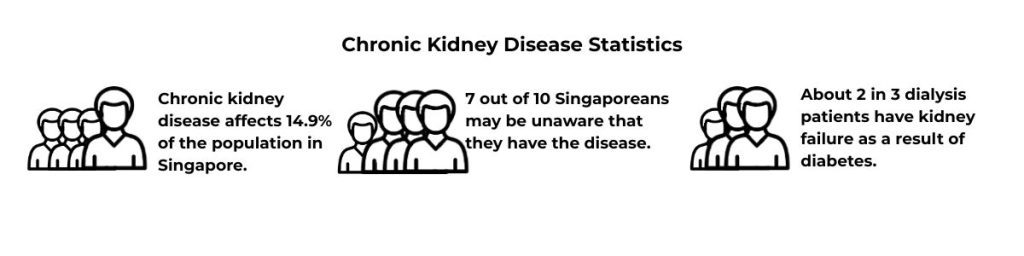
Chronic Kidney Disease Statistics In Singapore
Here are three key statistics regarding Chronic Kidney Disease in Singapore:
- Chronic kidney disease affects 14.9% of the population in Singapore, according to the 2024 National Population Health Survey. About 6 people are diagnosed with kidney failure every day.
- CNA reported that potentially 7 out of 10 Singaporeans were unaware that they have the disease.
- About 2 in 3 dialysis patients have kidney failure as a result of diabetes.
Common Causes Of Chronic Kidney Disease And Who Is At Risk?
Chronic Kidney Disease does not usually have a single point of origin. Rather, it is often the result of long-term systemic health issues.
- Diabetes Mellitus: The leading cause of CKD in Singapore. High blood sugar levels damage the tiny filtering units (nephrons) in the kidneys.
- Hypertension (High Blood Pressure): Uncontrolled blood pressure can cause the arteries around the kidneys to narrow, weaken, or harden, reducing blood flow to kidney tissue.
- Glomerulonephritis: Inflammation of the kidney’s filtering units, of which IgA Nephropathy is a common type.
- Family History: Individuals with a family history of kidney disease or polycystic kidney disease are at higher risk.
Singapore faces a unique challenge due to the high prevalence of diabetes – one of the highest among developed nations. Furthermore, because CKD is often asymptomatic in its early stages, many Singaporeans remain undiagnosed until the disease is advanced.
IgA Nephropathy (IgAN): A Critical Concern In Asia
IgA Nephropathy, also known as Berger’s Disease, is an autoimmune kidney disease that occurs when an antibody called immunoglobulin A (IgA) builds up in the kidneys. This buildup causes inflammation that, over time, can hamper the kidneys’ ability to filter waste from the blood.
IgAN is particularly relevant in the Singaporean context because:
- Prevalence: It is more common in people of Asian descent compared to other ethnicities.
- Silent Progression: Many patients are asymptomatic, only discovering the condition during routine medical check-ups or when blood or protein is found in their urine.
- Risk of Failure: Up to 30% of patients with IgAN may eventually develop kidney failure within 20 years of diagnosis.
How To Prevent And Manage Chronic Kidney Disease?
While advanced kidney damage is often irreversible, early intervention can significantly slow the progression of the disease and preserve kidney function.
- Strict Control Of Blood Sugar And Pressure: For those with diabetes or hypertension, maintaining levels within the target range is the most critical factor in preventing kidney damage.
- Dietary Adjustments: Reducing salt (sodium) intake helps manage blood pressure, while moderating protein intake can reduce the workload on the kidneys.
- Medication Adherence: New classes of drugs, including SGLT2 inhibitors and specific treatments for IgAN, have shown great promise in protecting kidney function.
- Regular Screening: Annual urine and blood tests (checking for ACR and eGFR) are essential for those in high-risk groups.
Learn More About Chronic Kidney Disease
Find The Best Kidney Specialist In Singapore
When it comes to your kidney health, you naturally would like to find the best kidney specialist in Singapore. Find out how and get a head start from our article on Finding The Best Kidney Specialist In Singapore.
Comment: The row below to be moved to article for healthcare professionals article
Find A Doctor
Verified Healthcare Professionals
We connect you with a network of qualified and experienced doctors who specialise in chronic health conditions, health screening, and longevity.
Trusted Information Source
We pride ourselves on providing accurate, up-to-date, and evidence-based information about each disease, its prevention, and treatment.
Privacy and Security
Your health information and personal data are paramount to us. We will protect your privacy throughout the booking process and beyond.
Convenience at Your Fingertips
Our user-friendly platform allows you to find and book appointments 24/7 from the comfort of your home.
Our Preferred Doctor You Can Consider For Chronic Kidney Disease Treatment
- Dr Wong Weng Kin is a highly qualified renal physician who combines deep expertise in complex kidney conditions with advanced skills in diagnostic and interventional nephrology, dialysis, and critical care. He offers holistic, personalised treatment that uses the latest research, technology, and precision medicine to protect long-term kidney health and overall well-being.



A diagnosis of Chronic Kidney Disease is no longer the daunting endpoint it once was. Modern medicine now offers us increasingly sophisticated tools to slow its progression and protect your future. By embracing early detection and a proactive partnership with your care team, you can take charge of your health and continue to lead a full, active life.
Dr Wong Weng Kin, Kidney Specialist
Book An Appointment
Take a proactive step for your health and peace of mind today. If you need to see a doctor about kidney treatment, our team is here to assist.
Financials
[findDoctor category="financial consultants" countries="Singapore" " limit="15"]
Related Content








FAQs - Test Your Knowledge About Chronic Kidney Disease
No, CKD is a chronic condition. However, with proper management, its progression can be significantly delayed, allowing patients to lead full lives.
No. In fact, most people with early-stage CKD do not feel ill or experience any pain.
IgAN is specifically an autoimmune condition. While diabetes damages kidneys through metabolic stress, IgAN involves the immune system attacking the kidney’s filters.
Yes. Maintaining a healthy weight, quitting smoking, and reducing salt intake are evidence-based ways to reduce the strain on your kidneys.
Additional Resources
- All you need to know about Kidney Biopsy | One Future Kidney Care
- Healthy Eating for Adults with Chronic Kidney Disease | National Institute of Diabetes and Digestive and Kidney Diseases
- How To Prevent Kidney Failure and Chronic Kidney Disease | SingHealth
- Living with Dialysis | Baxter Healthcare
- Sexual Health and Kidney Disease | National Kidney Foundation
.