

Exercise For Chronic Conditions – The Big Story

Exercise For Chronic Conditions – The Big Story
Exercise can help prevent, manage and rehabilitate many chronic health conditions. It can improve blood glucose control in Type 2 diabetes, help lower blood pressure, improve cardiovascular fitness, maintain muscle and bone strength, support mobility and balance, and improve quality of life.
But exercise for chronic conditions is not simply about going to the gym more often.
The type, intensity, frequency and duration of exercise may need to be adapted to a person’s medical condition, medications, fitness level, age, physical limitations and goals. This approach is commonly known as exercise medicine or exercise prescription.
In Singapore, the concept is already being incorporated into healthcare. Exercise Is Medicine Singapore (EIMS), hosted by Changi General Hospital, aims to make physical activity and exercise part of the prevention and treatment of chronic diseases.
The World Health Organization (WHO) also specifically includes people living with chronic conditions and disabilities in its physical activity recommendations.
The key message is simple: if you have a chronic condition, exercise may be more than something that is good for you. It may be an important part of your treatment plan.
What Is Exercise Medicine?
Exercise medicine is the use of appropriately prescribed physical activity and exercise to help prevent, manage or rehabilitate health conditions.
An exercise prescription considers factors such as:
- Medical condition and complications
- Current fitness and physical capacity
- Cardiovascular health
- Muscle and joint health
- Bone density and fracture risk
- Medications
- Balance and mobility
- Personal goals
The programme can then be adjusted according to type, intensity, frequency, duration and progression.
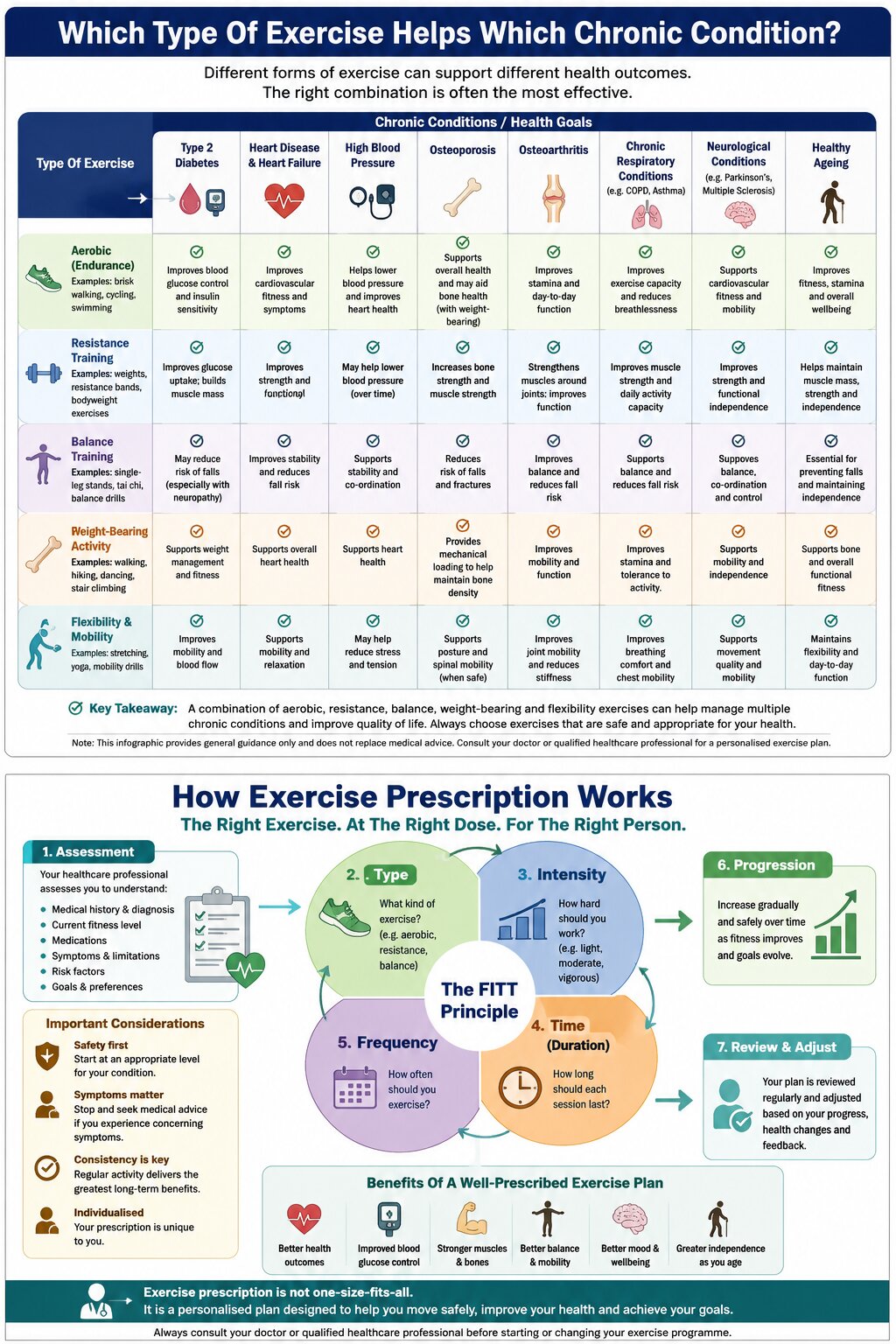
Click to expand infographic.

Powered by Find by 365Asia


[SG] Featured Doctor- Dr Kevin Koo
Orthopaedic Surgeon In Singapore
How Much Exercise Do You Need?
For most adults, the World Health Organization recommends 150–300 minutes of moderate-intensity aerobic activity per week, or 75–150 minutes of vigorous activity, together with muscle-strengthening activities on at least two days per week.
These recommendations also apply to many people living with chronic conditions. However, people who cannot meet these targets should be physically active according to their abilities and circumstances.
Some activity is better than none. Someone who is currently inactive may need to begin with shorter, easier sessions and gradually build up.
Exercise For Type 2 Diabetes
Exercise can improve insulin sensitivity and blood glucose control in people with Type 2 diabetes.
During exercise, contracting muscles increase their uptake of glucose from the bloodstream. Regular activity can therefore improve glucose management while also supporting cardiovascular fitness and weight management.
Both aerobic and resistance exercise are valuable. Medical experts recommend that most adults with diabetes undertake at least 150 minutes of moderate-to-vigorous aerobic activity each week, alongside resistance exercise two to three times per week.
Walking, cycling and swimming are examples of aerobic activity, while weights, resistance bands and bodyweight exercises can help maintain or build muscle.
Exercise For Osteoporosis
Appropriately prescribed exercise can help people with osteoporosis maintain bone and muscle strength, balance and physical function.
Weight-bearing and resistance exercises provide mechanical loading that can support bone health, while balance training can help reduce falls.
However, more impact is not necessarily better. People with osteoporosis, particularly those who have experienced vertebral or other fragility fractures, may need to modify exercises involving spinal bending, forceful twisting or high impact.
The International Osteoporosis Foundation recommends combining weight-bearing, muscle-strengthening and balance activities, with appropriate precautions for people who have sustained spinal fractures.
Exercise For Heart Disease, Hypertension And Other Conditions
Exercise also has an important role in cardiovascular health.
Regular physical activity can improve cardiovascular fitness and help manage blood pressure. People with stable cardiovascular disease may benefit from structured exercise, including cardiac rehabilitation where appropriate.
For chronic respiratory conditions such as COPD, exercise training can improve physical capacity and quality of life. For osteoarthritis, strengthening and aerobic activity can help improve physical function. People with neurological conditions may benefit from programmes targeting strength, balance, mobility and coordination.
The precise prescription differs according to the condition — which is why there is no single “best exercise” for everyone.
What Is The Right Exercise For You?
Exercise medicine follows a simple principle:
The right exercise, at the right dose, for the right person.
A medically guided programme may consider:
- Type: aerobic, resistance, weight-bearing, balance or mobility exercise.
- Intensity: how hard the person should work.
- Frequency: how often exercise should be performed.
- Duration: how long each session should last.
- Progression: how the programme should become more challenging as fitness improves.
This individualisation becomes particularly important when someone has several chronic conditions at the same time.
Is Exercise A Replacement For Medication?
No. Exercise is generally a component of medical treatment, rather than a replacement for medication.
Someone with Type 1 diabetes still requires insulin. A person at high risk of osteoporotic fracture may require medication. Someone with asthma may require prescribed inhalers.
Instead, exercise can complement medication, nutrition, weight management, physiotherapy and other treatments.
When Should You Seek Medical Advice?
Most healthy people can gradually become more active without specialist supervision.
However, medical advice may be appropriate if you have significant cardiovascular disease, osteoporosis with previous fractures, diabetes complications, chronic respiratory disease, neurological problems, substantial joint limitations or several chronic conditions.
The aim is not to prevent people from exercising.
It is to make exercise safer, more appropriate and more effective.
The Bottom Line
Exercise is more than a way to become fitter.
For people living with chronic conditions, it can become an important part of long-term health management.
Whether the goal is improving glucose control in diabetes, maintaining bone strength with osteoporosis, improving cardiovascular fitness or preserving independence with age, the principle remains the same:
Exercise should be prescribed according to the person — not simply according to the condition.
Looking For A Top Medical Specialist Certified To Prescribe Exercise Medicine In Singapore? Consider Dr Ananda Vella
Dr Ananda Vella is the Medical Director and Lead Consultant Orthopaedic Surgeon at OrthoCare – Orthopaedics and Sports Medicine in Singapore with over 20 years of medical experience. He is Swiss-double-fellowship-trained and MOH board-accredited orthopaedic specialist surgeon that specialises in lower limb conditions, including the foot and ankle, knee and hip, as well as all types of sports injuries and fractures.
In 2003, Dr Ananda graduated from National University of Singapore. He pursued his postgraduate training in Orthopaedic Surgery in Singapore and obtained his fellowship from the Royal College of Surgeons in Edinburgh.
Dr Ananda has also obtained a Graduate Diploma in Sports Medicine from the NTU Lee Kong Chian School of Medicine, Singapore, and is the first orthopaedic clinic to be exercise medicine certified.
Academic Qualifications
- MBBS (Singapore)
- MRCS (Edin)
- MMED (Ortho)
- FRCSED (Orthopaedics & Trauma)
- G. DIP (Sports Medicine)
Comment: The row below to be moved to article for healthcare professionals article
Find A Doctor
Verified Healthcare Professionals
We connect you with a network of qualified and experienced doctors who specialise in chronic health conditions, health screening, and longevity.
Trusted Information Source
We pride ourselves on providing accurate, up-to-date, and evidence-based information about each disease, its prevention, and treatment.
Privacy and Security
Your health information and personal data are paramount to us. We will protect your privacy throughout the booking process and beyond.
Convenience at Your Fingertips
Our user-friendly platform allows you to find and book appointments 24/7 from the comfort of your home.
Additional Resources
Book An Appointment
Take a proactive step for your health and peace of mind today. If you need to see an exercise medicine doctor, our team is here to assist.
Financials
[findDoctor category="financial consultants" countries="Singapore" " limit="15"]
Frequently Asked Questions (FAQs) About Exercise Medicine
What Is Exercise Medicine?
Exercise medicine is the use of appropriately prescribed physical activity and exercise to help prevent, manage or rehabilitate health conditions.
Can Exercise Help Chronic Conditions?
Yes. Regular physical activity can help prevent and manage conditions including cardiovascular disease, Type 2 diabetes and hypertension, while improving physical function and wellbeing.
How Much Exercise Should I Do?
Most adults should aim for 150–300 minutes of moderate activity per week, plus muscle-strengthening activities on at least two days. People with chronic conditions may need to adapt these recommendations according to their abilities and medical circumstances.
Is Exercise A Replacement For Medication?
No. Exercise is generally used alongside other treatments rather than as a universal replacement for medication.
Additional Resources
Related articles



External Links
- Physical Activity | World Health Organization
- WHO Guidelines On Physical Activity And Sedentary Behaviour | World Health Organization
- Standards Of Care In Diabetes 2026 | American Diabetes Association
- Exercise | International Osteoporosis Foundation