


For decades, the clinical management of chronic kidney disease has focused predominantly on the kidneys themselves—filtering the blood (i.e. dialysis), managing systemic blood pressure, and attempting to dampen inflammation within the renal tissues. However, recent medical breakthroughs and longitudinal studies have shifted the attention of nephrologists further “upstream.” Researchers have identified a biological link known as the Gut-Kidney Axis. This connection suggests that the root cause of certain autoimmune kidney diseases, specifically IgA Nephropathy (IgAN), may actually originate in the mucosal immune system of the gastrointestinal tract.
This discovery has paved the way for innovative “first-in-disease” therapies such as modified-release budesonide, which target the source of the disease in the gut rather than merely managing the collateral damage in the kidneys. For patients in Singapore, where and IgAN is the most common form of primary glomerulonephritis (GN) (a significant cause of chronic kidney disease and end-stage renal disease),understanding this connection is vital for navigating modern, precision-based treatment options.
Get An Appointment With A Kidney Specialist
Contact UsBack To: Kidney Disease Main Page
Understanding IgA Nephropathy: An Autoimmune Challenge
IgA Nephropathy, historically referred to as Berger’s Disease, is an autoimmune condition where the body’s immune system inadvertently triggers a cascade that damages the kidneys. Specifically, a protein called ImmunoglobulinA (IgA) becomes structurally abnormal.
In a healthy individual, IgA circulates and protects mucosal surfaces – including the mouth, lungs, and most significantly, the gastrointestinal tract. However, in patients with IgAN, these proteins are “galactose-deficient.” These abnormal IgA proteins form clumps called immune complexes, in the bloodstream. As the blood is filtered through the kidneys, these complexes become trapped in the glomeruli (the tiny filtering units of the kidney). This entrapment causes:
- Chronic Inflammation: The presence of these complexes triggers the body’s inflammatory response within the mesangium (the framework that sits inside the glomerulus to hold the tiny blood vessels in place).
- Glomerular Scarring: Over time, persistent inflammation leads to permanent scarring, known as fibrosis, which reduces the kidney’s ability to filter waste.
- Proteinuria And Haematuria: Blood and protein begin to “leak” into the urine, which are the primary clinical indicators of kidney stress.
In many Asian populations, including those in Singapore, IgAN tends to be more prevalent and can progress more aggressively toward kidney failure compared to Western cohorts. Traditionally, treatment involved slowing kidney disease progression and managing symptoms through blood pressure control and proteinuria reduction; commonly by using general blood pressure medication (such as ACE inhibitors). Doctors may also prescribe systemic steroids when patients are at high risk of rapid progression to end-stage kidney disease despite being on optimised renal supportive care medications. Systemic steroids, while effective to a degree, often come with a heavy burden of systemic side effects such as metabolic changes (e.g. redistribution of fat to the face and the back of the neck), steroid-induced diabetes or osteoporosis.
The Secret Connection: What Is The Gut-Kidney Axis?
To understand why the gut matters to the kidneys, we must look at the Mucosal Immune System. The gut is the body’s largest immune organ, constantly filtering through everything we eat and drink to distinguish between essential nutrients and harmful pathogens.
Within the walls of the small intestine, specifically in a region called the distalileum, lie specialised clusters of lymphoid tissue known as Peyer’spatches. These act as the “training camps” for the immune system, producing IgA antibodies to neutralise threats in the gut.
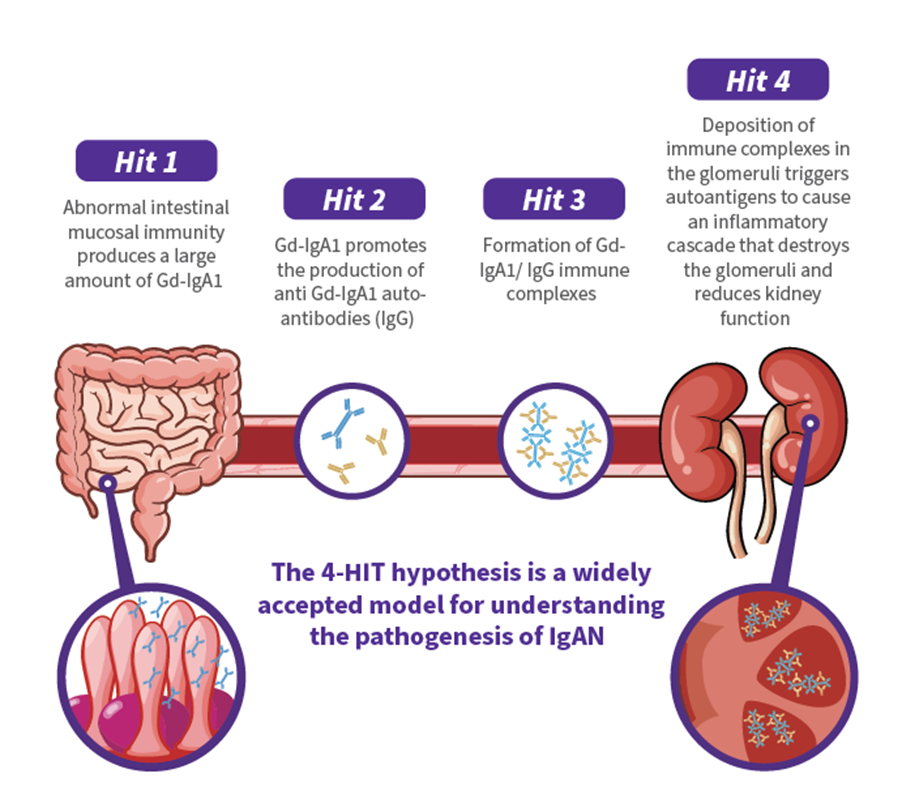
The Gut-Kidney Axis refers to the pathway where a dysfunction in these Peyer’s patches leads to the overproduction of the “faulty” version of IgA, known as Galactose-deficient IgA1 (Gd-IgA1). Because these antibodies are structurally abnormal, the body treats them as foreign invaders, producing “anti-antibodies” to attack them. This creates the toxic immune complexes that eventually travel through the circulatory system and lodge themselves in the kidneys, causing inflammation. This biological pathway—from the overactive immune response in the gut to the inflammatory damage in the kidney—is what scientists call the Four-Hit Hypothesis of IgA Nephropathy.
Modified-Release Budesonide: A Precision Approach Targeted To The Disease Source
Traditionally, the medical community sought a way to treat IgAN without subjecting the entire body to the harsh effects of systemic immunosuppressants. A modified-release formulation of budesonide has been developed specifically to address this need. Budesonide is a potent type of medicine known as a corticosteroid (or steroid). Corticosteroids mimic hormones the body naturally produces to reduceinflammation and calm an overactive immune system.
As a “first-in-disease” therapy, modified-release budesonide does not just treat the symptoms; it intervenes at one of the very first step of the disease process—the production of the faulty IgA in the gut.
How The Targeted-Release Mechanism Works
Modified-release budesonide utilises a sophisticated Targeted–ReleaseFormulation(TRF). Unlike traditional medications that dissolve in the stomach or upper intestine, the formulation is developed with a coating that delays the start of release of budesonide, and with triple-coated beads that mediate its sustained release. The coating allows for the bypassing of the stomach and upper small intestine and optimises the release of the budesonide-containing beads in the distal ileum. Following dissolution of the capsule shell, triple-coated beads contained within the capsule are released in the ileum. The inner layer contains the active budesonide, while the middle seal coating promotes stability of the budesonide. The outer coating mediates sustained release, inducing budesonide dissolution over a wider part of the distal ileum.
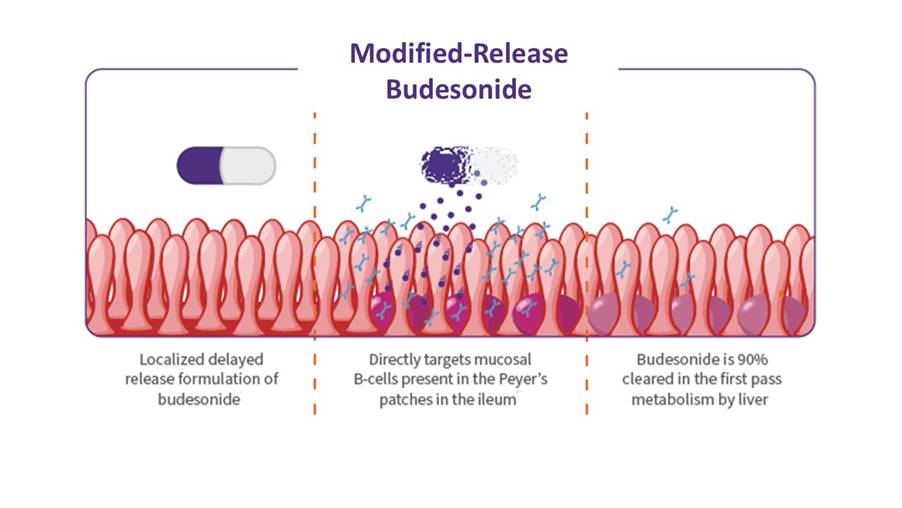
The medication is engineered to release its active ingredient when it enters an environment with the specific pH-level of the distalileum. By delivering the treatment directly to the Peyer’s patches, this formulation “silences” the overactive mucosal immune response at its headquarters.
Why Targeting The Gut Is Safer
Because the medication is delivered locally to the gut wall, very little of it enters the general bloodstream. It undergoes what is known as high first-pass metabolism in the liver, where approximately 90% of the drug is inactivated before it can circulate through the rest of the body. This is a significant advantage over traditional oral steroids, which circulate throughout the entire system and often cause significant side effects such as significant weight gain, increased blood sugar, bone density loss, and mood swings.
The 9-Month Treatment Journey: A Finite Strategy
Clinical trials for the current formulation of modified-release budesonide focused on a 9-month treatment period. Further trials are on-going for longer durations of treatment. The results from the 9-month trials demonstrated that intervention could significantly slow the decline of the Estimated Glomerular Filtration Rate (eGFR)—the primary measure of how well the kidneys are functioning—even after the medication was stopped. This “disease-modifying” potential is what sets gut-targeted therapy apart from supportive care.
Current medical practice guidelines for the management of IgAN recommend that for patients at risk of progressive kidney function loss, doctors should aim to simultaneously manage the generic responses to IgAN-induced nephron loss, as well as manage the IgAN-specific causes of nephron loss. The guidelines indicated that modified-release budesonide is the only treatment to date proven to reduce the levels of pathogenic forms of IgAN, and recommended that where it has been approved by health authorities, patients with IgAN at risk of progressive loss of kidney function be treated with a 9-month course of the medication.
Why This Matters For Patients In Singapore
The introduction of gut-targeted therapies represents a major shift toward precisionmedicine in the local healthcare landscape.
Early intervention is the most critical factor. Once the kidneys reach a stage of advanced scarring, no medication can “un-scar” the tissue. By identifying the disease early—often indicated by persistent protein in the urine during routine health screenings—and addressing the gut-kidney axis, patients may be able to significantly delay or even avoid the need for dialysis or kidney transplantation.
Furthermore, because many Singaporean patients are in the prime of their careers and lead active lives, the reduced side-effect profile of targeted therapy allows for a higher quality of life compared to high-dose systemic steroids. The ability to complete a treatment course in nine months rather than remaining on immunosuppressants indefinitely is a compelling prospect for many.
A New Era Of Renal Care
The discovery of the Gut-Kidney Axis has fundamentally changed our perspective on IgA Nephropathy. We no longer view it solely as a “kidney problem,” but as a systemic immune dysfunction that begins in the gut.
By using targeted therapies like modified-release budesonide to address the etiological root of the disease, doctors can protect kidney function more effectively and with fewer systemic risks. As medical science continues to uncover the complexities of the mucosal immune system, the future of renal care looks increasingly targeted, personal, and hopeful for patients in Singapore and beyond.
Get An Appointment With A Kidney Specialist
If you are looking for a kidney specialist in Singapore for management of IgAN or kidney disease, you can consider our Preferred Doctors:
- Dr Wong Weng Kin is a highly qualified renal physician who combines deep expertise in complex kidney conditions with advanced skills in diagnostic and interventional nephrology, dialysis, and critical care. He offers holistic, personalised treatment that uses the latest research, technology, and precision medicine to protect long-term kidney health and overall well-being.



[SG] Featured Doctor- Dr Kevin Koo
Learn More: Chronic Kidney Disease In Singapore
Back To: Kidney Disease Main Page
Frequently Asked Questions
While the exact genetic trigger is still being researched, the disease is caused by the overproduction of abnormal IgA antibodies (Gd-IgA1) in the gut’s mucosal immune system. These antibodies form immune complexes in the blood that get trapped in the kidneys, leading to inflammation and permanent damage.
The gut contains the majority of your body’s immune cells. In conditions like IgAN, the gut’s immune system becomes overactive and produces “glitchy” proteins. Because the blood circulates from the gut to the rest of the body, these proteins eventually reach the kidneys, causing “downstream” damage. This biological link is known as the Gut-Kidney Axis.
Traditional steroids are “systemic,” meaning they travel through your entire body, affecting your bones, skin, and metabolism. Modified-release budesonide is a targeted-release medication. It is designed to dissolve only when it reaches the end of the small intestine (the ileum), treating the immune cells at the source while ensuring that 90% of the medicine is cleared by the liver before it can reach the rest of your body.
All content on this site is informative only and is not intended to be a substitute for professional medical advice, diagnosis, or treatment, and should never be relied upon for specific medical advice. If you are experiencing a medical emergency, call 995 immediately or go to the nearest Accident & Emergency department.
health365.sg is a member of Group 365Asia.