

Chronic Back Pain In Singapore – The Big Story

Chronic Back Pain In Singapore: Causes, Diagnosis, And When To See A Pain Specialist
Back pain is one of the most common physical complaints in Singapore. While most acute back sprains resolve within a few weeks with rest and basic care, persistent pain that lasts for more than three months is classified as chronic back pain. This debilitating condition can interfere with work, sleep, mobility, and overall quality of life.
Understanding the root causes of chronic back pain, knowing how to access timely diagnostic imaging, and consulting the right medical expert can dramatically shorten your recovery pathway.
Chronic Back Pain In Singapore - The Statistics
Chronic back pain is a significant public health issue in Singapore.
- Lifetime Prevalence: Estimated that up to 80% of individuals in Singapore will experience low back pain at some point in their lives.
- Chronic Population: Research published in local clinical literature indicates that the prevalence of chronic low back pain in Singapore stands at approximately 8.1%.
- Healthcare Seeking: Over 80% of individuals suffering from chronic low back pain in Singapore seek medical consultation, spanning primary care clinics, specialist outpatient clinics, and Traditional Chinese Medicine (TCM) practices.
- Impact: Chronic back pain is strongly correlated with reduced physical function, sleep disturbances, psychological distress, and lower overall health-related quality of life.
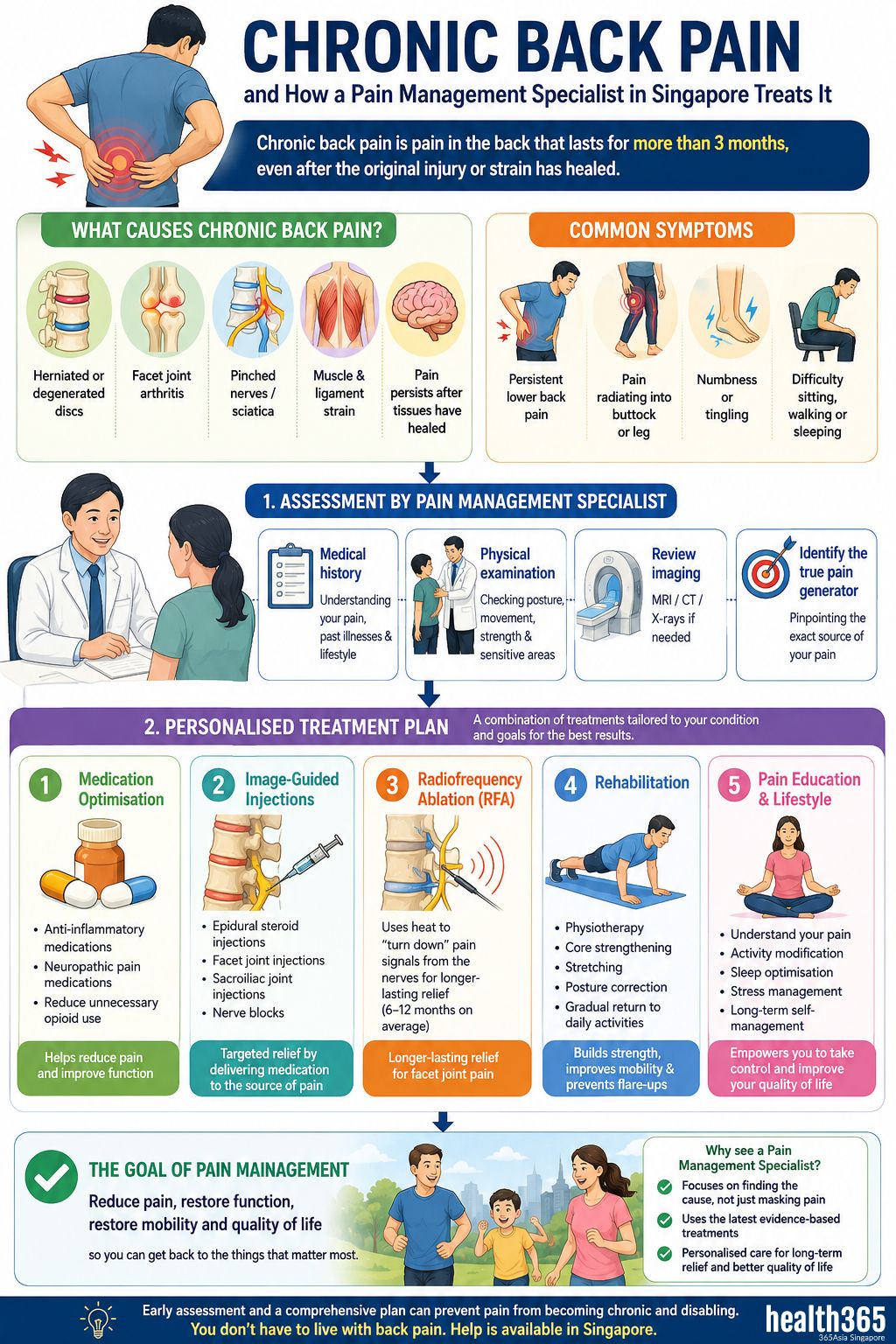
Click to expand infographic.



What Causes Chronic Back Pain?
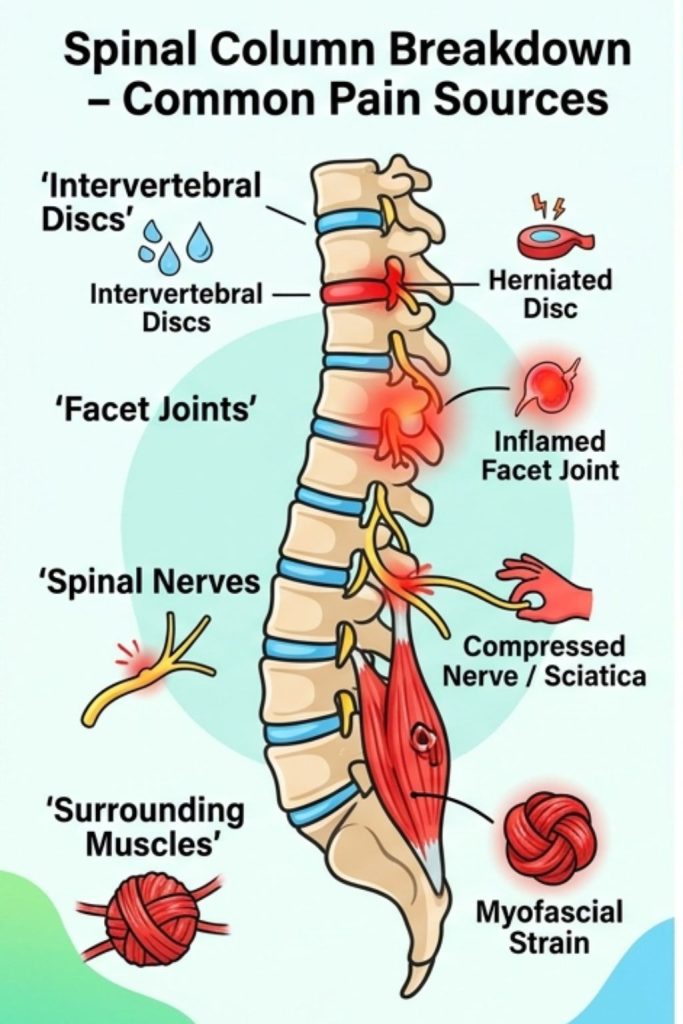
The human spine is a complex structure of vertebrae, intervertebral discs, facet joints, nerves, muscles, and ligaments. Chronic pain arises when one or more of these structures suffer ongoing irritation, degeneration, or injury.
1. Degenerative Disc Disease & Herniated Discs
With age or repetitive strain, the gel-like discs that cushion the spinal bones lose hydration and elasticity. A disc may bulge or rupture (herniated or “slipped” disc), placing direct pressure on adjacent spinal nerve roots.
2. Facet Joint Arthropathy
The facet joints link the vertebrae together. Like knee or hip joints, they are susceptible to wear-and-tear osteoarthritis, leading to localised stiffness and deep aching in the lower back.
3. Spinal Stenosis
Spinal stenosis occurs when the spinal canal narrows, compressing the spinal cord and exiting nerves. This frequently causes neurogenic claudication—pain, heaviness, or cramping in the legs when standing or walking.
4. Spondylolisthesis
This condition occurs when one vertebra slips forward over the one below it, disrupting spinal alignment and irritating surrounding nerve structures.
5. Myofascial Pain & Postural Strain
Long hours spent sitting at desks in Singapore’s office-heavy working culture, coupled with sedentary habits or improper weightlifting form, can lead to chronic muscular imbalances, trigger points, and soft tissue inflammation.
Diagnosis and Treatment Options
An accurate diagnosis is the cornerstone of effective back pain recovery.
Diagnostic Approaches
- Clinical Examination: Evaluation of posture, spinal range of motion, muscle strength, reflexes, and localised tenderness.
- Neurological Assessment: Straight-leg raise tests and dermatomal sensation testing to assess nerve root irritation.
- Diagnostic Imaging: X-rays, Magnetic Resonance Imaging (MRI), or Computed Tomography (CT) scans to visualize bone alignment, disc structure, and nerve compression.
The Spectrum of Treatment
Modern chronic back pain management follows a stepped, multidisciplinary approach tailored to the individual:
| Treatment Level | Modalities Included | Primary Goal |
| Conservative Care | Targeted physiotherapy, core strengthening, ergonomic corrections, lifestyle modification | Restore mechanical function and improve flexibility |
| Pharmacological Care | Neuropathic agents, non-NSAID analgesics, anti-inflammatories, targeted muscle relaxants | Calm nerve hyperexcitability and relieve acute flares |
| Interventional Medicine | Epidural steroid injections, radiofrequency ablation (RFA), nerve blocks, regenerative therapies (PRP) | Block pain signals directly at the source without major surgery |
| Multidisciplinary / Complementary | Biopsychosocial pain therapy, medical acupuncture | Address pain processing, stress, and systemic well-being |
Where Can You Get Medical Imaging?
When managing persistent back pain, obtaining visual clarity through diagnostic imaging (such as an MRI or X-ray) is often a critical step. Many patients assume they must undergo lengthy referral queues at major public or private hospitals just to get a scan. However, Singapore offers direct and independent avenues for diagnostic imaging via private diagnostic radiology centres.
Independent radiology centres such as AsiaMedic operate standalone facilities across Singapore. These centres feature state-of-the-art MRI (1.5T and 3.0T) and CT scanners with rapid turnaround times for reports.
Why Clinical Correlation Matters
While independent imaging provides swift visual answers, it is vital to remember that an MRI scan alone does not dictate treatment. Many asymptomatic adults have disc bulges or degenerative joint changes on MRI scans that cause no pain whatsoever.
Key Takeaway: Diagnostic scans must always be clinically correlated by a pain specialist who matches your physical symptoms and neurological exam with the precise structural findings on the image.
When And Why Should You See A Pain Management Specialist?
Many patients spend months cycling between basic pain relievers and general therapies without achieving long-term relief. A Pain Management Specialist is a medical doctor subspecialised in identifying complex pain pathways and delivering targeted, non-surgical interventional treatments.
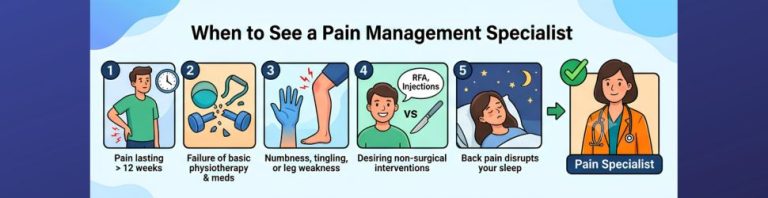
When To Make An Appointment
You should consider consulting a pain specialist if:
- Your back pain has persisted for more than 3 months despite rest and medication.
- You experience radiating pain, numbness, or tingling extending into your buttocks, thighs, or legs (sciatica).
- Conservative physiotherapy fails to bring sustained improvement, or exercises are too painful to perform.
- You wish to explore targeted relief to avoid or postpone major open spinal surgery.
- Back pain disrupts your sleep, work productivity, or emotional health.
Why See A Pain Management Specialist?
- Precise Target Identification: Pain specialists utilize advanced diagnostic nerve blocks under fluoroscopic (X-ray) or ultrasound guidance to pinpoint the exact generator of your pain.
- Minimally Invasive Interventions: Rather than relying solely on oral medications, specialists perform precise, day-procedure treatments such as radiofrequency ablation (RFA) to deactivate painful nerve fibers, or epidural steroid injections to eliminate local nerve inflammation.
- Biopsychosocial Care: They view chronic pain through a holistic lens, addressing physical symptoms alongside nervous system sensitisation, sleep disturbance, and psychological well-being.
Looking For A Top Pain Management Specialist In Singapore? Consider Dr Diana Chan (Advanced Pain Specialists)
When seeking expert interventional pain care in Singapore, consulting a recognised specialist with extensive clinical leadership is paramount. Dr Diana Chan is pain specialist whose personal experience with chronic injury allows her to offer deeply empathetic, patient-centric care. She has extensive expertise in performing over 500 advanced, minimally invasive interventional procedures. Dr Chan integrates modern clinical interventions with traditional techniques like acupuncture to restore quality of life.
Academic Qualifications
MBBS (Singapore), MMed (Anaes), FAMS (Anaes), MCI
Dr Diana Chan holds a Bachelor of Medicine and Bachelor of Surgery (MBBS) as well as a Master of Medicine in Anaesthesiology from the National University of Singapore. To further her expertise in medical research and advanced clinical practice, she obtained a Masters of Clinical Investigation (MCI) from the Yong Loo Lin School of Medicine. She is a recognised Fellow of the Academy of Medicine, Singapore (FAMS) and a Fellow in Interventional Pain Practice (FIPP) through the World Institute of Pain. Additionally, she holds a Graduate Diploma of Acupuncture (GDA) and the European Diploma of Regional Anaesthesia (EDRA), reflecting her comprehensive approach to pain management.
Articles Reviewed By Dr Diana Chan




Comment: The row below to be moved to article for healthcare professionals article
Find A Doctor
Verified Healthcare Professionals
We connect you with a network of qualified and experienced doctors who specialise in chronic health conditions, health screening, and longevity.
Trusted Information Source
We pride ourselves on providing accurate, up-to-date, and evidence-based information about each disease, its prevention, and treatment.
Privacy and Security
Your health information and personal data are paramount to us. We will protect your privacy throughout the booking process and beyond.
Convenience at Your Fingertips
Our user-friendly platform allows you to find and book appointments 24/7 from the comfort of your home.
Additional Resources
Book An Appointment
Take a proactive step for your health and peace of mind today. If you need to see a pain management specialist, our team is here to assist.
Financials
[findDoctor category="financial consultants" countries="Singapore" " limit="15"]
Frequently Asked Questions (FAQs) About Chronic Back Pain Treatment
1. Are non-surgical interventional treatments like Radiofrequency Ablation (RFA) permanent, and how do they work?
Non-surgical interventional treatments are designed to target and interrupt pain signals directly at their source without requiring open surgery. For example, Radiofrequency Ablation (RFA) uses thermal energy to temporarily disable specific nerve fibres responsible for sending pain signals from damaged facet joints to the brain.
While the relief provided by RFA or targeted injections is not always permanent—as nerves naturally regenerate over time—it typically lasts anywhere from 6 months to over a year. Many patients experience significant, long-term functional recovery, allowing them to participate effectively in core-strengthening physical therapy and break the chronic pain cycle. If nerves regenerate and symptoms gradually return, the procedure can safely be repeated.
2. Is epidural steroid injection safe, and will it just mask my pain?
Epidural steroid injections are a widely used, safe, and minimally invasive intervention for back pain and sciatica. Performed under real-time image guidance (such as fluoroscopy or ultrasound) by an experienced pain specialist, a precise dose of anti-inflammatory medication is delivered directly into the epidural space surrounding swollen spinal nerves.
Rather than simply “masking” pain like oral analgesics, the primary goal of an epidural injection is to rapidly suppress local nerve inflammation and tissue swelling caused by disc herniation or spinal stenosis. By calming the irritated nerve root, the injection opens a crucial “window of relief,” enabling you to engage in active rehabilitation and physical therapy without severe discomfort.
3. How does a Pain Management Specialist differ from a Spine Surgeon, and when should I choose non-surgical care?
While spine surgeons specialise in surgical procedures to repair or realign structural deformities (such as spinal fusion or discectomy), a Pain Management Specialist focuses on non-surgical, interventional, and holistic pain relief solutions.
An estimated 80–90% of chronic back pain cases can be managed effectively without open surgery. Consulting a pain management specialist is ideal if:
- You wish to avoid or postpone major surgery.
- Your MRI shows structural changes, but surgery is not immediately indicated or recommended by a surgeon.
- You have persistent pain after a previous back surgery (“failed back surgery syndrome”).
- You require targeted relief through minimally invasive techniques—such as joint injections, nerve blocks, or radiofrequency ablation—combined with regenerative therapies or medical acupuncture.
Additional Resources
Back pain | Mayo Clinic
Nerve Pain Treatments in Singapore | Advanced Pain Specialists
- Managing chronic back pain | Harvard Health Publishing