

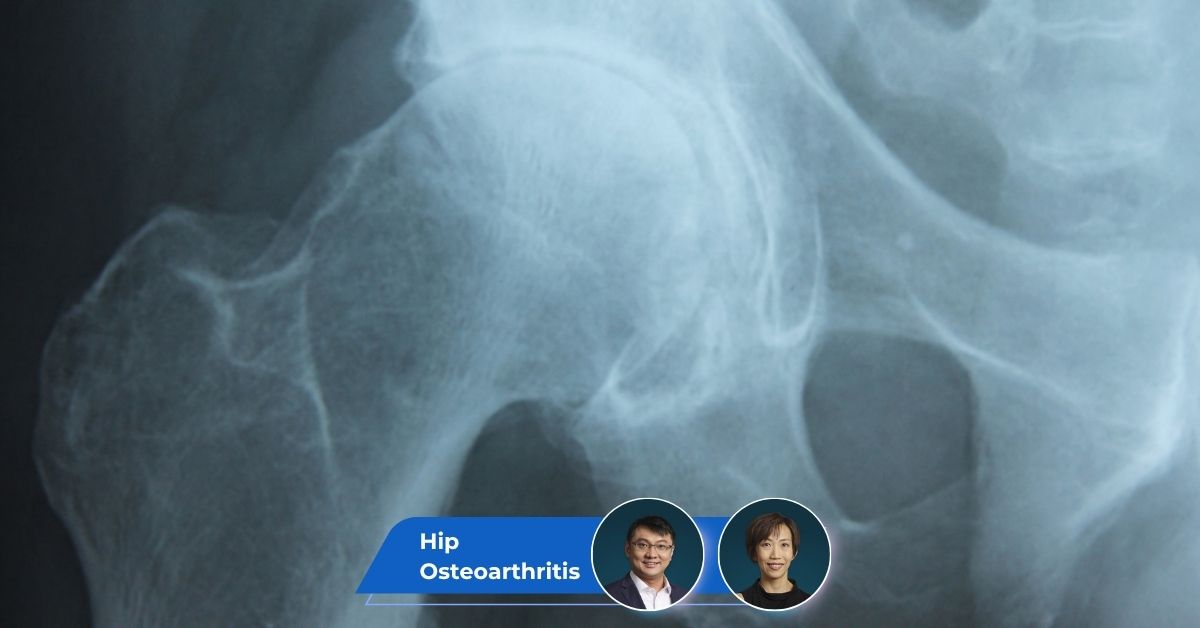
What Is Hip Osteoarthritis?
Hip Osteoarthritis is a degenerative joint condition characterised by the progressive wear and tear of the articular cartilage that cushions the hip joint. The hip is a ball-and-socket joint where the head of the thigh bone (femoral head) fits into the pelvic socket (acetabulum).
When the protective cartilage gradually erodes, the bones begin to rub directly against each other. This friction leads to pain, stiffness, bone spurs (osteophytes), and restricted mobility, significantly impacting an individual’s daily functional activities and quality of life.
Back To: Bone & Orthopaedic Health Main Page
Hip Osteoarthritis Prevalence In Singapore
Hip Osteoarthritis is a common musculoskeletal condition among aging populations in Singapore. As Singapore experiences rapid demographic aging, the burden of degenerative joint conditions continues to rise significantly.
While knee osteoarthritis is traditionally more prevalent in Asian populations, hip osteoarthritis accounts for a growing proportion of chronic joint pain and mobility limitation among middle-aged and elderly Singaporeans. According to epidemiological data, degenerative hip conditions account for thousands of specialist consultations and elective total hip replacement procedures conducted across Singapore’s public and private healthcare sectors annually.
What Are The Causes Of Hip Osteoarthritis & Risk Factors?
Hip Osteoarthritis develops when the smooth surface cartilage of the hip joint deteriorates over time. Several underlying causes and risk factors contribute to this degenerative process, including:
- Ageing: Natural cartilage degeneration increases significantly after the age of 50.
- Joint Overuse & Repeated Strain: Occupations or high-impact athletic activities involving heavy lifting, prolonged standing, or repetitive hip loading accelerate cartilage wear.
- Previous Joint Trauma: Prior hip fractures, labral tears, or dislocations can damage cartilage, leading to post-traumatic osteoarthritis years later.
- Obesity: Excess body weight increases mechanical loading and stress across the weight-bearing hip joints.
- Structural Abnormalities: Developmental conditions such as Femoroacetabular Impingement (FAI) or hip dysplasia alter joint alignment and accelerate cartilage breakdown.
- Genetics & Family History: Genetic predispositions affecting cartilage composition or joint alignment increase individual susceptibility.
What Are The Symptoms Of Hip Osteoarthritis?
Symptoms of Hip Osteoarthritis typically develop gradually and worsen over time without intervention. Common clinical presentations include:
- Groin & Hip Pain: Deep, aching pain primarily felt in the groin, outer thigh, or buttocks, which often worsens with weight-bearing activity.
- Joint Stiffness: Severe morning stiffness or stiffness after prolonged sitting that improves slightly with gentle movement.
- Reduced Range Of Motion: Difficulty bending, tying shoes, putting on socks, or striding normally.
- Limping or Gait Abnormalities: Antalgic gait (limping) developed to minimise weight bearing on the painful hip.
- Crepitus: A grinding, clicking, or crunching sensation or sound during movement of the hip joint.
- Referred Knee Pain: Pain radiating down the thigh towards the knee, which can sometimes mask the primary hip origin.
How To Prevent This Condition?
While primary risk factors like age and genetics cannot be modified, specific preventive strategies can protect joint health and delay disease progression:
- Maintain A Healthy Weight: Reducing body weight diminishes mechanical load and stress placed on the hip joint.
- Engage In Low-Impact Exercise: Regular low-impact activities like swimming, cycling, and walking maintain joint mobility and strengthen supporting hip musculature.
- Maintain Good Posture & Ergonomics: Practicing proper lifting techniques and avoiding repetitive heavy loading protects joint structures.
- Promptly Treat Hip Injuries: Early medical management of hip impingement, labral tears, or mechanical instability helps prevent secondary cartilage degeneration.
What Are The Costs Of Screening & Testing For Hip Osteoarthritis?
Accurate diagnosis and severity grading of Hip Osteoarthritis require clinical evaluation combined with diagnostic imaging:
| Diagnostic Test / Procedure | Function & Description | Estimated Cost (Private Sector)* |
| Specialist Consultation | Comprehensive clinical assessment, range-of-motion evaluation, and physical examination by an orthopaedic specialist. | S$150 – S$350 |
| Weight-Bearing Hip X-Rays | Standard initial imaging to evaluate joint space narrowing, bone spurs (osteophytes), and subchondral sclerosis. | S$100 – S$250 |
| Hip MRI Scan | High-resolution soft tissue imaging to detect early cartilage loss, labral tears, or avascular necrosis. | S$1,000 – S$2,000 |
| CT Scan Of The Hip | Detailed 3D bone imaging used for complex pre-operative surgical planning and structural assessment. | S$800 – S$1,500 |
*Note: The above estimates reflect prevailing private sector rates in Singapore for 2026. Prices vary according to clinic location, specialist seniority, and facility fees. Please confirm details directly with your preferred medical provider.
Which Doctor For Treatment Of Hip Osteoarthritis?
Managing Hip Osteoarthritis involves multidisciplinary expertise tailored to the stage of joint degeneration:
1. General Practitioner (GP) / Sports Medicine Physician
Primary care doctors and sports medicine specialists manage early-stage osteoarthritis using conservative strategies, pain management, physical therapy referrals, and lifestyle counseling.
2. Orthopaedic Surgeon
Orthopaedic Surgeons specialise in the definitive diagnosis, non-surgical interventions (such as targeted joint injections), and surgical management of bone and joint disorders, including total hip replacement.
3. Physiotherapist
Physiotherapists design tailored rehabilitation programs to strengthen surrounding hip musculature, improve joint flexibility, enhance balance, and restore normal walking patterns.
Preferred Doctors For Hip Osteoarthritis Treatment In Singapore
If you are seeking specialist assessment and treatment for Hip Osteoarthritis in Singapore, consider our Preferred Doctor partners:
Dr Tan Sok Chuen – Consultant Orthopaedic Surgeon
Dr Tan Sok Chuen is a Consultant Orthopaedic Surgeon specialising in hip and knee joint preservation, reconstruction, and replacement. She focuses on personalized joint care, minimally invasive techniques, and direct anterior approach total hip replacement to improve patient recovery outcomes.
Dr Adrian Lau – Consultant Orthopaedic Surgeon
Dr Adrian Lau is a Consultant Orthopaedic Surgeon with subspecialty expertise in adult reconstruction, complex hip and knee joint replacements, and sports injury management. He utilizes advanced surgical techniques to optimize joint function and restore patient mobility.




Resources To Help You Find A Doctor
Which Hospitals And Medical Centres Are There For Screening & Treatment?
Patients seeking Hip Osteoarthritis diagnosis and care can access services across Singapore’s healthcare network:
- Public Sector Institutions: Major tertiary hospitals, including Singapore General Hospital (SGH), National University Hospital (NUH), Tan Tock Seng Hospital (TTSH), and Changi General Hospital (CGH), provide diagnostic imaging, specialised joint clinics, and reconstructive surgeries.
- Private Hospitals: Comprehensive private orthopaedic care and surgery are available at Mount Elizabeth Hospitals (Orchard and Novena), Gleneagles Hospital, Farrer Park Hospital, and Mount Alvernia Hospital.
- Ambulatory & Imaging Centres: Specialised imaging networks such as AsiaMedic, RadLink, and Lifescan Imaging offer diagnostic X-rays and MRI scans.
What Is The Cost Of Hip Osteoarthritis Treatment In Singapore?
The cost of treating Hip Osteoarthritis varies depending on whether non-surgical management or surgical joint replacement is required:
| Treatment / Procedure | Description & Clinical Purpose | Estimated Cost (Private Sector)* | Ministry Of Health (MOH) Benchmark Fee Range (Doctor Fee)* |
| Conservative Therapy & Medications | Analgesics, NSAIDs, oral supplements, and targeted physical therapy sessions. | S$100 – S$300 per month | N/A |
| Intra-Articular Joint Injections | Corticosteroid or Viscosupplementation (Hyaluronic Acid) injections to reduce localized inflammation and pain. | S$500 – S$1,500 per injection | N/A |
| Total Hip Replacement (Unilateral) | Surgical procedure involving the replacement of damaged hip bone and cartilage with artificial prostheses. | S$30,000 – S$50,000 (Total Hospital & Doctor Bill) | S$4,900 – S$7,500 (Surgeon Fee Benchmark) |
*Note: Private sector costs in Singapore (2026) depend on hospital selection, length of stay, implant selection, and case complexity. MOH benchmark ranges refer specifically to professional surgeon fees for private sector primary total hip replacement.
Non-Surgical & Surgical Options Summary
- Lifestyle Modifications: Weight management, activity modification, and aquatic exercises.
- Medications: Pain relievers, anti-inflammatory medications (NSAIDs), and joint supplements.
- Physiotherapy: targeted hip muscle strengthening and joint mobilization.
- Intra-Articular Injections: Corticosteroid or hyaluronic acid injections for temporary symptom relief.
- Total Hip Replacement (Arthroplasty): Surgical replacement of the ball-and-socket joint with durable metal, ceramic, or polyethylene components when conservative measures no longer provide relief.
Additional Resources On Costs
- Financial Planning For Cost Of Medical Treatment
- MediSave And Medishield Life Coverage For Overseas Singaporeans
What Are The Insurance And Financing Considerations For This Condition?
Health & Hospitalisation (H&S) Insurance
- MediShield Life: Universal basic health insurance covering all Singapore Citizens and Permanent Residents. It provides coverage for subsidised hospitalisation and surgical procedures, including hip replacement, subject to surgical code limits and deductibles.
- Integrated Shield Plans (IPs): Commercial plans that enhance MediShield Life coverage, enabling higher claim limits and coverage for Class A/B1 public hospital wards or private hospital stays.
- Riders: Additional private insurance riders help reduce out-of-pocket co-payments and deductibles.
Find A Financial Adviser
If you are looking for a financial adviser to help navigate the complexities of insurance claims and financial planner for medical contingencies, you can consider our Preferred Financial Adviser partners:


Find A Panel Doctor
Looking for a doctor on the panel of your insurance provider? The following may be useful:
External Link: Health Insurance & Panel Doctor Networks
MediSave Usage & Government Subsidies
- Government Subsidies: Subsidised patients in public hospital wards can receive up to 50% to 80% direct subsidies for inpatient surgical care and diagnostic imaging, subject to means-testing.
- Inpatient & Surgical MediSave Withdrawal: MediSave can be used to co-pay inpatient hospital bills and surgical costs for total hip replacement according to the Table of Surgical Procedures (TOSP) withdrawal limits.
- Outpatient MediSave: Outpatient diagnostic scans (like X-rays or MRIs) and specialized physiotherapy sessions may be eligible for partial MediSave claims under applicable national limits.
Financial Assistance (MediFund & Support Schemes)
- MediFund: A safety net for needy Singaporeans facing financial difficulties with remaining bills after government subsidies, MediShield Life, and MediSave drawdowns.
- Hospital Trust Funds: Public health clusters offer dedicated financial assistance funds to support needy patients requiring medical devices, implants, or specialized rehabilitation.
FAQs
Hip Osteoarthritis is primarily caused by progressive wear and tear of the articular cartilage over time due to aging, joint strain, obesity, prior hip injuries, or structural joint abnormalities like femoroacetabular impingement.
Hip osteoarthritis pain typically develops gradually, persists over time, causes joint stiffness (especially in the morning), and reduces range of motion. Muscle strains usually present with sudden onset after activity and improve with brief rest and conservative care.
There is no complete cure to reverse cartilage loss from osteoarthritis. However, early to moderate symptoms can be effectively managed without surgery through physiotherapy, weight loss, anti-inflammatory medications, and targeted joint injections.
Total hip replacement is generally recommended when non-surgical treatments no longer manage hip pain effectively, or when severe pain and stiffness significantly restrict daily walking, sleep, and overall quality of life.
Most patients begin walking with support within 24 to 48 hours after surgery. Initial recovery takes approximately 4 to 6 weeks, while full functional recovery and return to low-impact activities typically occur within 3 to 6 months.
Contact Us For An Appointment
If you are experiencing persistent hip pain or stiffness and wish to consult an orthopaedic specialist, we can assist you with booking an appointment. Contact us via the button below.
Contact UsAdditional Resources
- Enhanced Recovery After Surgery (ERAS) for Hip and Knee Replacement: What It Is and Why It Matters | Hip & Knee Orthopaedics
- Hip Pain & Aging: Causes, Lifestyle Changes & Exercises | Hip & Knee Orthopaedics
- Hip Osteoarthritis | SingHealth
- Hip Arthritis: Causes, Symptoms & Treatment Options | Cleveland Clinic
- How to Prevent Osteoarthritis | HealthXchange
All content on this site is informative only and is not intended to be a substitute for professional medical advice, diagnosis, or treatment, and should never be relied upon for specific medical advice. If you are experiencing a medical emergency, call 995 immediately or go to the nearest Accident & Emergency department.
health365.sg is a member of Group 365Asia.