

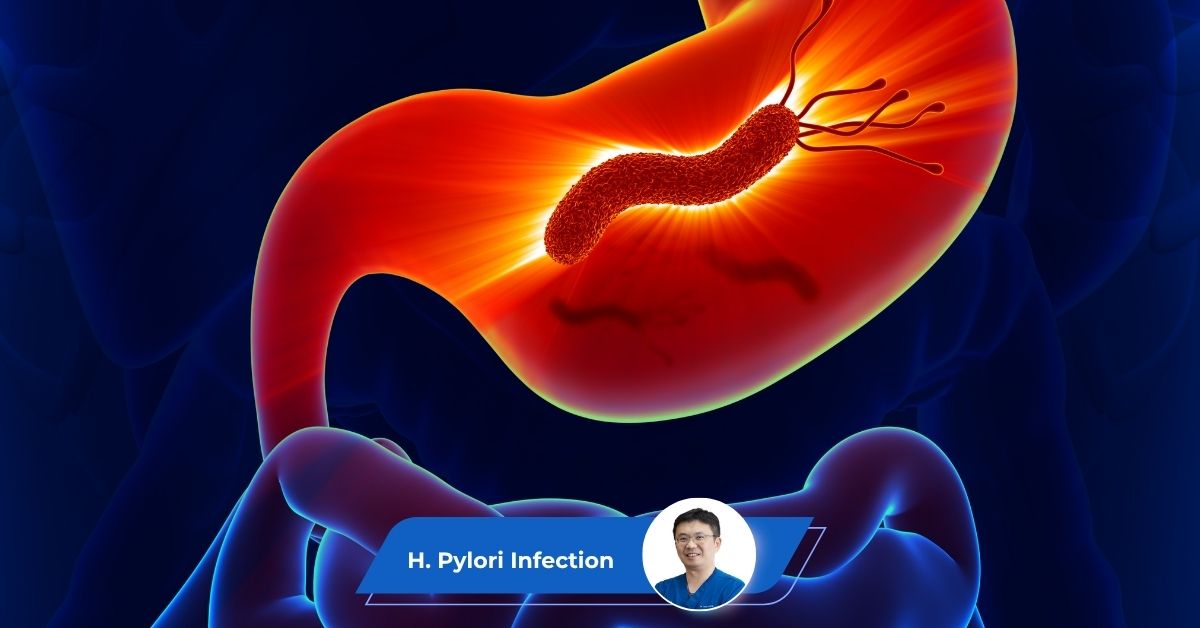
What Is H. Pylori Infection?
Helicobacter pylori (H. pylori) is a spiral-shaped, gram-negative bacterium that colonises the protective mucous lining of the human stomach. Left untreated, the organism causes chronic gastric mucosal inflammation, disrupting the natural mucus layer that shields the stomach lining from digestive acids.
Over time, this persistent infection can progress from chronic active gastritis to peptic ulcer disease (gastric and duodenal ulcers). In long-standing cases, it can cause intestinal metaplasia—a pre-cancerous change in the gastric lining—and significantly elevate the risk of developing gastric adenocarcinoma (stomach cancer) and gastric MALT lymphoma.
Back To: Stomach Cancer & Other Conditions Main Page
H. Pylori Prevalence In Singapore
In Singapore, H. pylori is significant health concern, particularly among older adults. Epidemiological studies indicate an overall prevalence rate of approximately 30% to 40% in the general population, with higher rates observed in individuals aged 50 and above.
Because stomach cancer is one of the leading causes of cancer-related mortality in Singapore, identifying and eradicating H. pylori is a key preventive strategy recommended by gastroenterologists to reduce the incidence of stomach ulcers and gastric malignancies.
What Are The Causes Of H. Pylori Infection & Risk Factors?
H. pylori transmission primarily occurs through direct person-to-person contact or environmental exposure. Key causes and risk factors include:
- Oral-Oral or Fecal-Oral Transmission: Sharing food, utensils, or drinking water contaminated with the bacteria.
- Intra-Familial Spread: Close living quarters and shared meals within household units represent the most common transmission pathway.
- Age: Older adults exhibit higher infection rates due to cumulative lifetime exposure.
- Unsanitary Conditions: Lack of proper hand hygiene or inadequate sanitation increases infection risks.
- Family History of Gastric Cancer: Individuals with a family history of stomach cancer face heightened clinical risk and require proactive screening.
What Are The Symptoms Of H. Pylori Infection?
A majority of individuals infected with H. pylori do not exhibit early symptoms. However, as inflammation progresses or ulcers develop, common symptoms include:
- Burning Upper Abdominal Pain: Dull or burning pain in the pit of the stomach, often worse when the stomach is empty.
- Bloating & Early Satiety: A feeling of excessive fullness or bloating shortly after starting a meal.
- Frequent Burping & Acid Regurgitation: Persistent belching accompanied by mild reflux symptoms.
- Nausea & Appetite Loss: Recurrent indigestion, loss of appetite, or mild nausea.
How To Prevent This Condition?
Preventive measures for H. pylori infection focus on hygiene and dietary practices:
- Practice Strict Hand Hygiene: Wash hands thoroughly with soap and water before meals and after using the bathroom.
- Ensure Food & Water Safety: Consume properly cooked food and clean, treated drinking water.
- Avoid Shared Utensils: Use serving spoons (communal cutlery) during group meals to reduce oral transmission risks.
- Early Screening: Individuals with persistent dyspepsia or a family history of gastric cancer should seek early diagnostic testing.
What Are The Costs Of Screening & Testing For H. Pylori Infection?
Screening and diagnostic tests for H. pylori infection range from non-invasive breath tests to invasive upper endoscopy:
| Screening / Diagnostic Test | Function & Description | Estimated Cost (Private Sector)* |
| Urea Breath Test (UBT) | Non-invasive gold standard test; measures exhaled carbon dioxide after drinking a urea solution to detect active bacterial infection. | S$120 – S$250 |
| Stool Antigen Test | Non-invasive test detecting H. pylori proteins in a stool sample to confirm active infection or treatment response. | S$100 – S$200 |
| Serology Blood Test | Checks for circulating antibodies against H. pylori; indicates past or current exposure (cannot distinguish past from active infection). | S$50 – S$150 |
| Gastroscopy (OGD) with Biopsy (TOSP SF701I) | Upper GI endoscopy with tissue biopsy for direct histological examination and rapid urease test (CLOtest). | S$650 – S$1,100 (Surgeon fee benchmark; excludes facility & anaesthetist fees) |
*Note: The above estimates reflect private sector benchmarks in Singapore in 2026. Prices vary depending on the clinic, hospital, doctor seniority, and specific laboratory modalities included. Please check directly with your healthcare provider for exact pricing.
Which Doctor For Treatment Of H. Pylori Infection?
Medical professionals who evaluate and treat H. pylori infection include:
- General Practitioner (GP) / Family Physician Initial point of contact for non-invasive testing (Urea Breath Test) and standard first-line eradication therapy for uncomplicated dyspepsia.
- Gastroenterologist Specialists in digestive disease who conduct gastroscopies, manage treatment-resistant or refractory H. pylori strains, assess ulcer complications, and perform surveillance for pre-cancerous conditions like intestinal metaplasia.
Preferred Doctors For H. Pylori Treatment In Singapore
If you are seeking a specialist for gastrointestinal evaluation and H. pylori treatment, you can consider our Preferred Doctor partner:
Dr John Hsiang – Gastroenterologist in Singapore Dr John Hsiang is a Fellowship-trained gastroenterologist and hepatologist with a research doctorate in liver disease. He sits on the Ministry of Health’s National Hepatitis C Programme Steering Committee, and his audited colonoscopy detection rates are above international minimum standards.
- Areas of Expertise: Helicobacter pylori infection, gastro-oesophageal reflux disease (GERD), intestinal metaplasia surveillance, bloating, constipation and diarrhoea, fatty liver disease (MASLD), viral hepatitis B and C, cirrhosis, water immersion colonoscopy, sedation-free colonoscopy, gastroscopy and colorectal cancer screening.
As a member of our Preferred Doctor Partner Programme, Dr John Hsiang actively co-written medical content for Health365 to verify clinical accuracy and clarity.
Content Co-written with Dr John Hsiang:
- Coming soon!
Resources To Help You Find A Doctor



[SG] Featured Doctor- Dr Pinakin V Parekh
Which Hospitals And Medical Centres Are There For Screening & Treatment?
For H. pylori screening and digestive health care in Singapore, patients can access public national medical centres, restructured hospitals, and private specialist clinics. Public tertiary institutions—such as Singapore General Hospital (SGH), National University Hospital (NUH), and Tan Tock Seng Hospital (TTSH)—provide diagnostic endoscopies and specialist clinics.
In the private sector, patients can visit sub-specialised gastroenterology clinics within hospital centres such as Mount Elizabeth Hospitals (Orchard and Novena), Gleneagles Hospital, Farrer Park Hospital, and Mount Alvernia Hospital. Standalone ambulatory day-surgery centres and diagnostic medical centres also perform diagnostic gastroscopy and non-invasive urea breath tests.
Explore: Find A Hospital resources.
What Is The Cost Of H. Pylori Infection Treatment In Singapore?
The following are estimated costs for H. pylori treatment modalities in Singapore:
| Treatment / Procedure | Description & Clinical Purpose | Estimated Cost (Private Sector)* |
| First-Line Eradication Therapy | 10 to 14-day combination regimen consisting of a Proton Pump Inhibitor (PPI) and two target antibiotics (e.g., Amoxicillin and Clarithromycin). | S$150 – S$350 (Outpatient medication course) |
| Second-Line / Bismuth Quadruple Therapy | 14-day salvage regimen (PPI, Bismuth subsalicylate, Metronidazole, and Tetracycline) for antibiotic-resistant strains. | S$250 – S$500 |
| Post-Treatment Confirmation Test | Urea Breath Test or Stool Antigen test performed at least 4 weeks post-treatment to confirm eradication. | S$100 – S$250 |
*Note: The above estimates are for the private sector in Singapore. Prices vary based on drug brand, dosage, and duration. Please check directly with your clinic or healthcare provider.
Additional Resources On Costs
- Cost Of Gastroscopy Screening In Singapore
- Financial Planning For Cost Of Medical Treatment
- MediSave And Medishield Life Coverage For Overseas Singaporeans
What Are The Insurance And Financing Considerations For This Condition?
Health & Hospitalisation (H&S) Insurance
- Health & Hospitalisation (H&S) Insurance
- MediShield Life: Singapore’s national health insurance covers inpatient admissions and approved day-surgery diagnostic procedures (such as diagnostic gastroscopy with biopsy under TOSP SF701I) at subsidised Class B2/C rates. Note: Screening gastroscopy without diagnostic indications or simple outpatient clinic consultations are not claimable under MediShield Life.
- Integrated Shield Plans (IPs): Private IPs offer additional coverage for Class A/B1 public hospital wards or private hospital admissions and day surgeries, significantly reducing out-of-pocket expenses for endoscopic evaluations.
- Critical Illness (CI) Policies: While early H. pylori infection is not a critical illness, severe downstream complications (such as advanced gastric cancer) may trigger lump-sum payouts under standard CI policies.
Find A Financial Adviser
If you are looking for a financial adviser to help navigate insurance claims and financial planning for medical contingencies, you can consider our Preferred Financial Adviser partners:


Find A Panel Doctor
Looking for a doctor on the panel of your insurance provider? The following may be useful:
MediSave Usage & Government Subsidies
- Government Subsidies: Subsidised patients at public hospitals and Polyclinics receive up to 50% to 80% direct subsidies for diagnostic investigations and outpatient medications based on means-testing.
- Day Surgery MediSave Withdrawal: MediSave can be used for eligible day-surgery diagnostic gastroscopies (subject to surgical limits under the Table of Surgical Procedures).
- Outpatient MediSave: Non-invasive outpatient urea breath testing or standard routine screening scans are subject to yearly outpatient MediSave withdrawal limits where applicable
FAQs
H. pylori is primarily transmitted through the oral-oral or fecal-oral routes. Common pathways include sharing infected food, water, or eating utensils, as well as close domestic contact within households
No, H. pylori infections rarely resolve spontaneously. Without targeted antibiotic eradication therapy, the bacteria usually persist lifelong in the stomach, leading to chronic active gastritis and increasing the risk of peptic ulcers or stomach cancer.
Confirmation testing (typically via a Urea Breath Test or Stool Antigen Test) should be conducted at least 4 weeks after completing the antibiotic course, and at least 2 weeks after stopping Proton Pump Inhibitors (PPIs), to prevent false-negative results.
No, non-invasive tests such as the Urea Breath Test (UBT) and Stool Antigen Test are highly accurate for detecting active infection. However, a gastroscopy is necessary if you have alarm symptoms (e.g., severe abdominal pain, bleeding, or weight loss) or if the doctor needs to evaluate for ulcers, intestinal metaplasia, or stomach cancer.
Yes, clinical studies demonstrate that successful eradication of H. pylori significantly reduces gastric mucosal inflammation and lowers the long-term risk of developing gastric adenocarcinoma and MALT lymphoma.
Contact Us For An Appointment
If you are experiencing persistent gastric discomfort or wish to consult a specialist regarding H. pylori screening and treatment, we can assist with an appointment. Contact us via the button below.
Contact UsAdditional Resources
- Helicobacter pylori | Richmond Gastroenterology Centre
Back To: Stomach Cancer & Other Conditions Main Page
All content on this site is informative only and is not intended to be a substitute for professional medical advice, diagnosis, or treatment, and should never be relied upon for specific medical advice. If you are experiencing a medical emergency, call 995 immediately or go to the nearest Accident & Emergency department.
health365.sg is a member of Group 365Asia.