

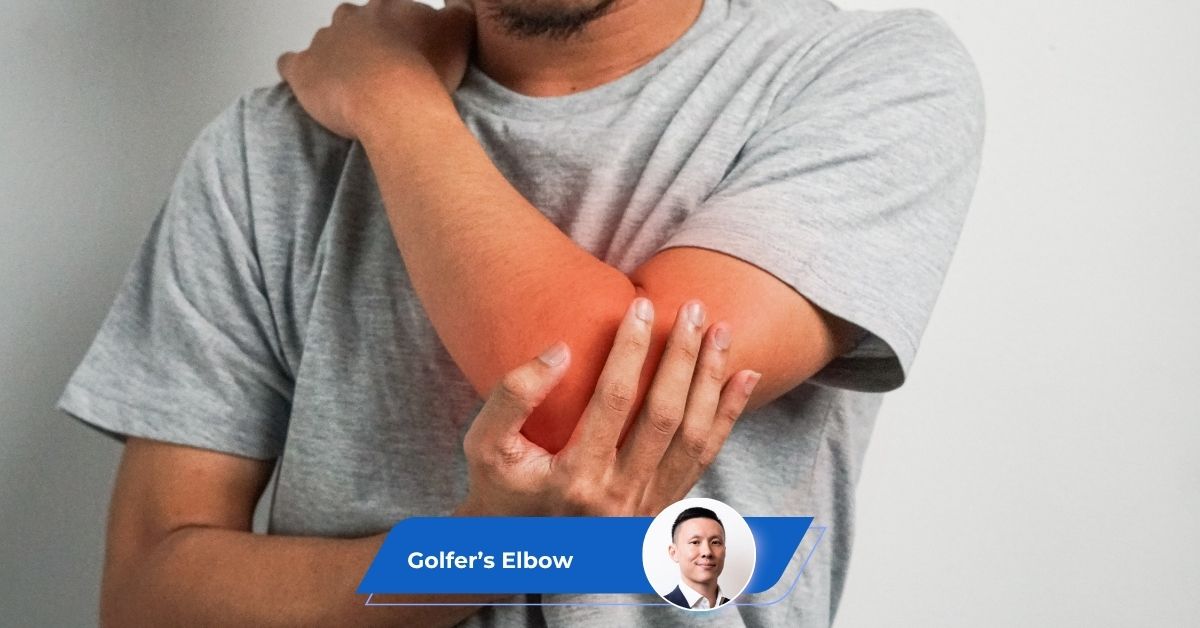
What Is Golfer’s Elbow?
Golfer’s Elbow—clinically known as medial epicondylitis—is a painful condition caused by inflammation or micro-tears in the tendons that join the forearm muscles to the bony bump on the inside of the elbow (the medial epicondyle). These tendons are responsible for flexing the wrist and fingers and controlling forearm pronation (rotating the palm downward).
When these flexor tendons are subjected to repetitive strain or sudden forceful pulling, small micro-tears develop, leading to localized swelling, pain, and reduced grip strength. Despite its name, Golfer’s Elbow is not restricted to golfers; it frequently affects athletes, manual labourers, office workers, and anyone engaged in repetitive hand, wrist, or forearm movements.
Back To: Bones & Orthopaedic Conditions Main Page
Golfer’s Elbow Prevalence In Singapore
Musculoskeletal disorders involving repetitive strain injuries, such as Golfer’s Elbow and Tennis Elbow (lateral epicondylitis), are common reasons for orthopaedic consultations in Singapore.
In Singapore’s active population and workforce, medial epicondylitis commonly affects individuals aged between 30 and 50 years. While less prevalent than Tennis Elbow, Golfer’s Elbow accounts for up to 10% to 20% of all epicondylitis cases in clinical practice. The condition frequently presents in individuals participating in racquet and throw sports, weightlifting, and occupations requiring persistent manual labour, heavy lifting, or intensive computer typing.
What Are The Causes Of Golfer’s Elbow & Risk Factors?
Golfer’s Elbow is primarily caused by repetitive stress or overuse of the forearm muscles that control wrist flexion and gripping. Over time, continuous stress creates microscopic tearing in the flexor-pronator tendon origin at the medial epicondyle.
Several key risk factors contribute to the development of Golfer’s Elbow:
- Repetitive Forearm & Wrist Motion: Engaging in sports or activities that require continuous wrist bending, twisting, or clenching.
- Improper Technique: Poor form or execution during golf swings, tennis forehands, or weightlifting places excess force on the elbow joint.
- Inadequate Equipment: Using golf clubs that are too heavy, tennis racquets with improper grip sizes, or unsupportive tools increases mechanical stress.
- Occupational Hazards: Jobs involving repetitive manual work—such as carpentry, painting, plumbing, assembly line work, and heavy typing—raise the risk of tendon irritation.
- Age: Individuals aged 30 and above are more susceptible due to reduced tendon elasticity and slower tissue repair.
- Obesity & Smoking: Excess body mass and smoking impair circulation, compromising tendon healing and increasing susceptibility to tendinopathy.
What Are The Symptoms Of Golfer’s Elbow?
Symptoms of Golfer’s Elbow may develop gradually over time or appear suddenly after acute exertion. Common signs and symptoms include:
- Pain & Tenderness: A dull or sharp pain felt on the inner side of the elbow, which may radiate down the inner forearm to the wrist.
- Stiffness: The elbow joint may feel stiff, making it uncomfortable or difficult to make a full fist.
- Weakness: Reduced strength when gripping objects, turning doorknobs, shaking hands, or flexing the wrist.
- Numbness or Tingling: A sensation of tingling or “pins and needles” radiating into one or more fingers (commonly the ring and little fingers) if the nearby ulnar nerve becomes irritated or compressed.
- Pain Aggravation: Discomfort that worsens when bending the wrist downward, squeezing an object, or lifting items with the palm facing up.
How To Prevent This Condition?
Preventive strategies for Golfer’s Elbow focus on reducing stress on the forearm tendons and maintaining muscle balance:
- Strengthen Forearm Muscles: Perform gentle resistance exercises for forearm flexors and extensors to build load tolerance.
- Stretch Before Activity: Warm up properly and stretch the wrist flexors and extensors prior to playing sports or starting repetitive tasks.
- Use Correct Technique & Equipment: Work with a professional coach or instructor to refine golf swings or racquet techniques, and ensure sports equipment is properly fitted.
- Lift Correctly: Keep wrists stable and neutral when lifting heavy objects, relying on the legs and upper arms rather than isolated wrist strain.
- Pace Yourself & Rest: Take regular breaks during repetitive work sessions to allow forearm muscles to recover.
What Are The Costs Of Screening & Testing For Golfer’s Elbow?
Screening and diagnostic evaluation for Golfer’s Elbow costs range from S$50 to S$2,000+ depending on the clinical setting and modality required:
| Screening / Diagnostic Test | Function & Description | Estimated Cost (Private Sector)* |
| Specialist Consultation | Physical examination, range-of-motion testing, and localized palpation by an orthopaedic specialist. | S$150–S$300 (initial consultation) |
| X-Ray (Elbow) | Evaluates bony structures to rule out arthritis, bone spurs, stress fractures, or calcifications near the epicondyle. | S$80–S$200 |
| Diagnostic Ultrasound | Provides real-time imaging of soft tissues to assess tendon inflammation, partial tears, or fluid accumulation. | S$300–S$600 |
| Magnetic Resonance Imaging (MRI) | Generates high-resolution cross-sectional images to pinpoint severe tendon tears, structural damage, or ulnar nerve entrapment. | S$1,000–S$2,000 |
Note: The above estimates are for the private sector in Singapore in 2026. Prices will vary depending on the clinic, hospital, doctor seniority, and specific tests included. Please check directly with your chosen clinic or healthcare provider for the most accurate and up-to-date pricing.
Which Doctor For Treatment Of Golfer’s Elbow?
Medical professionals involved in the diagnosis, non-surgical management, and surgical treatment of Golfer’s Elbow include orthopaedic surgeons, sports medicine specialists, and physiotherapists:
1. Orthopaedic Surgeon
An Orthopaedic Surgeon specializing in shoulder, elbow, and sports injuries evaluates persistent or severe tendon issues. They perform diagnostic evaluations, administer targeted non-surgical therapies (such as injections), and perform minimally invasive arthroscopic or open tendon repair when non-surgical options fail to relieve symptoms.
2. Sports Medicine Specialist
A Sports Medicine Physician focuses on non-surgical management of musculoskeletal injuries, biomechanical correction, guided exercise prescription, and regenerative therapies for athletes and active individuals.
3. Physiotherapist & Hand Therapist
Physiotherapists and hand therapists play a central role in non-surgical recovery and post-operative rehabilitation. They guide targeted eccentric strengthening, soft tissue release, ergonomic modifications, and custom bracing to restore elbow function.
Preferred Doctors For Golfer’s Elbow Treatment In Singapore
If you are looking for a doctor for Golfer’s Elbow evaluation and treatment, you can consider our Preferred Doctor partner:
Dr Bryan Wang – Orthopaedic Surgeon in Singapore
Dr Bryan Wang is an established fellowship-trained orthopaedic specialist in Singapore with over 20 years of clinical experience, specialising in shoulder, elbow, knee, and sports injuries. He graduated from the National University of Singapore (NUS) in 2005 and obtained his Fellowship from the Royal College of Surgeons of Edinburgh (FRCSEd Ortho) in 2015.
Dr Wang completed advanced fellowship training in upper limb reconstruction and sports medicine at the Pan Am Clinic in Canada under renowned shoulder and elbow surgeon Prof Peter MacDonald. During his fellowship in Canada, he served as an assistant team physician for the Winnipeg Jets, a professional National Hockey League (NHL) team, gaining extensive expertise in treating high-performance athletes. Dr Wang prioritises evidence-based practice, patient-centric care, and minimally invasive techniques to support optimal recovery and early return to daily activities.
As a member of our Preferred Doctor Partner Programme, Dr Bryan Wang actively co-written medical content for Health365 to verify clinical accuracy and clarity.
Content Co-written with Dr Bryan Wang:
- Do I Have Frozen Shoulder If I Have Trouble Lifting My Shoulder High?
- Depth Analysis Of Surgical Decisions
- Can A Rotator Cuff Tear Heal Without Surgery?
- Do I Have A Rotator Cuff Tear? Learn About Arthroscopic Minimally Invasive Surgery In Singapore
Resources To Help You Find A Doctor

[SG] Featured Doctor- Dr Kevin Koo
- Top 10 Orthopaedic Specialists In Singapore For Golfer’s Elbow: 365Asia List
- Top 10 Sports Injury Doctor In Singapore: 365Asia List
Which Hospitals And Medical Centres Are There For Screening & Treatment?
For Golfer’s Elbow examination, diagnostic imaging, and treatment in Singapore, care can be accessed across public restructured hospitals, private hospitals, and specialized outpatient orthopaedic clinics.
In the public sector, major tertiary institutions—including Singapore General Hospital (SGH), National University Hospital (NUH), Tan Tock Seng Hospital (TTSH), and Ng Teng Fong General Hospital (NTFGH)—provide comprehensive non-surgical and surgical orthopaedic care.
In the private sector, patients can visit sub-specialised orthopaedic and sports clinics situated within hospital hubs such as Mount Elizabeth Hospitals (Orchard and Novena), Gleneagles Hospital, Farrer Park Hospital, and Mount Alvernia Hospital. Specialised diagnostic imaging centers, such as AsiaMedic, RadLink and Lifescan Imaging, provide advanced MRI and ultrasound services for soft tissue evaluation.
Explore: Find A Hospital resources.
What Is The Cost Of Golfer’s Elbow Treatment In Singapore?
The following table provides estimated private sector costs for non-surgical and surgical Golfer’s Elbow treatments in Singapore:
| Treatment / Procedure | Description & Clinical Purpose | Estimated Cost (Private Sector)* |
| Physiotherapy & Rehabilitation | Physical therapy sessions including eccentric exercise, ultrasound therapy, manual soft tissue release, and ergonomic guidance. | S$150–S$300 per session |
| Corticosteroid / PRP Injections | Ultrasound-guided corticosteroid or Platelet-Rich Plasma (PRP) injections into the flexor tendon origin to decrease inflammation and promote tissue healing. | S$300–S$1,500 per injection |
| Surgical Tendon Repair / Debridement (Day Surgery) | Minimally invasive arthroscopic or open surgery to remove damaged tendon tissue (debridement) and reattach healthy tendon tissue to the bone. | S$15,000–S$20,000+ (includes surgeon, anaesthetist, and facility fees) |
Note: The above estimates are for the private sector in Singapore. Prices will vary depending on the clinic, hospital, doctor seniority, and specific tests included. Please check directly with your chosen clinic or healthcare provider for the most accurate and up-to-date pricing.
Treatment for Golfer’s Elbow aims to relieve pain, restore forearm strength, and enable a safe return to regular physical activities. Common treatment options include:
Lifestyle Changes
- Rest & Activity Modification: Temporarily avoiding movements or sports that provoke elbow pain to allow the tendon time to recover.
- Ice Therapy: Applying ice packs to the inner elbow for 15 to 20 minutes several times daily to mitigate acute swelling and discomfort.
- Ergonomic Adjustments: Modifying workplace setups, equipment grip thickness, or tool handling to reduce mechanical strain on the wrists and forearms.
Non-Surgical Therapies
- Oral Medications: Non-steroidal anti-inflammatory drugs (NSAIDs) or oral analgesics prescribed short-term to manage localized inflammation and pain.
- Supportive Bracing: Counterforce elbow straps or wrist splints worn during daily tasks to offload mechanical stress from the flexor tendon attachment.
- Targeted Injections: Injections of corticosteroids or Platelet-Rich Plasma (PRP) directly into the affected region for persistent pain that does not respond to initial rest and therapy.
Surgical Interventions
- Surgical Tendon Repair / Release: Recommended when severe pain or functional impairment persists despite 6 to 12 months of conservative treatment. The surgeon performs debridement of chronically degenerative tendon tissue and repairs the healthy tendon back to the medial epicondyle.
Additional Resources On Costs
- Financial Planning For Cost Of Medical Treatment
- MediSave And Medishield Life Coverage For Overseas Singaporeans
- Surgical Cost For Sport Injury Treatment In Singapore
- Can I Claim Insurance For Physiotherapy In Singapore?
What Are The Insurance And Financing Considerations For This Condition?
Health & Hospitalisation (H&S) Insurance
- MediShield Life: Singapore’s basic national health insurance covers all Singapore Citizens and Permanent Residents. It provides coverage for inpatient ward stays and day surgical procedures (such as surgical tendon repair under Table of Surgical Procedures) up to specified claim limits, subject to annual limits and deductibles.
- Integrated Shield Plans (IPs): Private commercial IPs offer enhanced coverage above MediShield Life for Class A/B1 public hospital wards or private hospital admissions, increasing annual claim limits and reducing out-of-pocket costs.
- Critical Illness (CI) & Personal Accident Riders: Personal accident policies with medical reimbursement clauses may cover treatment costs if Golfer’s Elbow is caused directly by an acute physical injury or sports accident.
Find A Financial Adviser
If you are looking for a financial adviser to help navigate insurance claims and financial planning for medical contingencies, you can consider our Preferred Financial Adviser partners:

Find A Panel Doctor
Looking for a doctor on the panel of your insurance provider? The following may be useful:
MediSave Usage & Government Subsidies
- Government Subsidies: Singaporeans receiving care as subsidised patients at public hospital specialist outpatient clinics or day surgery units receive means-tested government subsidies of up to 50% to 80%.
- Surgical & Day Surgery MediSave Withdrawal: MediSave can be used for eligible day surgical procedures (e.g., surgical tendon debridement/repair under TOSP) up to fixed withdrawal limits (e.g., Table 4A surgical limit capped at S$2,380) alongside daily ward allowance limits.
- Outpatient MediSave: MediSave may be withdrawn up to S$600 per year per patient for eligible outpatient diagnostic MRI or CT scans under prevailing Ministry of Health guidelines.
Financial Assistance (MediFund & Support Schemes)
- MediFund: A safety net established by the Singapore Government for needy Singaporeans facing financial difficulties with remaining bills after subsidies, MediShield Life, and MediSave drawdowns. Application can be made through Medical Social Workers at public healthcare institutions.
- Hospital Trust Funds: Public hospital clusters maintain dedicated patient assistance funds to assist eligible low-income patients with medical supplies or rehabilitation expenses.
FAQs
Golfer’s Elbow (medial epicondylitis) causes pain on the inner side of the elbow due to irritation of the wrist flexor tendons. In contrast, Tennis Elbow (lateral epicondylitis) causes pain on the outer side of the elbow due to overuse of the wrist extensor tendons.
Yes. Over 90% of Golfer’s Elbow cases resolve successfully with non-surgical conservative treatments—such as rest, ice, targeted physiotherapy, activity modification, and supportive bracing—without requiring surgical intervention.
Recovery timelines vary based on severity. Mild to moderate tendon inflammation usually improves within 6 to 12 weeks of structured non-surgical care. Chronic or long-standing tendinopathy may require 3 to 6 months of active rehabilitation, while surgical recovery typically takes 3 to 6 months for a full return to high-impact activities.
You should consult an orthopaedic specialist if inner elbow pain persists for more than 2 to 3 weeks despite rest, if pain interferes with daily gripping tasks, or if you experience numbness or tingling radiating into your fingers.
Yes, surgical repair or debridement for Golfer’s Elbow is typically performed as a day surgery procedure in Singapore, allowing patients to return home on the same day after recovering from anaesthesia.
Contact Us For An Appointment
If you are experiencing persistent inner elbow pain or wish to consult a specialist regarding Golfer’s Elbow treatment, we can assist you with an appointment. Contact us via the button below.
Contact UsAdditional Resources
- Preventive Measures to Golfer’s Elbow Injury | Beacon Orthopaedics
Back To: Bones & Orthopaedic Conditions Main Page
All content on this site is informative only and is not intended to be a substitute for professional medical advice, diagnosis, or treatment, and should never be relied upon for specific medical advice. If you are experiencing a medical emergency, call 995 immediately or go to the nearest Accident & Emergency department.
health365.sg is a member of Group 365Asia.