


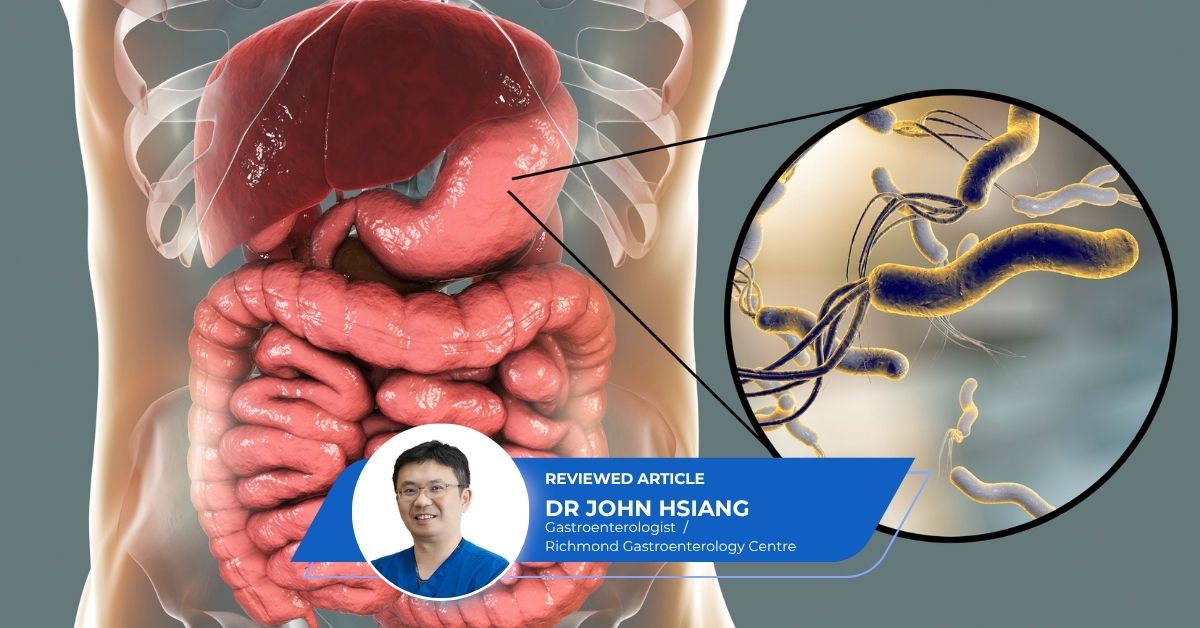
Stomach cancer is the seventh most common cancer in men in Singapore and the ninth in women. More than two in three patients are diagnosed at stage III or IV, when the outlook is far worse than for early disease. Found early, it is often curable, sometimes with an endoscopic procedure alone.
That gap between late and early diagnosis is where Helicobacter pylori (H. pylori) and a condition called gastric intestinal metaplasia (GIM) come in. Worldwide, an estimated 89% of stomach cancers outside the upper junction with the gullet are attributed to H. pylori. This article explains how a common stomach infection can change the stomach lining over decades, what Singapore’s own research shows and who should be checked.
Back To: H. Pylori In Singapore
What Is Gastric Intestinal Metaplasia?
From Infection To Metaplasia: The Correa Cascade
Doctors describe the path from infection to cancer as the Correa cascade. It unfolds in stages over years or decades:
- Chronic active gastritis. H. pylori triggers inflammation that lasts as long as the bacterium does. Strains carrying virulence factors such as CagA provoke a stronger reaction.
- Atrophic gastritis. Years of inflammation destroy the specialised glands that make acid and digestive enzymes. The lining becomes thinner and the stomach produces less acid.
- Intestinal metaplasia. Patches of damaged lining are replaced by intestinal-type cells, including mucus-filled goblet cells. This is a change in cell type, not a genetic mutation.
- Dysplasia. Cells begin to look disorganised under the microscope. High-grade dysplasia sits one step away from invasive cancer.
- Intestinal-type adenocarcinoma. The most common form of stomach cancer.
The cascade is a useful map, not a conveyor belt. Most people with H. pylori never progress beyond gastritis. Singapore’s clinical guideline on gastric premalignant lesions also points out that cancer probably arises from genetic instability in stomach stem cells within this damaged background. GIM is therefore best understood as a warning sign of a high-risk stomach rather than a patch of tissue that turns into cancer by itself.
One twist catches many patients out. H. pylori cannot live on intestinal-type cells, so in a stomach with extensive GIM the bacterium may become sparse or disappear. A negative breath test does not mean the stomach lining is healthy.
What Singapore Research Tells Us About GIM Risk
The most useful local evidence comes from the Gastric Cancer Epidemiology and Molecular Genetics Programme (GCEP). Researchers followed 2,980 people who had screening gastroscopies at four Singapore hospitals and found GIM in 44% of them.
The key finding was that risk depends on how much of the stomach is affected, measured with a staging system called OLGIM (Operative Link on Gastric Intestinal Metaplasia). To give an OLGIM stage, the endoscopist takes biopsies from at least five set areas of the stomach and the pathologist scores how extensive the metaplasia is, from stage 0 to stage IV.
- OLGIM III to IV: about 21 times the risk of early gastric neoplasia compared with no GIM, with a median of around 23 months before it was detected
- OLGIM II: about seven times the risk, with a median of around 51 months
- OLGIM I: no statistically significant increase in that study
Smoking added further risk in people with intermediate or advanced GIM. Participants were Chinese adults aged 50 and above, so the figures apply most directly to that group.
Which Test Answers Which Question?
Different tests answer different questions, and mixing them up is a common source of confusion.
| Test | Detects active H. pylori? | Shows GIM or precancer? | Best used for |
| Urea breath test | Yes | No | First diagnosis without red flags; confirming clearance after treatment |
| Stool antigen test | Yes | No | An alternative to the breath test; confirming clearance |
| Blood antibody test | No, only past exposure | No | Limited use, as it stays positive after cure |
| Gastroscopy with mapping biopsies | Yes, via biopsy | Yes | Red flags, higher-risk individuals, GIM staging and surveillance |
Singapore’s guideline also recommends high-resolution, image-enhanced endoscopy (for example narrow-band imaging), which makes GIM and subtle early cancers easier to see during the scope.
Who Should Consider A Gastroscopy To Check For GIM?
Singapore has an intermediate rate of stomach cancer, so routine screening of everyone is not recommended. The Academy of Medicine, Singapore guideline instead suggests targeted screening for people aged 50 and above with three or more of these risk factors:
- Chinese ethnicity
- Male sex
- A history of H. pylori infection
- Heavy smoking
- A parent, sibling or child with stomach cancer
- Pernicious anaemia
Anyone with warning symptoms such as weight loss, difficulty swallowing, black stools or iron deficiency anaemia needs a gastroscopy regardless of age. If your main concern is everyday bloating or indigestion, our guide Your Persistent Bloating or Acid Reflux Actually H. Pylori? explains when a breath test is enough.
Does Treating H. Pylori Reverse GIM?
This is the question patients ask most, and the honest answer has two parts.
Before precancerous changes develop, eradication clearly helps. A meta-analysis of seven randomised trials involving 8,834 people found that treating H. pylori cut stomach cancer risk by about 45%.
Once GIM is established, the benefit is less certain. Pooled data show a clearer benefit in atrophic gastritis than in GIM or dysplasia. Atrophy can partly recover after treatment, but established GIM often persists.
None of this is a reason to skip treatment. Singapore’s guideline strongly recommends eradicating H. pylori whenever it is found, because it removes the ongoing inflammation. What treatment cannot do is replace surveillance in someone who already has significant GIM. If your treatment has not worked, our guide Why H. Pylori Treatment Fails And What Comes Next covers the next steps.
How Often Is Surveillance Recommended?
Singapore’s guideline bases follow-up intervals on OLGIM stage plus extra risk factors (significant smoking, age above 50, incomplete-type GIM, persistent H. pylori or a first-degree relative with stomach cancer):
| OLGIM stage | Without extra risk factors | With extra risk factors |
| 0 to I | No routine surveillance | Every 3 years (OLGIM I) |
| II | Every 5 years | Every 3 years |
| III to IV | Every 3 years | Every 2 years (two or more risk factors) |
International guidelines differ. The American Gastroenterological Association advises against routine surveillance for everyone with GIM but supports it for higher-risk patients who choose it. European guidance recommends a three-year interval for extensive GIM. Singapore’s recommendations are more specific because they draw on local GCEP data. You can read more about how a structured GIM surveillance programme works in practice.
Clinical Insights: What Happens In The Consultation Room
Dr John Hsiang, Senior Consultant Gastroenterologist, explains how he talks patients through a GIM diagnosis.
“Patients often arrive worried after seeing the word ‘precancerous’ on a biopsy report. My first job is to put that word into proportion. Most people with GIM will never develop stomach cancer. What matters is how much of the stomach is involved, the subtype, whether H. pylori is still present and the person’s other risk factors.
A report that says ‘focal intestinal metaplasia’ from one or two random samples often does not tell me enough. To stage it properly, the stomach needs systematic biopsies from set areas so the pathologist can give an OLGIM stage. That stage, not the label, decides whether someone needs another scope in two, three or five years. Some need none at all.
The other conversation is about breath tests. A negative result after treatment is good news for the infection, but it says nothing about the lining. For patients with known GIM, the follow-up plan is built around endoscopy.”
Frequently Asked Questions
No. GIM is a change in the type of cells lining the stomach. It signals a higher-risk stomach, and the level of risk depends on how extensive it is.
Sometimes partly, but often not. Atrophy can improve after eradication, while established GIM frequently persists. That is why staging and, where appropriate, surveillance matter even after successful treatment.
No. Only a small minority of people with H. pylori ever develop stomach cancer, commonly estimated at around 1 to 3% over a lifetime. Bacterial strain, genetics, smoking, diet and how long the infection persists all influence the risk.
Speak to a Gastroenterologist About GIM and Stomach Cancer Risk
If you have been told you have intestinal metaplasia, have a family history of stomach cancer or have several of the risk factors above, a specialist review can clarify your actual risk and whether surveillance makes sense. Health365’s stomach cancer guide covers symptoms and treatment in more depth.
Dr John Hsiang sees patients at Richmond Gastroenterology Centre in Mount Elizabeth Orchard and Farrer Park Medical Centre. View Dr John Hsiang’s profile on 365Asia .
Alternatively, make an appointment via the button below:
Contact MedicalTravel.asiaReferences
- Namasivayam V, Koh CJ, Tsao S, et al. Academy of Medicine, Singapore clinical guideline on endoscopic surveillance and management of gastric premalignant lesions. Ann Acad Med Singap. 2022;51(7):417-435.
- Lee JWJ, Zhu F, Srivastava S, et al. Severity of gastric intestinal metaplasia predicts the risk of gastric cancer: a prospective multicentre cohort study (GCEP). Gut. 2022;71:854-863.
- Ford AC, Yuan Y, Moayyedi P. Helicobacter pylori eradication therapy to prevent gastric cancer: systematic review and meta-analysis. Gut. 2020;69:2113-2121.
- Gupta S, Li D, El Serag HB, et al. AGA clinical practice guidelines on management of gastric intestinal metaplasia. Gastroenterology. 2020;158:693-702.
- Pimentel-Nunes P, Libanio D, Marcos-Pinto R, et al. Management of epithelial precancerous conditions and lesions in the stomach (MAPS II). Endoscopy. 2019;51:365-388.

This article is medically reviewed by Dr John Hsiang, Senior Consultant Gastroenterologist, Richmond Gastroenterology Centre. Last reviewed: October 2026.
Back To: H. Pylori In Singapore
All content on this site is informative only and is not intended to be a substitute for professional medical advice, diagnosis, or treatment, and should never be relied upon for specific medical advice. If you are experiencing a medical emergency, call 995 immediately or go to the nearest Accident & Emergency department.
health365.sg is a member of 365Asia.