

Anorectal Conditions – The Big Story

Anorectal Conditions: Not Just A Pain That Can Be Ignored - The Big Story
Anorectal conditions include a wide range of disorders that involve the anal canal and rectum. These include both benign and potentially serious problems. They may arise from infection, inflammation, structural weakness, or abnormal growths.
Some of the most common anorectal conditions are:
- Anal fistula
- Anal fissure
- Haemorrhoids
- Perianal abscess
- Rectal prolapse
- Rectal polyps
Each of these conditions has its own set of causes, symptoms, risks, and treatments.
Common Causes Of Anorectal Conditions
Common anorectal conditions such as haemorrhoids, anal fissures, fistulas, abscesses, and rectal prolapse can arise from a variety of causes. These causes often relate to lifestyle, bowel habits, or underlying medical conditions. The main contributing factors include:
Constipation and Straining
Chronic constipation or frequent straining during bowel movements is one of the most common contributors. Excess pressure on the anal and rectal veins can lead to haemorrhoids, while hard stools can cause anal fissures.
Diarrhoea
Recurrent diarrhoea can irritate the anal lining and contribute to fissures, skin irritation, or infections, increasing the risk of abscess formation.
Sedentary Lifestyle
Prolonged sitting, especially on the toilet, increases pressure in the anal region and can worsen haemorrhoids. Lack of regular physical activity may also slow bowel transit.
Dietary Factors
Low-fibre diets can lead to constipation and straining, whereas excessive spicy foods may irritate the anal canal. Dehydration is another factor that can harden stools.
Pregnancy and Childbirth
Hormonal changes and increased pressure on pelvic veins during pregnancy often lead to haemorrhoids. Vaginal delivery can also contribute to anal sphincter injuries or rectal prolapse.
Obesity
Excess body weight increases pressure on the pelvic and anorectal veins, raising the risk of haemorrhoids and other anorectal disorders.
Age and Weakening of Tissues
As people age, the anal and rectal tissues lose elasticity and strength, making conditions like rectal prolapse more likely.
Infections and Inflammatory Conditions
Chronic infections, Crohn’s disease, and other inflammatory bowel diseases can lead to anal fistulas, abscesses, or chronic irritation.
Genetic Predisposition
Some people are more prone to conditions like haemorrhoids or fistulas due to inherited connective tissue weakness or vascular fragility.
Previous Surgery or Trauma
Past anorectal surgery, injury, or repeated anal trauma can increase the likelihood of recurrent conditions.
Rectal polyps are growths that develop on the lining of the rectum, and their causes are often linked to genetic, lifestyle, and medical factors. The main causes include:
Genetic Predisposition
Certain inherited conditions increase the risk of developing rectal polyps:
- Familial Adenomatous Polyposis (FAP): A rare condition causing hundreds to thousands of polyps.
- Lynch Syndrome: Increases the risk of colorectal polyps and cancer.
- Family History: Having first-degree relatives with polyps or colorectal cancer raises your likelihood.
Age
The risk of polyps rises with age, particularly after 50 years, as the lining of the colon and rectum becomes more susceptible to abnormal growths.
Diet and Lifestyle
- Diets high in red or processed meat and low in fibre are linked to polyp formation.
- Obesity and sedentary lifestyles may also contribute.
- Smoking and excessive alcohol consumption are additional risk factors.
Chronic Inflammation
Conditions like ulcerative colitis or Crohn’s disease increase the risk of polyps due to ongoing inflammation in the rectal lining.
Metabolic and Hormonal Factors
Diabetes and insulin resistance have been associated with a slightly higher risk of colorectal polyps.
Previous Polyps
People who have had polyps removed are more likely to develop new ones in the future, especially if the polyps were large or contained abnormal cells.
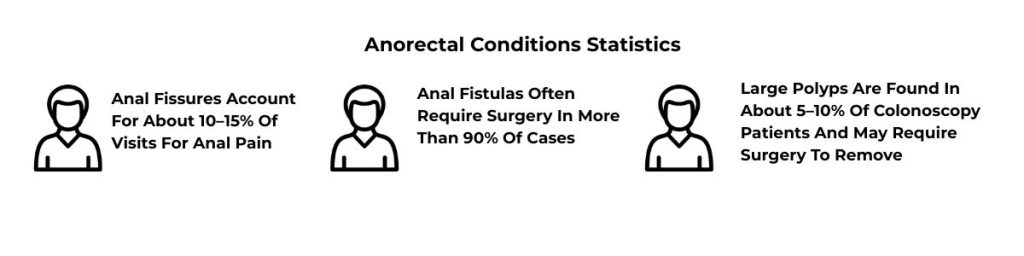
Anorectal Conditions Statistics
Anorectal conditions are common and affect a significant proportion of adults worldwide.
Haemorrhoids are particularly prevalent, with studies showing that up to 50% of adults experience symptomatic haemorrhoids by age 50, and around 10–20% of these cases eventually require procedural or surgical treatment when conservative measures fail.
Anal fissures, often caused by straining or hard stools, affect approximately 1 in 350 adults annually, and about 40% of chronic fissures that do not respond to medical therapy may need surgery.
Anal fistulas, which typically follow abscess formation, are less common but more likely to require intervention, with over 90% of cases eventually managed surgically.
Rectal polyps, which are often asymptomatic, are increasingly detected through screening. About 5–10% of colonoscopy patients have at least one large polyp greater than 1 cm, and 10–15% of these polyps show high-grade dysplasia or early cancer, highlighting the importance of early removal. While many can be treated endoscopically, 10–20% of large rectal polyps still require surgical intervention, particularly when they are sessile or suspicious for malignancy.
Focus On Rectal Polyps
What Are The Symptoms Of Rectal Polyps?
Rectal polyps, unfortunately, often do not cause noticeable symptoms, especially when they are small. Many cases are discovered incidentally during routine screening procedures such as colonoscopy.
When symptoms do occur, they can vary depending on the size, number, and location of the polyps. One of the most common signs is the presence of blood in the stool, which may appear as bright red streaks or darker, tar-like faeces. Some individuals may also notice mucus discharge or experience changes in bowel habits, such as alternating constipation and diarrhoea.
Larger polyps can occasionally cause discomfort or a sensation of incomplete bowel emptying.
In rare cases, a very large polyp might protrude from the rectum, causing irritation or pain during bowel movements. Persistent bleeding from rectal polyps can lead to iron-deficiency anaemia, presenting with fatigue, dizziness, or pale skin.
Why Early Detection And Removal Of Rectal Polyps Matter
Most rectal polyps are benign. However, certain types, particularly adenomatous polyps, have the potential to develop into colorectal cancer over time. For this reason, any rectal bleeding or unexplained change in bowel habits should prompt medical evaluation and appropriate screening.
When To See A Doctor And How Are Rectal Polyps Treated?
You should see a doctor if you experience symptoms such as rectal bleeding, blood in the stool, unexplained changes in bowel habits, persistent abdominal discomfort, or a feeling that your bowel does not empty completely.
Diagnosis of rectal polyps is usually made through a colonoscopy, which allows the doctor to view the inside of the rectum and colon and remove any detected polyps at the same time.
Treatment typically involves polypectomy, a minimally invasive procedure to remove the growths. The removed tissue is then sent for laboratory analysis to determine if further monitoring or treatment is needed. Regular follow-up colonoscopies may be recommended to check for recurrence or new polyp formation.
Polypectomy
Most polyps can be safely removed during a colonoscopy through a procedure called a polypectomy, where specialised instruments are used to cut or snare the growth from the intestinal wall.
This is minimally invasive and usually performed as a day procedure.
Transanal Minimally Invasive Surgery (TAMIS)
For larger or more complex polyps that cannot be fully removed during colonoscopy, a surgical approach such as Transanal Minimally Invasive Surgery (TAMIS) may be recommended.
TAMIS allows precise removal of rectal polyps through the anal opening using advanced laparoscopic instruments, avoiding the need for major abdominal surgery. Both methods are effective in eliminating polyps and reducing the risk of future colorectal cancer.
Learn More About Anorectal Conditions And Rectal Polyps
Comment: The row below to be moved to article for healthcare professionals article
Find A Doctor
Verified Healthcare Professionals
We connect you with a network of qualified and experienced doctors who specialise in chronic health conditions, health screening, and longevity.
Trusted Information Source
We pride ourselves on providing accurate, up-to-date, and evidence-based information about each disease, its prevention, and treatment.
Privacy and Security
Your health information and personal data are paramount to us. We will protect your privacy throughout the booking process and beyond.
Convenience at Your Fingertips
Our user-friendly platform allows you to find and book appointments 24/7 from the comfort of your home.
Our Preferred Doctor You Can Consider For Anorectal Condition Management Or Treatment:

Powered by Find by 365Asia

Dr Chong Choon Seng 张峻诚医生
Singapore, Singapore
General Surgery, General Surgery (Colorectal), General Surgery (Hernia)

[SG] Featured Doctor- Dr Kevin Koo
Orthopaedic Surgeon In Singapore
Rectal cancer is a treatable condition, especially with new techniques and platforms. Seek treatment early to have a better and safer outcome.
Dr Chong Choon Seng
Book An Appointment
Take a proactive step for your health and peace of mind today. If you need to see an colorectal / anorectal surgeon, our team is here to assist.
Financials
[findDoctor category="financial consultants" countries="Singapore" " limit="15"]
Related Content



FAQs - Test Your Knowledge About Anorectal Conditions And Rectal Polyps
Many anorectal conditions develop due to chronic constipation, straining during bowel movements, prolonged sitting, low fibre intake, or infections. In some cases, underlying medical issues such as inflammatory bowel disease or genetic factors can also play a role.
Rectal polyps often do not cause symptoms and may be discovered during routine screening. When symptoms occur, they can include rectal bleeding, mucus in the stool, changes in bowel habits, or a sensation of incomplete bowel emptying. Larger polyps may sometimes protrude from the anus.
Most rectal polyps are removed during colonoscopy in a procedure called a polypectomy. For larger or more complex polyps, Transanal Minimally Invasive Surgery (TAMIS) may be recommended. Both approaches are minimally invasive and effective in preventing potential progression to colorectal cancer.
Treatment depends on the severity of the condition. Mild haemorrhoids and fissures can often be managed with dietary changes, topical medications, or minimally invasive procedures such as rubber band ligation. Anal fistulas and abscesses usually require surgical drainage or repair to prevent infection and recurrence.
Maintaining good bowel habits is key. Eat a high-fibre diet rich in fruits, vegetables, and whole grains, drink plenty of water, and avoid straining during bowel movements. Regular exercise and prompt attention to digestive symptoms also help reduce the risk of developing anorectal conditions.
Additional Resources
- Transanal Surgery in Singapore | Ark Surgical Practice
- Anal Fistula Treatment in Singapore | Ark Surgical Practice
- Transanal minimally invasive surgery (TAMIS) for rectal cancer | Science Direct
- Rectal Cancer | Mayo Clinic
- Haemorrhoids (Piles) – Symptoms & Treatment | SGH
.