

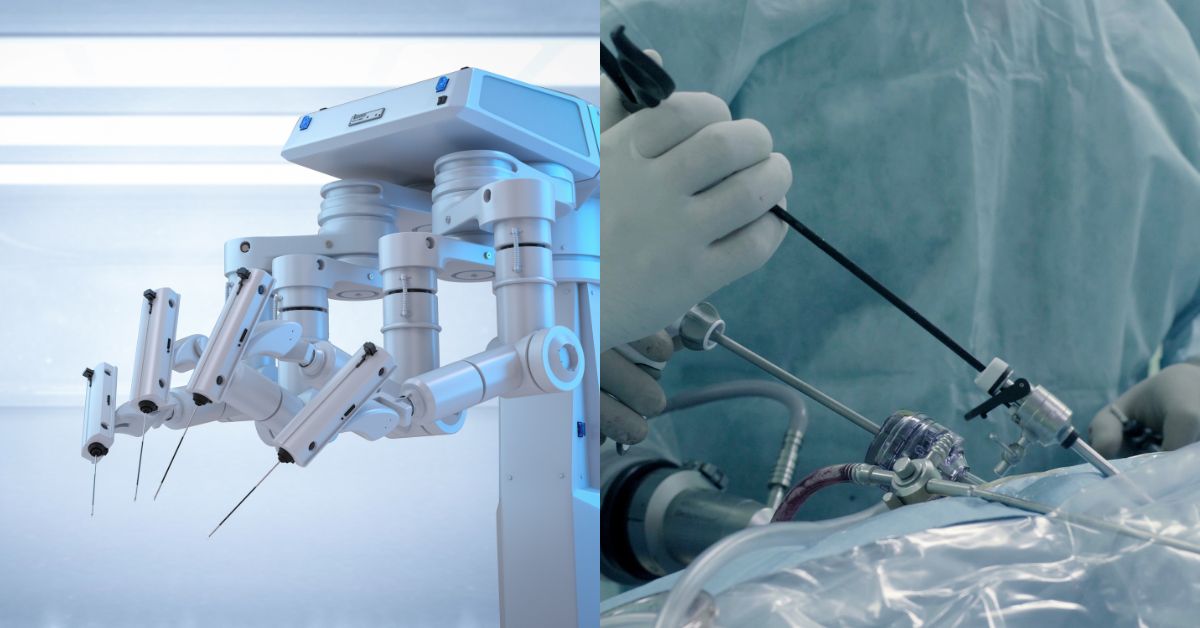
If you or a loved one are preparing for an upcoming procedure, hearing terms like “minimally invasive,” “laparoscopic,” and “robotic-assisted” can feel incredibly overwhelming. To cut through the medical jargon and help you advocate for your health, we have put together a cheat sheet breaking down exactly when a surgeon will lean toward the cutting-edge precision of a robot, and when the trusted, tactile agility of traditional laparoscopy is actually the safer, superior choice.
Need To Consult A Surgeon?
Contact UsBack To: Surgical Treatments Main Page
The Minimally Invasive Surgical Cheat Sheet
Disclaimer: The information provided in this article, including the surgical cheat sheet, is for educational and informational purposes only and is not intended as professional medical advice, diagnosis, or treatment. Every patient’s anatomy, medical history, and surgical needs are unique. Always consult with a qualified physician or board-certified surgeon to discuss your specific clinical options and determine the safest surgical approach for your condition. Do not disregard professional medical advice or delay seeking it because of something you have read on this website.
🟢 When Should I Choose Robotic Surgery (RS)?
Choose robotic surgery when…
| Scenario | Why the Robot Wins |
| Deep, Narrow Spaces (e.g., prostatectomy, deep pelvic/rectal surgery) | The tiny, wristed instruments can flex and rotate in tight corners where straight sticks cannot. |
| Intricate Reconstruction (e.g., delicate suturing/sewing, hernia repairs) | High precision and 7 degrees of instrument freedom make fine needle work much easier. |
| Microscopic Precision Needed (e.g., working right next to delicate nerves/vessels) | The 3D high-definition vision offers depth perception, and the system filters out natural hand tremors. |
| Long, Exhausting Procedures (e.g., complex multi-hour cancer resections) | The surgeon sits comfortably at an ergonomic console, reducing physical fatigue and keeping them sharp. |
🔵 When Should I Choose Laparoscopic Surgery (LS)?
Choose laparoscopic surgery when…
| Scenario | Why Laparoscopy Wins |
| Straightforward Procedures (e.g., routine gallbladder removal, simple appendix removal) | RS provides no clinical benefit here; LS is faster to set up and highly cost-effective. |
| Tactile Assessment Needed (e.g., feeling tissue density or locating a hidden tumor) | RS has zero haptic feedback. LS allows the surgeon to physically “feel” tissue resistance through the instruments. |
| Multi-Quadrant Surgeries (e.g., cancer spanning from the deep pelvis up to the upper liver) | Human hands can instantly redirect LS tools across the entire abdomen. A robot would require a lengthy undocking and repositioning process. |
| Acute Emergencies (e.g., rapid internal bleeding or ruptured organ) | LS equipment is instantly ready. The robot requires a lengthy sterile draping, calibration, and docking setup. |
| Anatomical Space Constraints (e.g., pediatric patients or exceptionally petite adults) | The bulky external robotic arms are prone to colliding with each other if the entry incisions are too close together. |
The Bottom Line: Think of Robotic Surgery as a high-powered microscope with mechanical wrists—perfect for precise, localised, deep-tissue work. Think of Laparoscopic Surgery as an agile, fast-deploying multi-tool—perfect for speed, tactile touch, and moving across large areas.
How To Choose Between Robotic And Laparoscopic Surgery?
Ultimately, there is no universal “winner” in the debate between robotic and laparoscopic surgery; they are simply different, highly specialised tools in a surgeon’s toolkit. The most advanced technology isn’t always the best fit for a routine procedure, just as traditional methods can fall short in deep, highly complex anatomical spaces. The best way to use this guide is as a conversation starter at your next pre-op appointment.
Surgeons You Can Consider
If you are looking for a general surgeon for treatment or consultation, here are our Preferred Doctors you can consider





Dr Tan Wee Boon

Dr Kim Guowei




Dr Chong Choon Seng 张峻诚医生

[SG] Featured Doctor- Dr Kevin Koo
Back To: Surgical Treatments Main Page
All content on this site is informative only and is not intended to be a substitute for professional medical advice, diagnosis, or treatment, and should never be relied upon for specific medical advice. If you are experiencing a medical emergency, call 995 immediately or go to the nearest Accident & Emergency department.
health365.sg is a member of Group 365Asia.