

Treating Chronic Back Pain Without Open Surgery With Radiofrequency Ablation – The Big Story

Treating Chronic Back Pain Without Open Surgery With Radiofrequency Ablation (RFA)
TL;DR: Radiofrequency Ablation (RFA) At A Glance
- Targeted Non-Surgical Relief: Radiofrequency Ablation (RFA) is a minimally invasive procedure that uses controlled thermal energy to disrupt pain signals from specific spinal nerves, offering targeted relief for chronic lower back pain without open surgery.
- Sustained Function & Reduced Medication Reliance: RFA typically provides 6 to 18 months of significant pain reduction, helping patients regain mobility, engage effectively in physical therapy, and reduce reliance on daily pain medications.
- Precision Diagnostic Protocol: Before undergoing RFA, patients complete image-guided diagnostic nerve block injections to confirm that specific spinal structures (such as facet joints) are the primary source of pain.
- Minimal Downtime & Day Procedure: Performed under local anaesthesia with light sedation, RFA involves no surgical incisions or muscle cutting, allowing most individuals to return home the same day and resume light daily activities within 24 to 48 hours.
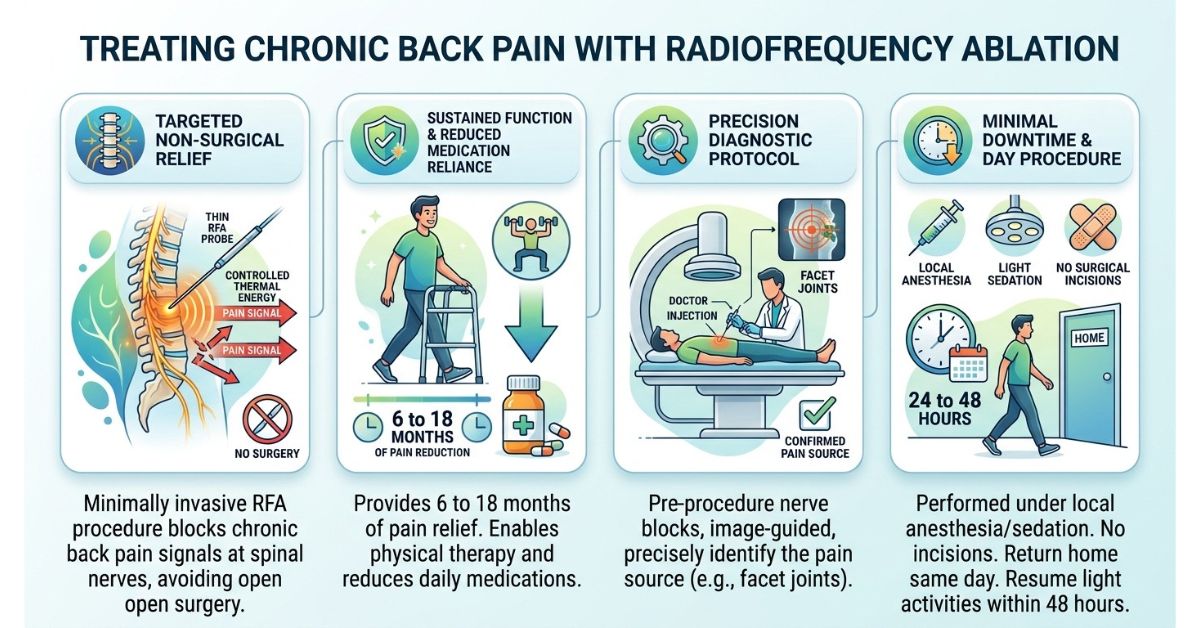
Click to expand infographic.
The Hidden Burden Of Chronic Back Pain In Singapore
Chronic back pain is a major contributor to physical disability and reduced quality of life among adults in Singapore. While acute back strain often improves with temporary rest and conservative management, pain that persists beyond 12 weeks is classified as chronic and can disrupt daily work, mobility, and sleep.
Many individuals live with persistent lower back pain for months or years, cycling through oral analgesics, topical patches, and physical therapy without lasting improvement. In a significant number of cases, the pain originates from degenerative wear and tear in the small stabilising joints of the spine (facet joints) or internal disc disruption, rather than major structural instability that necessitates open spinal surgery.
When conservative measures offer insufficient relief and open surgery is not clinically indicated or desired, interventional procedures such as radiofrequency ablation provide a valuable non-surgical option to restore physical function.

Powered by Find by 365Asia


[SG] Featured Doctor- Dr Diana Chan
Pain Management Specialist
Key Clinical Mechanisms: How Radiofrequency Ablation Works
Radiofrequency ablation is an evidence-based interventional technique designed to interrupt pain signals transmitted along specific sensory nerve fibers before they reach the brain.
Unlike traditional open spinal surgery, RFA does not require large skin incisions, muscle disruption, or structural alterations to the vertebral column. Instead, a specialised micro-needle is positioned precisely beside the target nerve using real-time fluoroscopic (X-ray) or ultrasound guidance.
- Targeted Thermal Lesioning: Once correct positioning is confirmed via sensory and motor testing, radiofrequency energy generates mild, localised heat (typically around 80°C) at the uninsulated needle tip.
- Signal Interruption: This controlled heat creates a precise lesion on the targeted sensory nerve (such as the medial branch nerve supplying a painful facet joint), blocking its ability to conduct pain signals.
- Preservation of Function: Because the procedure targets sensory nerve branches, surrounding motor nerves, muscles, and overall spinal stability remain unaffected.
Overview Of RFA Modalities
Depending on the underlying pathology and affected tissue, different radiofrequency techniques may be utilised:
- Conventional Thermal RFA: Uses continuous thermal energy to create a localised lesion on sensory nerves transmitting pain from arthritic facet joints.
- Pulsed Radiofrequency (PRF): Delivers high-voltage electrical pulses in short bursts, maintaining tissue temperature at or below 42°C. This alters nerve signal transmission via neuromodulation without causing structural tissue destruction, making it suitable for mixed sensory-motor nerve pathways.
- Cooled Radiofrequency: Employs water-cooled technology to create larger, spherical thermal lesions, providing broader coverage for complex or variable nerve pathways in joint and disc pathology.
Treatment Pathways: Integrating RFA Into Pain Care
Evaluating a patient for radiofrequency ablation involves a structured clinical management pathway:
1. Clinical Evaluation & Medical Imaging
A thorough clinical assessment, including physical examination and imaging studies (such as MRI or spinal X-rays), is conducted to identify candidate structural pain sources.
2. Diagnostic Nerve Block Injection
To confirm the source of pain, a temporary diagnostic block is performed by injecting a small amount of local anaesthetic near the suspected target nerves. If the patient experiences significant short-term pain reduction during the diagnostic phase, it validates the specific nerve as the primary target for RFA.
3. Outpatient RFA Procedure
The procedure is performed in an outpatient or day-surgery setting under local anaesthesia, often with mild sedation for comfort. Micro-needles are placed under live imaging guidance and tested for safety before thermal treatment is applied. The total procedure generally takes between 30 and 60 minutes.
4. Post-Procedure Recovery & Rehabilitation
Patients are observed briefly before discharge on the same day. Mild localised soreness at the injection site may occur for a few days. As procedural inflammation subsides, progressive pain reduction typically occurs over two to four weeks, enabling patients to participate more effectively in physical rehabilitation.
Comparing Non-Surgical Pain Therapies & Surgical Options
| Treatment Category | Primary Mechanism | Invasiveness & Recovery | Typical Efficacy Duration |
| Conservative Care (Physical Therapy, Oral Medications) | Strengthens core musculature, improves flexibility, and provides systemic symptom management. | Non-invasive; requires consistent ongoing participation. | Variable; relies on continuous medication or exercise maintenance. |
| Spinal / Joint Injections (Corticosteroids, Local Anaesthetics) | Reduces localised inflammation around affected nerves or joint structures. | Minimally invasive day procedure; minimal downtime. | Temporary relief (typically weeks to a few months). |
| Radiofrequency Ablation (RFA) | Thermally interrupts sensory nerve conduction transmitting pain signals from target joints. | Minimally invasive micro-needle procedure; resume normal light activity in 24–48 hours. | Extended relief (typically 6 to 18 months); can be repeated if nerve regeneration occurs. |
| Open Spine Surgery (e.g., Spinal Fusion, Decompression) | Corrects structural deformities, stabilises spinal segments, or decompresses spinal cord/nerve roots. | Surgical procedure requiring incisions, hospital stay, and formal postoperative recovery. | Structural outcome is permanent; pain management response varies. |
Get An Appointment For A Pain Management Consultation
If you are experiencing persistent lower back pain and wish to explore non-surgical interventional options, you may consult a Pain Management Specialist.
Our Preferred Doctor You Can Consider For Treatment Of Chronic Back Pain With Radiofrequency Ablation
For individuals seeking specialised evaluation and care for chronic back pain with radiofrequency ablation in Singapore, consulting an experienced pain management specialist helps ensure access to personalised diagnostic and therapeutic strategies.
Dr Diana Chan (Pain Management Specialist In Singapore)
Dr Diana Chan (Advanced Pain Specialists) is a pain specialist whose personal experience with chronic injury allows her to offer deeply empathetic, patient-centric care. She has extensive expertise in performing over 500 advanced, minimally invasive interventional procedures. Dr Chan integrates modern clinical interventions with traditional techniques like acupuncture to restore quality of life.
Articles Reviewed By Dr Diana Chan



Slipped Disc Treatment Without Surgery In Singapore
- April 30, 2026



"Many patients assume their only choices for persistent back pain are taking lifelong painkillers or undergoing major spine surgery. Radiofrequency ablation fills that critical gap. It allows us to precisely target and deactivate pain signals at the source, giving patients back their quality of life without open surgery."
Dr Diana Chan, Pain Management Specialist
Find A Doctor
Verified Healthcare Professionals
We connect you with a network of qualified and experienced doctors who specialise in chronic health conditions, health screening, and longevity.
Trusted Information Source
We pride ourselves on providing accurate, up-to-date, and evidence-based information about each disease, its prevention, and treatment.
Privacy and Security
Your health information and personal data are paramount to us. We will protect your privacy throughout the booking process and beyond.
Convenience at Your Fingertips
Our user-friendly platform allows you to find and book appointments 24/7 from the comfort of your home.
Additional Resources
- 365Asia List of Best Pain Management Specialists In SIngapore
When Should You See A Pain Management Specialist For Chronic Back Pain?
You should consider consulting a pain specialist if:
- Your back pain has persisted for more than 3 months despite rest and medication.
- You experience radiating pain, numbness, or tingling extending into your buttocks, thighs, or legs (sciatica).
- Conservative physiotherapy fails to bring sustained improvement, or exercises are too painful to perform.
- You wish to explore targeted relief to avoid or postpone major open spinal surgery.
- Back pain disrupts your sleep, work productivity, or emotional health.

Frequently Asked Questions About Radiofrequency Ablation
Does Radiofrequency Ablation Cause Permanent Nerve Damage?
No. Thermal RFA selectively disrupts the sensory nerve fibers responsible for transmitting pain signals. Over time—typically between 6 and 18 months—the sensory nerve endings naturally regenerate. If back pain eventually returns following nerve regeneration, the procedure can be safely evaluated and repeated if clinically indicated.
Is General Anaesthesia Required For RFA?
No. RFA is routinely performed under local anaesthesia to numb the skin and deeper tissues around the target site. Light sedation may be administered to keep patients relaxed and comfortable while remaining awake to provide feedback during routine sensory testing.
How Soon Can Normal Activities Be Resumed After RFA?
Most patients are discharged on the same day within a few hours of the procedure. Light daily activities can generally be resumed within 24 to 48 hours, while strenuous physical exertion and heavy lifting should be avoided for a few days according to the doctor’s instructions.
Will RFA Permanently Cure Spinal Degeneration?
RFA does not reverse underlying structural changes such as spinal arthritis or degenerative disc disease. Instead, it targets the specific nerve pathways that convey pain signals from these damaged structures. By managing pain effectively, RFA helps restore physical mobility and allows patients to engage in active rehabilitation programmes.