

You Found Breast Lumps – The Big Story

You Found Breast Lumps - The Big Story
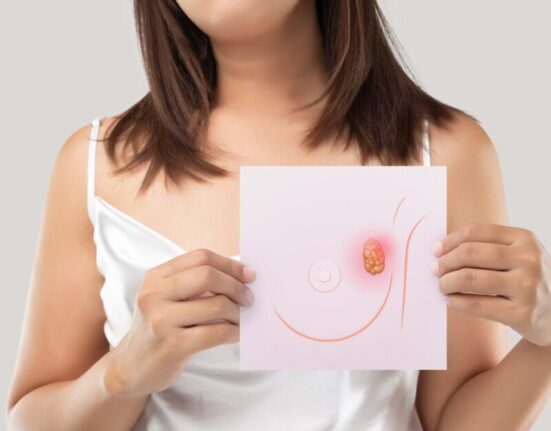
A breast lump is a mass or growth that develops in the breast. A breast lump can be a sign of breast cancer, but it is usually benign
Breast tissue is naturally not uniformly soft. It may naturally feel uneven, with ridges, firmness, and nodularity, and the breasts may even feel different from time to time due to hormonal changes.
Due of this natural variability in the breasts, it may not always be easy to know whether what is felt is really a breast lump or just normal tissue.
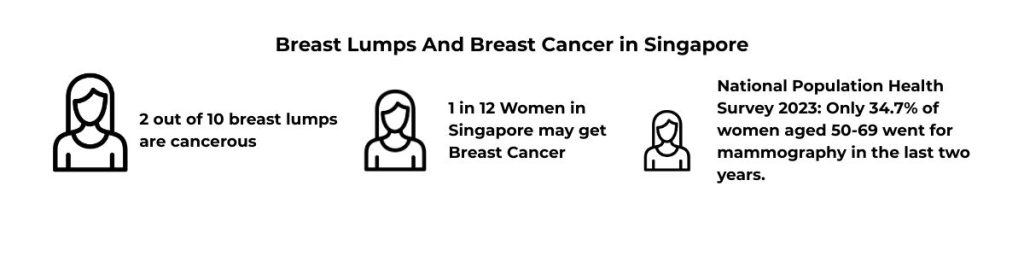
Breast Lumps Singapore Statistics
About 10% of women may experience breast lumps in their lifetimes. About 80% of breast lumps are due to benign conditions, and the remaining are malignant. In Singapore, about 1 in 12 women will get breast cancer in their lifetimes (Singapore Cancer Registry 2022).
In Singapore, despite high awareness of breast cancer, studies have found that a relatively low percentage of women – 34.7% – in the high risk age group (40-69 years old) had gone for a mammogram in the past 2 years.
Who Is At Risk For Breast Lumps?
Risk factors for non-cancerous breast lumps include:
- Age. Certain conditions (e.g. fibrocystic changes and fibroadenomas) that cause breast lumps are more common in women aged 30-50.
- Menstrual periods. Extra fluid in the breasts before or during Menses.
- Pregnancy. The breasts may feel lumpy during pregnancy due to growth in the number of size of the mammary glands.
- Premenopause. Hormone changes might make the breasts feel lumpier and tender.
Risk factors for breast cancer include:
- Age and Sex. Breast cancer risk increases with age, particularly after 40 years old. Men may also get breast cancer but the risk is much lower as compared to women.
- Family History. A woman’s breast cancer risk is greatly increased if she inherits mutated BRCA1 or BRCA2 genes. Woman an immediate family history of breast cancer is twice as likely to develop breast cancer themselves (compared to those without such family history).
- Reproductive History. A woman faces increased risk of breast cancer if she does not have children or had the first child after the age of 35, had onset of menses before the age of 11, or had cessation of menses after the age of 55.
- Diet. Excessive consumption of red meat, animal fat, and alcohol may increase breast cancer risk.
- Body Weight and Physical Activity. Weight gain, particularly for post-menopausal women, contributes to increased breast cancer risk.
- Intake of Hormones. Post-menopausal women on long term Hormone Replacement Therapy (HRT) have an increased risk of breast cancer. Younger girls between the ages of 10-15 who take oral contraceptive pills also faces increased risk.
- Previous Abnormal Breast Biopsy. Certain breast biopsy results may be indicative of an increased risk of breast cancer.
- History of Breast Cancer. Women with previous instances of breast cancer face an increased risk of developing breast cancer again.
Learn More About Breast Lumps
Top 3 Non-Cancer Conditions That Causes Breast Lumps
Fibroadenomas
Fibroadenomas are among the most common non-cancerous breast lumps, particularly in women under 30. They are solid, smooth, and rubbery growths that move easily under the skin when touched. These lumps form due to an overgrowth of glandular and connective tissue within the breast. Though they can vary in size and sometimes grow larger during pregnancy or with hormonal changes, fibroadenomas are typically harmless. Most do not require treatment unless they are large, painful, or cause cosmetic concerns. Doctors usually confirm the diagnosis with ultrasound or biopsy to rule out malignancy.
Breast Cysts
Breast cysts are fluid-filled sacs within the breast tissue, often linked to hormonal fluctuations. They are most common in women between the ages of 35 and 50, especially those approaching menopause. Cysts can feel soft or firm and may fluctuate in size throughout the menstrual cycle, sometimes becoming tender or painful. They are generally benign and not associated with an increased risk of breast cancer. Diagnosis is usually confirmed with an ultrasound, and if a cyst is uncomfortable, a doctor may drain it with a fine needle to relieve symptoms.
Fibrocystic Breast Changes
Fibrocystic breast changes are a very common condition affecting women of reproductive age. Instead of a single lump, they cause the breast tissue to feel lumpy, rope-like, or thickened, often in both breasts. These changes are driven by hormonal fluctuations and can cause tenderness, swelling, and lumpiness that vary with the menstrual cycle. While fibrocystic changes are completely benign, they can make it harder to distinguish new lumps from the normal texture of the breast. Regular self-awareness and professional check-ups are important to identify any unusual or persistent changes.
Comment: The row below to be moved to article for healthcare professionals article
Find A Doctor
Verified Healthcare Professionals
We connect you with a network of qualified and experienced doctors who specialise in chronic health conditions, health screening, and longevity.
Trusted Information Source
We pride ourselves on providing accurate, up-to-date, and evidence-based information about each disease, its prevention, and treatment.
Privacy and Security
Your health information and personal data are paramount to us. We will protect your privacy throughout the booking process and beyond.
Convenience at Your Fingertips
Our user-friendly platform allows you to find and book appointments 24/7 from the comfort of your home.
Our Preferred Doctors You Can Consider For Breast Health Screening Or Treatments:

Powered by Find by 365Asia


[SG] Featured Doctor- Dr Kevin Koo
Orthopaedic Surgeon In Singapore
Book An Appointment
Take a proactive step for your health and peace of mind today. If you need to see a doctor about breast lumps or breast health, our team is here to assist.
Financials
[findDoctor category="financial consultants" countries="Singapore" " limit="15"]
Related Content



FAQs - Test Your Knowledge About Breast Lumps
No, not all breast lumps are cancerous. In fact, most are benign conditions such as cysts, fibroadenomas, or fibrocystic changes. However, it is impossible to tell by touch alone whether a lump is harmless or malignant. That is why every new lump or noticeable change in the breast should be checked by a healthcare professional for accurate diagnosis.
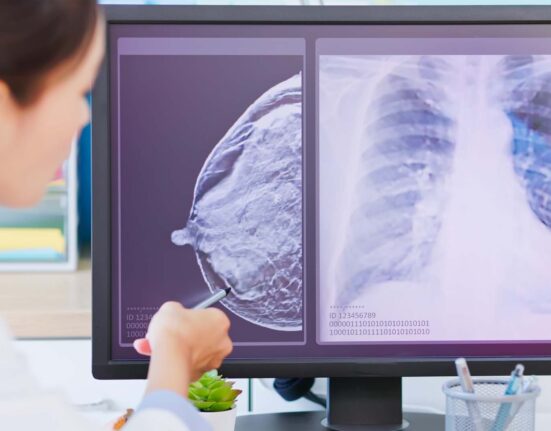
Both are imaging tools, but they serve different purposes. A mammogram is an X-ray of the breast that is excellent for detecting early signs of cancer, such as tiny calcifications, particularly in women over 40.
A breast ultrasound uses sound waves and is more useful for younger women with dense breast tissue. Ultrasound also helps to distinguish whether a lump is solid or fluid-filled. In many cases, doctors recommend both tests together for a clearer picture.
Yes, absolutely. Pain is not a reliable indicator of whether a lump is benign or malignant. Many cancerous lumps are painless, while some harmless conditions like cysts may cause tenderness. Any persistent lump, whether painful or not, should always be examined by a doctor
While general practitioners play an important role in breast health, a breast surgeon brings specialised expertise. Consulting a breast surgeon, even for routine screening, can be advantageous because they are highly skilled in evaluating breast changes, interpreting imaging results, and recommending the most appropriate next steps. Their in-depth knowledge can provide extra reassurance and ensure that no subtle abnormalities are overlooked.
Yes, men can also develop breast lumps and, in rare cases, breast cancer. Although male breast cancer accounts for less than 1% of all cases, it is often diagnosed at a later stage due to lack of awareness. Any lump, swelling, or nipple changes in men should be promptly assessed by a healthcare professional.
Additional Resources
- Breast Lump | Breast Friend Surgery & Wellness
- Breast Self Examination | Singapore Cancer Society
- Fibroadenoma | Cleveland Clinic
- Breast Cysts | SingHealth
- Fibrocystic Breast Changes | Cancer Research UK
.