

Dr Lee Lip Seng – General Surgeon (Liver, Pancreas & Gallbladder)
Find By 365Asia Preferred Doctor Partner Programme
Dr. Lee Lip Seng – HepatoPancreatoBiliary Surgeon in Singapore
Specialist in Hepato-Pancreato-Biliary Laparoscopic and Robotic Surgery

At-a-Glance
Dr Lee Lip Seng is a fellowship-trained Senior Consultant General Surgeon who specialises in hepatopancreatobiliary (HPB) surgery. With over 20 years of clinical experience, he focuses on advanced laparoscopic and robotic treatments for complex liver, pancreas, gallbladder, and bile duct conditions, ensuring personalized care across every phase of surgery.
✔ Areas of Expertise:Minimally invasive liver, pancreatic, and gallbladder surgery, complex bile duct procedures, and hernia repairs.
✔ Clinic: LS Lee Surgery (Google Map)
✔ Language: Bahasa, Cantonese, English, Hokkien, Mandarin
✔ Insurance Panels: AIA, Alliance Healthcare, AXA,
Cigna, DA ADEPT, Fullerton Healthcare, Great Eastern, HSBC Life, IHP (Integrated Health Plans), Income, Prudential, Singlife
✔ Practicing At: Mount Elizabeth Novena Specialist Centre, Parkway East Medical Centre
Know Before You Go: Provides clear-guided approach for patients facing complex liver, pancreas, and biliary surgeries.
the vision
Genuine And Patient-Focused Surgical Services
“I believe that every patient deserves care that is genuine, compassionate, and centred around their individual needs. My goal is to provide surgical services that not only deliver the best possible outcomes but also prioritise trust and open communication.”
– Dr Lee Lip Seng
Get To Know Dr Lee Lip Seng
Dr Lee Lip Seng’s advanced skills and knowledge benefitted numerous patients through the use of minimally invasive surgery, including robotic and laparoscopic techniques. His commitment to clinical excellence and innovative treatment approaches has significantly enhanced patient outcomes and quality of life. Dr Lee’s surgical prowess is complemented by his compassionate patient care, which has earned him multiple accolades and recognition from both his peers and patients. His dedication to providing exceptional care is evident in his meticulous approach to diagnosis, treatment planning, and postoperative management.
Dr Lee Lip Seng’s contributions to the field of surgery and medical education have left an indelible mark on the healthcare community. Through his innovative approaches and compassionate care, he continues to make a profound difference in the lives of his patients.
Clinical Expertise
Dr Lee Lip Seng specialises in a variety of advanced surgical techniques and treatments, specifically focusing on:
- Gallbladder – Gallstones, Gallbladder & Bile Duct Surgery
- Liver – Liver Cancers, Liver tumours and Liver Cysts.
- Pancreas – Pancreatic Cancers, Pancreatic Tumours and Pancreatic Cysts
- Hernia – Hernia Repair Surgery
- General Surgery & Endoscopy Procedures – Acute Appendicitis, Gastritis & Gastric Ulcers, Abscess Drainage, Skin Lumps & Bumps, Colonoscopy, Gastroscopy
- Minimally Invasive Surgery (Laparoscopic and Robotic)
What Is His Ethos In Medicine?
Dr Lee’s strongly believes that continuous learning and innovation are key to providing the best possible care for patients. He is passionate about staying at the forefront of surgical advancements and incorporating new technologies and techniques into his practice.
Academic Qualifications
- MB BCh BAO (Ireland)
- MRCS (Edinburgh)
- MMed (Surgery)
- FRCS(Edinburgh)
- FAMS(General Surgery)
Publications
- Low-cost model for pancreatojejunostomy simulation in minimally invasive pancreatoduodenectomy
- Laparoscopic whipple’s procedure for pancreatic uncinate cancer with replaced right and left hepatic artery
- ICG-guided laparoscopic anatomical segment VI resection for radiologically responding colorectal liver metastases
- Management of rare tumours: Case series of undifferentiated embryonal sarcoma of the liver (UESL) in adults
- Technical insights to multivisceral resections using the da Vinci Xi
10 Questions & Answers
I help patients with HPB conditions to make informed and individualised treatment decisions. These diseases are often complex, not only because HPB surgery is among the most technically demanding areas of abdominal surgery, but also due to significant anatomical variation that can affect both operative planning and outcomes.
Seeing my patients recover well especially those who benefited from minimally invasive surgery, has motivated me strongly to continue to provide safe, evidence- based care.
- When a new liver lesion or tumour is found on imaging, such as during routine health screening scans.
- When a pancreatic tumour is detected, or a pancreatic cyst is discovered on a scan.
- When colorectal (colon) cancer has spread to the liver and may be completely treated with surgical removal.
- When the cancer marker CA19-9 is elevated, especially if accompanied by symptoms or abnormal scan findings.
- When gallstones are causing problems, such as:
- abdominal pain (biliary colic)
- gallbladder inflammation (cholecystitis)
- jaundice (yellowing of the skin/eyes)
- pancreatitis (inflammation of the pancreas)
I attend and actively participate in the International and local HPB related conferences, and engage in ongoing Continuous Medical Education (CME) to maintain up-to-date clinical knowledge.
My patient care philosophy is to deliver genuine, patient-focused surgical care and to ensure continuity of care from pre-operative through to post-operative management.
I have multiple patients with similar scenarios. These patients’ successful outcome encourages me to continue to do well for the rest of my patients.
Patient story 1:
This patient (middle-aged man) came to see me after a raised CA19-9 result. Further test with scans biopsy confirmed pancreatic cancer that had spread to the liver. Although surgery was not an option, after discussion, he acted quickly and chose to proceed with treatment without delay. With prompt investigation and coordinated care, systemic therapy was started early, giving him the best chance of respond.
Patient story 2:
This patient was diagnosed with a large but localised pancreatic tumour. Despite the anxiety that she faced after the major diagnosis, she stayed focus on the treatment and recovery. The tumour was removed successfully using minimally invasive surgery, Healing was smooth with no wound complications, and she manged to begin chemotherapy as planned.
Patient story 3:
This patient had recurring abdominal pain that did not improve despite multiple rounds of gastric medications. Instead of accepting the ongoing symptoms, he continued seeking the cause of his pain. Once gallstones were identified as the cause, he underwent laparoscopic cholecystectomy and made a complete recovery, with symptoms resolved.
Patient story 4:
This patient (a young gentleman) was diagnosed with a large liver cancer on the right side of the liver (about 15cm). Removing the tumour would leave a borderline amount of remaining liver, so the decision required carefully planning and preparation. Despite the uncertainty, the patient stayed determined for the treatment. He proceeded with detail investigations, including liver volumetry to measure the future liver remnant and an ICG test to assess liver function. He also followed the full pre-operative preparation plan closely. With thorough 3D pre-operative planning of the liver anatomy, he successfully underwent surgery to remove the tumour. He recovered well, achieved clear surgical margins, and remains on regular follow up.
- Many patients confused gallbladder as urinary bladder. The gallbladder is a small organ located under the liver and stores bile juice, which helps with digestion. It is not related to the urinary bladder. Since the gallbladder stores and concentrates the bile juice, stones can form there. Bile juice is produced by the liver (not the gallbladder), and therefore after gallbladder removal surgery the digestive tract is intact and most people can live normally after gallbladder removal.
- Patients sometimes assume gallstones can be “ flushed out” like kidney stones by drinking more water. Gallbladder is part of the digestive system, not related to the urinary system in our body. Drinking more water will not help the gallstones in the gallbladder to pass through the urine. On the other hand, small gallstones can be more risky of dropping into the bile duct and cause blockage, infection, inflammation, jaundice or pancreatitis which can be serious.
Clear communication is the key.
I maintain work-life balance through good time management, and set clear boundaries. Outside work, I make time to be with my family, play badminton, listen to music on Spotify, and catch up with friends and colleagues. These help me stay refreshed and present for my patients.
There are a few exciting developments in HPB Surgery:
- Robotic surgery: Minimally invasive techniques continue to advance. The use of robotic platforms has further improved precision and outcomes in complex procedures for treatment of pancreas, liver and bile duct tumours, allowing selected patients to benefit from smaller incisions and faster recovery.
- Use of indocyanine green (ICG) fluorescence imanging in liver surgery has help surgeons to better visualise the liver anatomy, bile ducts and tumour boundaries during surgery. This supports safer anatomical liver resection, improves the ability to achieve clear margins, and help reduce blood loss.
- 3D anatomical reconstruction for pre-opearative planning. This allows the surgeons to visualise liver structures more accurately. It also helps to estimate future liver remnant, i.e. the amount of liver that will remain after surgery, so the procedure can be planned more safely.
Do not ignore persistent abdominal symptoms. If discomfort, pain, bloating or indigestion does not improve, seek medical attention early.
Unfortunately, most HPB cancers have no symptoms in early stage, therefore it is important to keep up with regular health screening and check-ups. Do not ignore abnormal cancer markers blood test.
Reviewed Articles
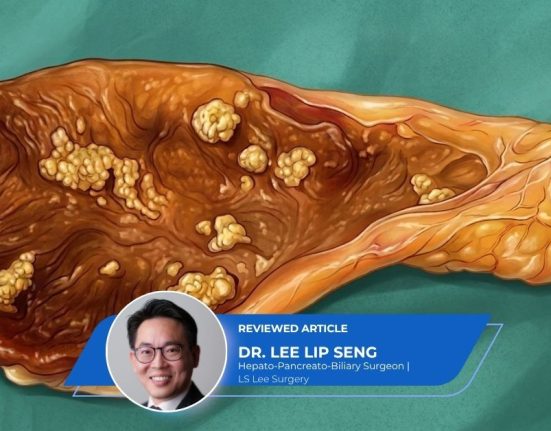

Robotic Surgery For Choledochal Cysts In Adult Patients
- March 26, 2026
- 2 minutes read
- 216 Views
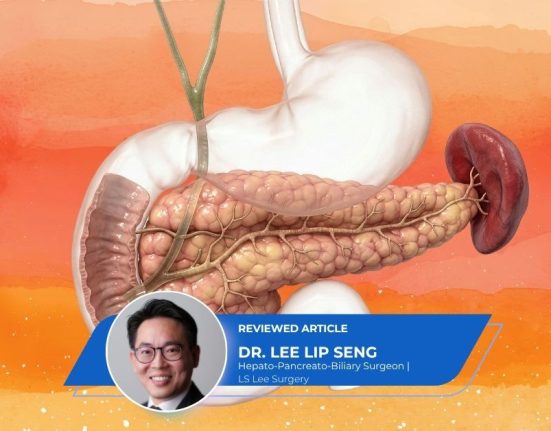
Types Of Pancreatic Cysts: Which Ones Are Dangerous?
- March 26, 2026
- 3 minutes read
- 217 Views

The Safety Of Keyhole Gallbladder Removal Surgery For Older Patients
- March 26, 2026
- 3 minutes read
- 311 Views
Interview Videos
Dr Lee Lip Seng explains the benefits and risks of laparoscopic gallstone surgery.
All content on this site is informative only and is not intended to be a substitute for professional medical advice, diagnosis, or treatment, and should never be relied upon for specific medical advice. If you are experiencing a medical emergency, call 995 immediately or go to the nearest Accident & Emergency department.
health365.sg is a member of Group 365Asia.