


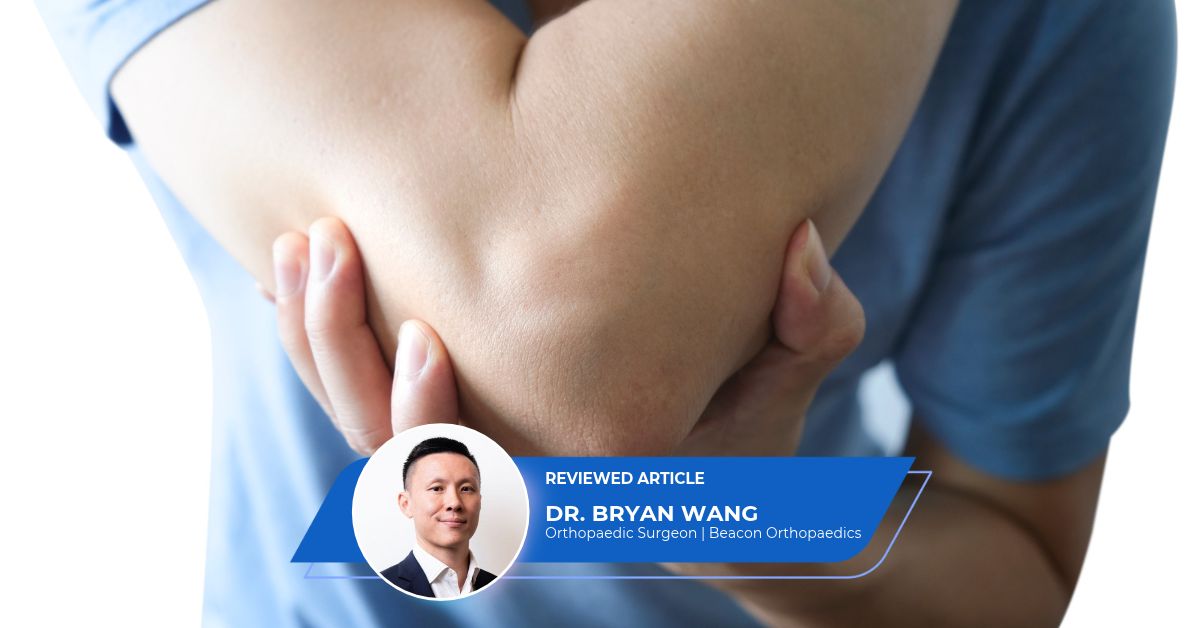
If pain on the inner side of your elbow persists despite resting or reducing your usual activities, you may wonder whether you need specialist treatment. Golfer’s elbow, medically known as medial epicondylitis or medial elbow tendinopathy, affects the tendons that attach the forearm muscles to the inner side of the elbow. Despite its name, the condition is not limited to golfers. It can affect anyone whose activities repeatedly load these tendons.
Many patients improve with non-surgical treatment. However, persistent pain, reduced grip strength or difficulty performing everyday tasks may warrant further assessment to confirm the diagnosis and review the available treatment options.
Dr Bryan Wang, an orthopaedic surgeon at Beacon Orthopaedics (at Gleneagles Hospital), explains why reducing the strain on an injured elbow is often an important first step in treatment.
Back To: Orthopaedic Care In Singapore: Upper Limbs
What Is Golfer’s Elbow?
Golfer’s elbow affects the tendons that attach the forearm muscles to the medial epicondyle, the bony prominence on the inner side of the elbow. These muscles help bend the wrist and fingers and contribute to forearm rotation.
Repeated gripping, lifting, wrist movements or certain sporting activities can place excessive stress on these tendons. Over time, the tendon may develop changes associated with persistent pain and reduced function.
Although golfers can develop the condition through repeated swinging movements, it also occurs in people who perform manual work, use tools, lift weights or carry out repetitive tasks at work.
What Are The Symptoms Of Golfer’s Elbow?
Common symptoms include:
- Pain and tenderness around the inner elbow.
- Discomfort when gripping or lifting objects.
- Pain when bending the wrist against resistance.
- Reduced grip strength because of pain.
- Symptoms that worsen during activities involving repetitive forearm movements.
Some patients also experience tingling or numbness in the ring and little fingers. These symptoms may indicate irritation of the nearby ulnar nerve and should be assessed rather than automatically attributed to golfer’s elbow.
Why Rest And Activity Modification Matter
When a tendon is repeatedly exposed to movements that aggravate it, reducing that load can help settle symptoms and support recovery. This does not necessarily mean avoiding all arm movements or stopping every physical activity.
Dr Bryan Wang explains in an interview with health365 (click here to watch: Dr Bryan Wang on elbow injuries and treatment) :
“For many elbow injuries the first line of treatment very often is rest and activity modification. I typically advise my patients to avoid the aggravating activity… we may even prescribe the patient with an elbow splint or an elbow brace to allow the elbow soft tissues to rest and recover.”
Activity modification may involve reducing repetitive gripping, temporarily changing weight-training exercises, adjusting how tools are held or modifying work tasks. An elbow splint or brace may be useful in selected cases, depending on the source of pain and the activities that trigger symptoms.
The aim is to reduce aggravating stress while maintaining suitable movement and gradually returning to normal activities. Prolonged complete rest is not necessarily helpful, and the appropriate approach depends on the individual injury.
What Treatments Can Help Persistent Golfer’s Elbow?
Physiotherapy And Progressive Exercises
Physiotherapy may help restore forearm strength, improve tolerance to loading and support a gradual return to work, exercise or sport.
A programme may include progressive strengthening exercises for the wrist and forearm, alongside guidance on activity modification and technique. Exercises should be adjusted to the severity of symptoms rather than repeatedly pushing through significant pain.
Improvement may take weeks or months, particularly when symptoms have been present for a long time.
Medication And Other Non-Surgical Treatments
Suitable pain-relief medication or anti-inflammatory treatments may help some patients manage symptoms. Their suitability depends on medical history, other medications and potential side effects.
An elbow brace or splint may also be considered to reduce stress during selected activities.
Injections and other interventions are sometimes discussed for persistent symptoms, but their benefits and limitations differ. For example, corticosteroid injections may provide short-term relief but are not necessarily a lasting solution. Platelet-rich plasma (PRP) injections are another option sometimes considered, although evidence of benefit is variable.
Your treating clinician can explain the evidence, risks, costs and alternatives before recommending an intervention.
When Should You Consider Surgery For Golfer’s Elbow?
Surgery is generally considered only when symptoms remain troublesome despite an appropriate course of non-surgical treatment and continue to interfere with daily activities, work or sport.
There is no single time limit that means every patient should proceed to surgery. The decision depends on the severity and duration of symptoms, the diagnosis, functional limitations and response to previous treatment.
Before discussing an operation, an orthopaedic surgeon will assess the elbow, review the treatment tried so far and consider whether another condition may be causing the pain. Imaging may be appropriate when the diagnosis is uncertain or when the findings could influence treatment.
What Does Golfer’s Elbow Surgery Involve?
For selected patients, surgery may involve removing damaged tendon tissue and repairing the affected tendon attachment. Depending on the case, the procedure may be performed using an open or arthroscopic technique.
The appropriate method depends on the extent and location of the tendon problem and the surgeon’s assessment. Surgery does not guarantee complete pain relief, and rehabilitation is usually needed afterwards to restore movement and progressively rebuild strength.
Patients should discuss the expected benefits, possible complications, recovery requirements and alternatives before deciding whether an operation is appropriate.
How Much Does Golfer’s Elbow Treatment Cost In Singapore?
The cost depends on the type of treatment required and where it is provided. In Singapore’s private healthcare sector, the overall expense may include specialist consultation, diagnostic imaging, physiotherapy, medication, injections and, in selected cases, surgery.
If surgery is recommended, additional charges may include the surgeon’s professional fees, anaesthetist’s fees, day surgery or hospital facility charges, surgical materials and follow-up care.
There is no single price that applies to every case. Patients can refer to the Ministry of Health’s hospital bill information and fee benchmarks for guidance on relevant procedures and typical charges. It is advisable to request an itemised estimate from the healthcare provider before proceeding.
Can Insurance Cover Golfer’s Elbow Treatment?
Depending on the policy, private medical insurance may cover eligible specialist consultations, investigations, surgery or hospitalisation. Coverage varies according to the plan, exclusions, limits and applicable terms.
An Integrated Shield Plan may provide additional coverage beyond MediShield Life, depending on the plan and treatment setting. Employer-provided medical insurance may also offer benefits, but outpatient consultations, physiotherapy and injections may be subject to different coverage rules from surgery or hospitalisation.
Before proceeding with treatment, check with your insurer whether the proposed care is covered, whether pre-authorisation is required, and whether you need to use a panel specialist or an approved facility. Ask about deductibles, co-payments, claim limits and potential out-of-pocket expenses.
For more information, see the Ministry of Health’s guide to Integrated Shield Plans.
When Should You See An Orthopaedic Surgeon?
Consider a specialist assessment if inner elbow pain persists despite activity modification, affects your grip or interferes with work, exercise or everyday tasks.
An assessment is also advisable if symptoms are worsening, the diagnosis is unclear, or you have persistent tingling, numbness or weakness in your hand.
Seek prompt medical attention if you develop severe pain following an injury, significant swelling, a hot and swollen joint with fever, or new substantial weakness or loss of sensation.
An orthopaedic assessment can help establish the likely cause of your symptoms and determine whether continued non-surgical treatment, further investigations or surgery should be considered.
Frequently Asked Questions
Recovery varies depending on the severity of the tendon problem, how long symptoms have been present and whether aggravating activities can be modified. Some patients improve over several weeks, while more persistent cases may take months. Continued pain should prompt a review of the diagnosis and treatment plan.
No. Most cases are initially managed without surgery, using activity modification, appropriate exercises and other treatments when needed. Surgery may be considered if symptoms remain functionally limiting despite an adequate course of non-surgical treatment.
No. Golfer’s elbow affects the tendons on the inner side of the elbow, whereas tennis elbow affects tendons on the outer side. Both can result from repetitive loading and may cause pain during gripping or lifting, but they involve different tendon attachments.
Arrange An Assessment
If persistent inner elbow pain is affecting your work, exercise or daily activities, an assessment can help clarify the diagnosis and identify suitable treatment options.
Dr Bryan Wang at Beacon Orthopaedics can assess your elbow symptoms and discuss an appropriate management plan based on your clinical findings and goals.
Click the button below to get assistance arranging an appointment with Dr Bryan Wang.
Contact MedicalTravel.asia
This medical content has been reviewed by Dr Bryan Wang, an experienced orthopaedic surgeon in Singapore known for his patient-centred approach, advanced minimally invasive techniques, and comprehensive management of complex shoulder conditions.
Back To: Orthopaedic Care In Singapore: Upper Limbs
All content on this site is informative only and is not intended to be a substitute for professional medical advice, diagnosis, or treatment, and should never be relied upon for specific medical advice. If you are experiencing a medical emergency, call 995 immediately or go to the nearest Accident & Emergency department.
health365.sg is a member of 365Asia.