

Health365 Guide To Gamma Knife Radiosurgery In Singapore: Treatment, Costs & MOH Benchmarks
Gamma Knife radiosurgery is a non-invasive, highly precise form of stereotactic radiosurgery (SRS) used to treat brain tumours, vascular malformations, and neurological conditions without a surgical incision. Despite its name, Gamma Knife does not involve a physical blade; instead, it uses up to 192 targeted beams of cobalt-60 gamma radiation to destroy diseased tissue while sparing surrounding healthy brain tissue.
Contact MedicalTravel.asiaBack To: Cancer Treatments Main Page
What Are The Conditions Treated With Gamma Knife?
Gamma Knife radiosurgery is indicated for both benign and malignant intracranial conditions, particularly lesions located near critical brain structures or deep within the skull base where open craniotomy poses high surgical risk.
- Brain Metastases: Secondary tumours originating from lung, breast, melanoma, or renal cancers.
- Acoustic Neuromas (Vestibular Schwannomas): Benign tumours on the cranial nerve responsible for balance and hearing. Treatment aims to control tumour growth while minimising damage to surrounding structures, including the facial and hearing nerves.
- Meningiomas: Benign tumours arising from the meninges (brain membranes), often located along the skull base or sagittal sinus.
- Arteriovenous Malformations (AVMs): Abnormal tangles of blood vessels in the brain. Radiation induces gradual thickening and closure of the abnormal vessels over 2 to 3 years.
- Trigeminal Neuralgia: A severe facial pain disorder caused by nerve compression. Radiation ablates the pain-signal pathway on the trigeminal nerve root.
- Pituitary Adenomas: Selected pituitary tumours may be treated with Gamma Knife, particularly residual or recurrent tumours following surgery. Tumours close to or compressing the optic nerves may require other treatments, including surgical decompression.
Comparison: Gamma Knife vs. Open Craniotomy vs. CyberKnife
Gamma Knife, Open Craniotomy, and CyberKnife are all options for treating brain tumours, vascular malformations, and nerve disorders. They however use entirely different methods, require different recovery times, and involve vastly different surgical risks.
1. Gamma Knife Radiosurgery
Gamma Knife is highly specialised, non-invasive stereotactic radiosurgery designed specifically and exclusively for the brain, skull base, and upper neck.
- The Method: The procedure targets intracranial lesions with extreme precision—often within a margin of error of less than 0.5 mm. To achieve this, it uses a lightweight stereotactic head frame (or a custom mask) to keep the head perfectly still. Up to 192 low-dose beams of gamma radiation are then directed at the target, converging at a single point to destroy diseased cells while sparing surrounding healthy brain tissue.
- The Process: It is commonly delivered as a single-session (one day) outpatient procedure. Depending on the condition, lesion size and proximity to critical structures, some patients may require treatment over multiple sessions. Depending on the equipment and treatment protocol, head immobilisation may use either a stereotactic frame or a custom-fitted mask. Local anaesthesia is used only for the frame attachment points, and patients do not require general anaesthesia.
- The Recovery: Many patients can return to light daily activities within a day or two, although recovery varies depending on the treatment method, underlying condition and individual response.
- Best Suited For: Deep-seated brain tumours (benign or malignant), brain metastases, arteriovenous malformations (AVMs), and trigeminal neuralgia.
2. Open Craniotomy (Traditional Brain Surgery)
An open craniotomy is an invasive surgical procedure where a neurosurgeon physically opens the skull to access the brain.
- The Method: Under general anaesthesia, the surgeon makes an incision in the scalp, removes a section of the bone (the bone flap), and uses scalpel and surgical tools to physically visualise and excise as much of the tumour or lesion as possible. The bone flap is then replaced and secured with plates and screws, and the scalp is stitched shut.
- The Process: This is a major inpatient surgery requiring 3 to 7 days in the hospital, usually starting with a night in the Intensive Care Unit (ICU) or High Dependency Unit (HDU) for close neurological monitoring.
- The Recovery: Post-operative recovery is long and intensive, typically taking 4 to 8 weeks. Patients face standard surgical risks, including infection, brain swelling, bleeding, and potential neurological deficits depending on the tumour’s location.
- Best Suited For: Very large brain tumours, rapidly progressive life-threatening mass effect, or lesions that require immediate debulking because they are causing severe pressure on the brain.
3. CyberKnife Radiosurgery
CyberKnife is a versatile, non-invasive robotic radiosurgery system that can treat tumours anywhere in the body, including the brain.
- The Method: CyberKnife uses a robotic linear accelerator and image-guidance technology to deliver stereotactic radiation from multiple angles. Depending on the treatment site, imaging systems may track patient or target movement, including respiratory motion for selected body treatments. Unlike conventional Gamma Knife systems, CyberKnife can also be used to treat selected tumours outside the brain.
- The Process: Treatment may be delivered in one or multiple sessions, depending on tumour size, location, proximity to critical structures and the prescribed radiation dose.
- The Recovery: Just like Gamma Knife, it is completely non-invasive, allowing patients to resume normal routines within 1 to 2 days without surgical recovery barriers.
- Best Suited For: Large or irregularly shaped brain tumours that are too big for a single high-dose session, tumours in the spine or other moving organs (like the lungs or prostate), or patients who cannot wear a rigid head frame.
| Feature | Gamma Knife SRS | Open Craniotomy | CyberKnife SRS |
| Invasiveness | Non-invasive (No incision) | Invasive (Surgical opening of skull) | Non-invasive (No incision) |
| Target Area | Intracranial (Brain & Skull Base) | Intracranial & Spine | Intracranial, Spine & Full Body |
| Fixation Method | Stereotactic Head Frame or Custom Mask | N/A | Mask or Real-time Image Tracking |
| Anaesthesia | Local (Frame site) + Light Sedation | General Anaesthesia | None or Light Sedation |
| Hospital Stay | Outpatient / Day Surgery | Typically several days; ICU/HDU monitoring may be required. | Outpatient |
| Recovery Period | 1 to 2 Days | 4 to 8 Weeks | 1 to 2 Days |
| Infection Risk | Minimal / Very Low | Moderate to High | Minimal / Very Low |
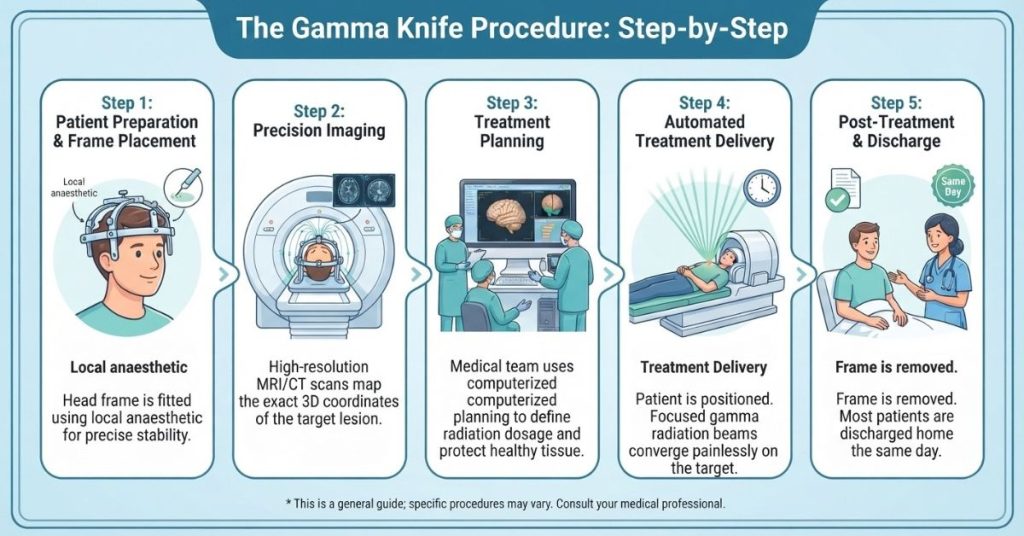
The Gamma Knife Procedure: Step-by-Step
- Patient Preparation & Frame Fitting: A lightweight stereotactic frame is secured to the head using four local anaesthetic pin sites. Alternatively, frameless mask systems are used for multi-fraction treatments.
- Precision Diagnostic Imaging: Precision Diagnostic Imaging: High-resolution MRI, CT or cerebral angiography may be performed to define the target and surrounding structures. Imaging and localisation protocols depend on whether a frame-based or mask-based treatment approach is used.
- Computerised Treatment Planning: The neurosurgeon, radiation oncologist, and medical physicist map out sub-millimeter dosage boundaries to maximise tumour coverage and protect adjacent critical structures (e.g., optic chiasm, brainstem).
- Treatment Execution: The patient lies on the automated couch, which advances into the Gamma Knife unit. Beams converge precisely on the target. The procedure is painless and silent, lasting between 30 and 90 minutes.
- Post-Treatment & Discharge: The frame is removed, pin sites are dressed, and most patients are discharged home on the same day.
Costs & Ministry of Health (MOH) Fee Benchmarks in Singapore
In Singapore, private specialist fees for stereotactic radiosurgery and complex neurosurgical interventions are guided by the Ministry of Health (MOH) Fee Benchmarks to ensure transparent pricing.
MOH Fee Benchmark Guidance for Neurosurgical Procedures
Depending on the procedure and billing by the clinic, the table of benchmark surgeon fees below may apply.
| TOSP Code | Procedure Description | MOH Benchmark Surgeon Fee | MOH Benchmark Anaesthetist Fee |
| SK817B | Brain, Various Lesions, Stereotactic Procedure – Unilateral | S$13,300 – S$18,000 | Case-dependent |
| SK711B | Brain, Various Lesions, Stereotactic Procedure – Bilateral | S$15,900 – S$22,400 | Case-dependent |
Note:
1) These are MOH benchmark fees for listed stereotactic procedures, not confirmed Gamma Knife-specific prices. Actual billing classification and fees depend on the procedure performed and the treating institution.
2) Total hospital bills include facility fees, radio-physics planning charges, MRI/CT imaging, and hospital stay charges, which are billed separately from doctor professional fees.
Financing & Insurance Eligibility in Singapore
Eligible Gamma Knife radiosurgery treatments may be claimable under MediSave and MediShield Life, subject to the applicable treatment classification, clinical indications and prevailing claim limits. From 1 June 2026, the MediShield Life claim limit for eligible outpatient radiosurgery is S$15,700 per course of treatment, while the MediSave withdrawal limit is S$3,750 per treatment.
For Integrated Shield Plans, coverage depends on the insurer, policy terms and treatment setting.
Private panel specialists can assist in securing a Letter of Guarantee (LOG) from major insurers (e.g., AIA, Great Eastern, Prudential, HSBC Life, Singlife) prior to admission.
Find A Financial Adviser
If you are looking for a financial adviser to help navigate the complexities of insurance claims and financial planner for medical contingencies, you can consider our Preferred Financial Adviser partners:




Find A Panel Doctor
Looking for a doctor on the panel of your insurance provider? The following may be useful:
Read: Health Insurance & Panel Doctor Networks
Additional Resources On Costs
- Chemotherapy and Other Costs of Cancer Treatment in Singapore
- Financial Planning For Cost Of Medical Treatment
- MediSave And Medishield Life Coverage For Overseas Singaporeans
Where To Get Gamma Knife Treatment In Singapore
Gamma Knife radiosurgery in Singapore is available through both the public healthcare system and private specialist facilities. The procedure requires specialised stereotactic equipment and a multidisciplinary team comprising neurosurgeons, radiation oncologists and medical physicists.
1. Public Restructured Hospitals
Singapore Citizens and Permanent Residents can seek Gamma Knife assessment and treatment through the public healthcare system, subject to clinical suitability and referral arrangements.
- National University Hospital (NUH): Operates a dedicated Gamma Knife Radiosurgery service under its Department of Surgery. Its multidisciplinary team includes neurosurgeons, radiation oncologists and medical physicists. Consultations are available at the NUH Medical Centre (Surgical Specialists Centre) and Kent Ridge Wing (University Surgical Centre).
- Ng Teng Fong General Hospital (NTFGH): Its Neurosurgery Department lists Gamma Knife radiosurgery among its services. Patients should check with the hospital regarding the location of the actual treatment facility.
- Alexandra Hospital (AH): Provides neurosurgical consultations and treatment planning for patients requiring Gamma Knife radiosurgery. However, AH specifies that these procedures are currently performed at NUH.
Note: Singapore Citizens and Permanent Residents may qualify for subsidised Specialist Outpatient Clinic care through eligible referral routes. Singapore Citizens can obtain subsidised referrals through polyclinics, while eligible CHAS, Merdeka Generation and Pioneer Generation cardholders may also obtain referrals through participating CHAS GP clinics. Permanent Residents can obtain subsidised referrals through polyclinics. Subsidies are subject to eligibility and means-testing.
2. Private Hospitals & Specialist Centres
For patients who prefer private specialist consultations, direct doctor selection or greater flexibility in scheduling, Gamma Knife treatment is also available at:
- Mount Elizabeth Novena Hospital (Parkway Gamma Knife Centre): Houses Singapore’s private Parkway Gamma Knife Centre, a dedicated facility for stereotactic radiosurgery. Patients can consult private neurosurgeons and radiation oncologists to determine their suitability for treatment and discuss the available treatment arrangements.
Public vs. Private Treatment Pathways
| Factor | Public Restructured Hospitals (e.g. NUH) | Private Hospitals (e.g. Mount Elizabeth Novena) |
|---|---|---|
| Access & Referrals | Referral through eligible public healthcare pathways for subsidised care. | Patients can generally make direct appointments with private specialists. |
| Waiting Time | Waiting times depend on clinical urgency, specialist availability and treatment requirements. | Scheduling may offer greater flexibility, depending on specialist and facility availability. |
| Doctor Selection | Subsidised patients generally receive team-based care under an assigned specialist. | Patients generally have greater flexibility in selecting their specialist. |
| Financing & Insurance | Government subsidies for eligible patients, MediSave and MediShield Life, subject to prevailing claim limits and eligibility. | MediSave and MediShield Life may apply to eligible treatments, subject to claim limits and applicable restrictions. Integrated Shield Plans and corporate insurance may provide additional coverage, depending on policy terms. |
Important: MediShield Life coverage for eligible outpatient radiosurgery, including Gamma Knife treatment, was expanded with effect from 1 June 2026. Eligible patients can claim up to S$15,700 per course of treatment under MediShield Life, while MediSave withdrawals are subject to a limit of S$3,750 per treatment. Actual reimbursement depends on eligibility, treatment classification and applicable claim conditions.
Who Can Perform Gamma Knife Radiosurgery?
Performing Gamma Knife radiosurgery is not the job of a single doctor but rather the responsibility of a highly specialised, multidisciplinary team. Because the procedure combines complex neurosurgery with advanced radiation physics, safety and success depend on the close collaboration of three core experts working in concert.
In Singapore, these teams are typically based at major neurosurgical hubs in both public restructured hospitals and private specialist centres.
The Gamma Knife Team
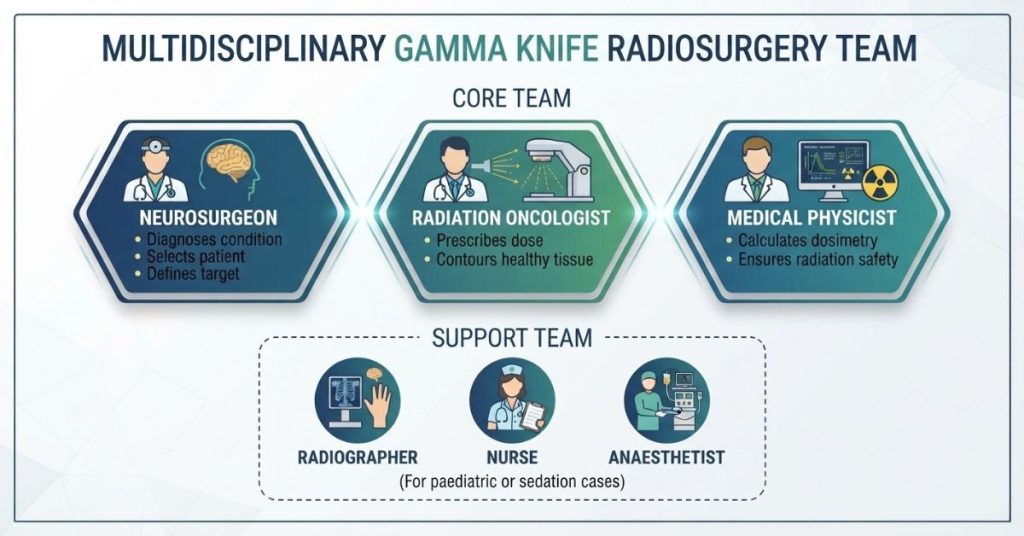
Every patient undergoing Gamma Knife treatment is managed by a team comprising a neurosurgeon, a radiation oncologist, and a medical physicist. Each member plays a distinct and vital role in the process.
1. Neurosurgeon
The neurosurgeon is the primary physician responsible for the patient’s overall care pathway.
- Role in Gamma Knife: The neurosurgeon determines if Gamma Knife radiosurgery is the most appropriate treatment for the patient’s specific condition (e.g., a brain tumour or AVM) compared to conventional open surgery.
- Specific Responsibilities: They are responsible for identifying and delineating the exact anatomical target within the brain that needs to be treated. During the procedure itself, the neurosurgeon is present to oversee the fitting of the stereotactic head frame or mask, ensuring precise anatomical localisation.
2. Radiation Oncologist
The radiation oncologist is a specialist in using radiation to treat medical conditions.
- Role in Gamma Knife: While the neurosurgeon focuses on where to treat, the radiation oncologist focuses on how much radiation to deliver. They work closely with the neurosurgeon and physicist to develop the treatment plan.
- Specific Responsibilities: They prescribe the radiation dose required to destroy the diseased tissue while ensuring that the dose to surrounding healthy brain structures remains within safe limits (a process called “contouring”).
3. Medical Physicist
The medical physicist is an expert in the physics of radiation.
- Role in Gamma Knife: The physicist is the guardian of the technology and safety. They are responsible for the technical execution of the treatment plan.
- Specific Responsibilities: They perform complex computer calculations (dosimetry) to translate the radiation dose prescribed by the oncologist into a workable plan that the Gamma Knife machine can deliver. They also conduct rigorous quality assurance checks on the equipment before treatment to ensure absolute accuracy and patient safety.
Specialist Accreditation and Training
Neurosurgeons and radiation oncologists involved in Gamma Knife treatment should have relevant specialist qualifications and specific training and experience in stereotactic radiosurgery. The multidisciplinary team should also include appropriately trained medical physicists.
Regular conferences and workshops, such as those hosted by the Asian Leksell Gamma Knife Society, serve as platforms for local specialists to exchange knowledge and maintain international standards of practice.
Frequently Asked Questions
Gamma Knife treatment has demonstrated good tumour control rates for several intracranial conditions. However, outcomes vary according to the condition being treated, tumour size and location, treatment dose and individual patient factors. Your specialist can explain the expected benefits and risks based on your diagnosis.
The radiation delivery itself is entirely painless. Patients experience mild pressure during the application of the local anaesthetic for the head frame pins, which subsides quickly.
Most patients return to work and light daily routines within 24 to 48 hours post-procedure, avoiding heavy physical exertion for 3 to 5 days to allow head frame pin sites to heal.
Gamma Knife radiosurgery may be covered under MediSave and MediShield Life, subject to the applicable outpatient radiosurgery or surgical claim rules, clinical indications and prevailing limits. Integrated Shield Plan coverage depends on the insurer, policy terms and treatment setting. Patients should confirm their coverage with the treating hospital and insurer before proceeding.
Click For An Appointment With A Gamma Knife Radiosurgery Specialist
If you require assistance for an appointment with a specialist for gamma knife radiosurgery or for cancer treatment, click the button below
Contact MedicalTravel.asiaBack To: Cancer Treatments Main Page