

Early Colorectal Cancer Detection – The Big Story

Early Colorectal Cancer Detection – The Critical Path To Survival
Colorectal cancer remains a significant health challenge in Singapore, consistently ranking as one of the most common cancers for both men and women. While the diagnosis may be daunting, the data reveals a clear message: Early colorectal cancer detection is the single most important factor in improving treatment outcomes and saving lives.
The Impact Of Colorectal Cancer In Singapore - The Statistics
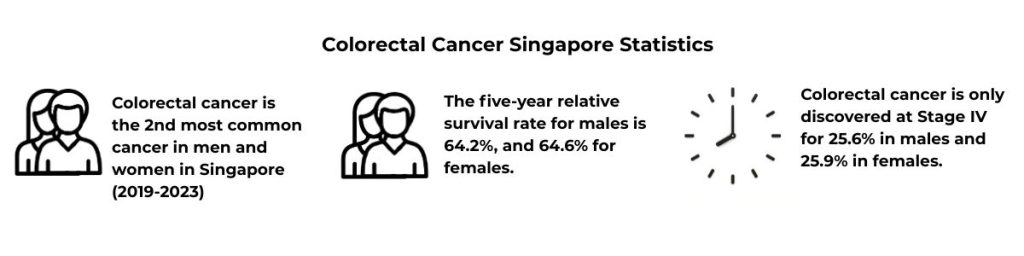
According to the Singapore Cancer Registry Annual Report 2023, colorectal cancer is the second most frequent incident cancer in males, accounting for 15.8% of all male cancer cases between 2019 and 2023. For females, it ranks as the second most common cancer, representing 12.8% of cases in the same period.
The statistics underscore the prevalence of the disease:
- Incidence in Males: 7,101 new cases were recorded between 2019 and 2023.
- Incidence in Females: 6,211 new cases were recorded during the same timeframe.
- Lifetime Risk: Approximately 1 in 23 males and 1 in 30 females in Singapore will develop colorectal cancer in their lifetime.
Why Early Colorectal Cancer Detection Matters
The stage at which the cancer is diagnosed significantly influences the Five-Year Age-Standardised Relative Survival (ASRS) rate. When colorectal cancer is detected early (Stage I), the chances of survival are substantially higher compared to advanced stages.
For the period of 2019–2023, the survival data for colorectal cancer in Singapore shows:
- Overall Survival: The five-year relative survival rate for males stands at 64.2% and 64.6% for females.
- The Survival Gap: Patients diagnosed at Stage IV face a much more difficult prognosis than those whose cancer is caught at Stage I or II.
In the most recent reporting period (2019–2023), approximately 20.1% of colorectal cancer cases in males and 19.4% in females were diagnosed at Stage I. Conversely, a significant portion of cases—25.6% in males and 25.9% in females—were only discovered at Stage IV. This highlights a critical need for increased participation in early colorectal cancer detection programmes.
Recognising The Symptoms Of Colorectal Cancer
While colorectal cancer often begins as asymptomatic polyps, individuals should be vigilant for persistent changes in bowel habits or other warning signs, including:
- Blood in the stool (either bright red or very dark).
- Persistent abdominal discomfort, such as cramps or gas pain.
- A feeling that the bowel does not empty completely.
- Unexplained weight loss or fatigue.
Screening For Early Colorectal Cancer Detection
In Singapore, the Health Promotion Board encourages regular screening for individuals aged 50 and above, or earlier for those with a family history of the disease. Screening is the primary tool for early colorectal cancer detection and can involve:
- Faecal Immunochemical Test (FIT): A simple, non-invasive test that detects trace amounts of blood in the stool. This should be performed annually.
- Colonoscopy: A more comprehensive procedure that allows a doctor to examine the entire colon and remove any pre-cancerous polyps before they develop into cancer.
Learn More About Colorectal Cancer And Early Detection
Find The Best Colorectal Surgeon In Singapore
When it comes to your colorectal health, you naturally would like to find the best colorectal surgeon in Singapore. Find out how and get a head start from our article on Finding The Best Colorectal Surgeon In Singapore.
Comment: The row below to be moved to article for healthcare professionals article
Find A Doctor
Verified Healthcare Professionals
We connect you with a network of qualified and experienced doctors who specialise in chronic health conditions, health screening, and longevity.
Trusted Information Source
We pride ourselves on providing accurate, up-to-date, and evidence-based information about each disease, its prevention, and treatment.
Privacy and Security
Your health information and personal data are paramount to us. We will protect your privacy throughout the booking process and beyond.
Convenience at Your Fingertips
Our user-friendly platform allows you to find and book appointments 24/7 from the comfort of your home.
Our Preferred Doctor You Can Consider For Colorectal Cancer Screening
- Dr Juanda Leo Hartono is a Gastroenterologist in Singapore with extensive training in inflammatory bowel disease, colorectal cancer and advanced endoscopy. Patients benefit from his evidence-based care and deep understanding of complex gastrointestinal and liver conditions.
- Dr Henry Tan Chor Lip is a Senior Consultant General Surgeon in Johor who provides gastrointestinal endoscopy services for the screening and early detection of colorectal cancer. With extensive experience in both public and private practice, he routinely performs colonic endoscopies and surgeries to manage various colorectal conditions.

Powered by Find by 365Asia



[SG] Featured Doctor- Dr Kevin Koo
Orthopaedic Surgeon In Singapore
Early colonoscopy saves lives, and enables detection * prompt removal of pre-malignant polyps.
Dr Henry Tan
Book An Appointment
Take a proactive step for your health and peace of mind today. If you need to see a doctor about colorectal cancer detection, our team is here to assist.
Financials
[findDoctor category="financial consultants" countries="Singapore" " limit="15"]
Related Content





FAQs - Test Your Knowledge About Early Colorectal Cancer Detection
Early detection is the most critical factor in surviving colorectal cancer. The survival rate is significantly higher when the cancer is diagnosed at an early stage compared to when it has spread to distant organs. Early detection often means that the cancer is more manageable and may require less aggressive treatment.
For individuals with an average risk and no symptoms, the Health Promotion Board recommends starting regular screening at the age of 50. However, if you have a family history of colorectal cancer or polyps, or if you suffer from inflammatory bowel disease, you should consult a doctor about starting early colorectal cancer detection screenings at an earlier age.
Yes, and this is the primary goal of screening. Many early-stage colorectal cancers or pre-cancerous polyps do not cause any pain or visible symptoms. Methods such as the Faecal Immunochemical Test (FIT) or a colonoscopy are designed to find these hidden issues, allowing for medical intervention before the condition progresses.
No, polyps are growths on the inner lining of the colon or rectum that are not yet cancerous. However, some types of polyps can develop into cancer over time. The benefit of early colorectal cancer detection through colonoscopy is that these polyps can often be removed during the procedure itself, effectively preventing the cancer from developing in the first place.
Both tests are effective tools for early colorectal cancer detection, but they serve different roles in a screening strategy. A FIT test is a non-invasive, annual stool test that is highly convenient for regular monitoring. In contrast, a colonoscopy is a more comprehensive procedure performed every ten years that allows a doctor to both detect and remove pre-cancerous polyps during the same session.
If your FIT result is positive, you will be advised to undergo a colonoscopy to investigate the cause of the blood in your stool. Ultimately, the choice often depends on your personal health risk profile and preference for a yearly home-based test versus a more definitive clinical procedure performed less frequently.
Additional Resources
- Guide To Preparing For A Colonoscopy | Juanda Leo Gastroenterology Liver Clinic
- More younger adults diagnosed with early-onset colorectal cancer in Singapore | National Cancer Centre Singapore
- Study Identifies Potential Warning Signs of Colorectal Cancer in Younger Adults | National Cancer Institute, USA
- Early onset colorectal cancer | The BMJ
- Reducing Risk for Colorectal Cancer | U.S. Centers For Disease Control & Prevention
.