

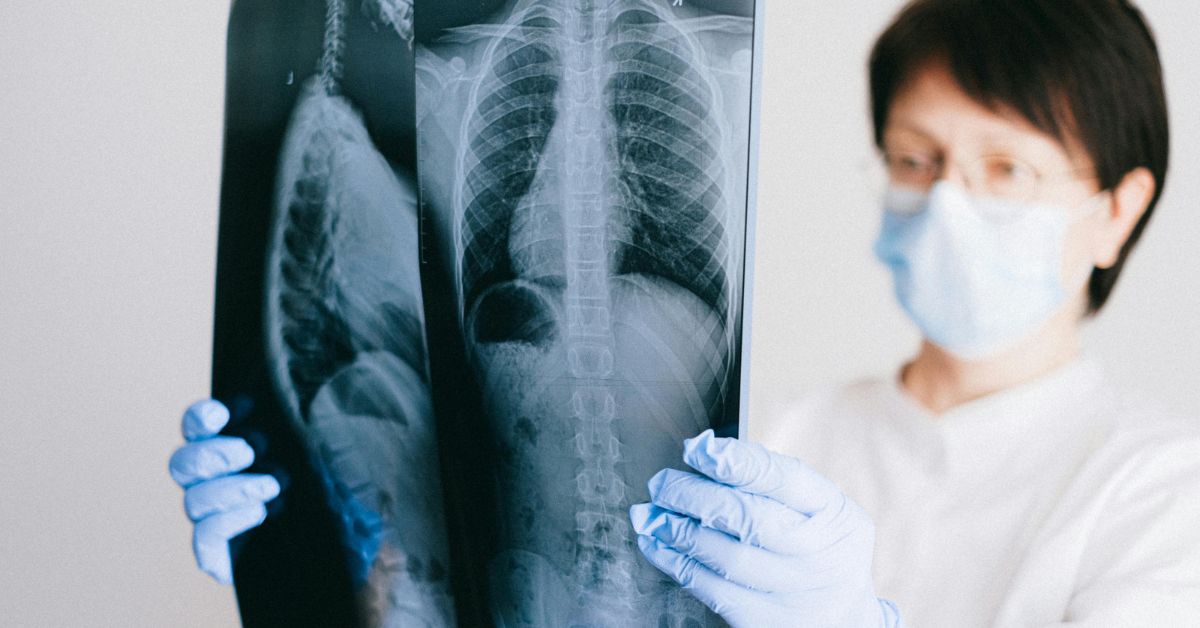
When your doctor orders an X-ray, Ultrasound, CT scan, or MRI, a medical expert works behind the scenes to analyse those images and provide an accurate diagnosis. That expert is a diagnostic radiologist.
While all radiologists are fully qualified medical doctors, their training, clinical focus, and mastery over specific imaging technologies vary significantly. Understanding these differences can help you better navigate your healthcare journey in Singapore.
Back To: Medical Imaging Main Page
Quick Summary: Radiologist Qualifications At A Glance
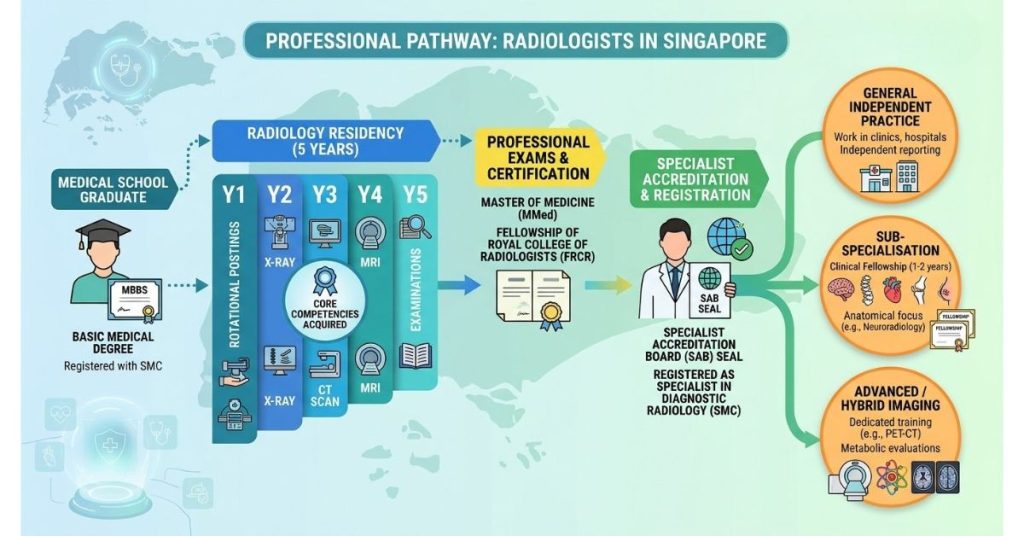
- Baseline Accreditation: Every specialist radiologist in Singapore must complete a 5-year residency and pass national examinations (MMed, FRCR) governed by the Specialists Accreditation Board (SAB) and registered under the Singapore Medical Council (SMC) Register of Specialists.
- Core Modalities: All accredited diagnostic radiologists are trained to protocol and report general X-rays, Ultrasounds, Computed Tomography (CT), and Magnetic Resonance Imaging (MRI).
- Advanced & Hybrid Imaging: Scans involving nuclear metabolic tracers (such as PET-CT or PET-MRI) require post-residency subspecialisation or dual accreditation in Nuclear Medicine.
- Organ-Specific Subspecialisation: Complex cases (e.g., heart blockages, brain aneurysms, joint tears) are routinely directed to radiologists who have completed 1 to 2 years of post-doctoral fellowship training in specific body regions.
1. The Foundation: Basic Certification In Diagnostic Radiology
In Singapore, a medical practitioner cannot simply acquire imaging equipment and style themselves as a radiologist. Diagnostic radiology is a strictly regulated specialty overseen by the Ministry of Health (MOH), the Specialists Accreditation Board (SAB), and the College of Radiologists, Singapore.
To attain official status as a certified diagnostic radiologist, a doctor must complete a comprehensive postgraduate pathway:
- Basic Medical Degree: Graduate with a recognised Bachelor of Medicine, Bachelor of Surgery (MBBS or equivalent) registered with the Singapore Medical Council.
- 5-Year Specialist Residency: Complete 60 months of structured specialist residency training across Singapore’s public healthcare clusters (SingHealth, NHG, or NUHS).
- Mastery Examinations: Pass advanced postgraduate assessments, including the Master of Medicine (MMed) in Diagnostic Radiology from the National University of Singapore (NUS) and the Fellowship of the Royal College of Radiologists (FRCR) from the UK.
- Specialist Board Registration: Receive official accreditation from the SAB and entry onto the SMC Register of Specialists.
This standard certification guarantees that every specialist radiologist in Singapore possesses the expertise required to interpret baseline diagnostic imaging safely and accurately.
2. How Radiologists Master Different Imaging Technologies
Patients frequently inquire whether a radiologist requires distinct licences to operate separate imaging machines, such as CT, MRI, or PET scanners.
The distinction relies on core diagnostic modalities versus advanced hybrid technologies:
- Core Equipment (X-Ray, Ultrasound, CT, MRI): Every board-certified diagnostic radiologist in Singapore completes extensive rotation-based clinical training across these modalities throughout their 5-year residency. They are fully certified to protocol, review, and report scans produced by these devices.
- Advanced Nuclear & Hybrid Imaging (PET-CT, PET-MRI): Positron Emission Tomography (PET) measures cellular metabolic activity alongside structural anatomy. Interpreting these complex hybrid scans typically demands targeted post-residency fellowship training or dual accreditation in both Diagnostic Radiology and Nuclear Medicine. Radiologists evaluating PET scans often maintain specialised board credentials, such as certification from the Certification Board of Nuclear Cardiology (CBNC) or subspecialty recognition from the SAB.
3. Anatomical Subspecialisation: Matching Experts To Clinical Conditions
While a general diagnostic radiologist is qualified to evaluate scans across the entire body, modern clinical practice relies heavily on subspecialists. These are radiologists who focus on a single organ system to identify fine subtleties in complex diseases.
Following their initial 5-year residency, many radiologists complete 1 to 2 years of clinical fellowship training at tertiary academic centres in Singapore or renowned international institutions (such as Harvard Medical School or Royal Brompton Hospital).
Common radiology subspecialties in Singapore include:
| Subspecialty Focus | Key Modalities Used | Clinical Conditions Diagnosed |
| Cardiothoracic / Cardiac Radiology | Cardiac CT, CT Angiography, Cardiac MRI | Coronary artery disease, structural heart defects, myocardial tissue viability, heart failure. |
| Musculoskeletal (MSK) Radiology | High-Field MRI, Ultrasound, CT | Cartilage damage, tendon/ligament tears, sports injuries, degenerative spine conditions. |
| Neuroradiology | Brain & Spine MRI, CT Angiography | Acute stroke, brain aneurysms, neurodegenerative disorders (dementia), head and neck tumours. |
| Breast & Women’s Radiology | Digital Mammography, Breast MRI, Ultrasound | Early-stage breast cancer screening, dense tissue evaluations, image-guided biopsies. |
| Interventional Radiology | Angiography, Fluoroscopy, CT Guidance | Minimally invasive image-guided treatments, vascular stenting, uterine fibroid embolisation, tumour ablation. |
Frequently Asked Questions (FAQ)
You can verify a doctor’s credentials directly through the Singapore Medical Council (SMC) Search for Registered Doctors. Look for their entry under the Register of Specialists to confirm their accreditation in Diagnostic Radiology or Nuclear Medicine.
For routine health screenings or standard X-rays, any board-certified diagnostic radiologist is fully qualified to interpret the results. However, if your referring physician or specialist is evaluating a complex condition, such as a suspected coronary artery blockage or an intricate spinal cord issue, they will typically request that your scan be reported by a radiologist with specific fellowship training in that anatomical discipline.
No, diagnostic radiology services in Singapore typically require a medical referral. To undergo specialised scans such as an MRI or CT, you must first consult a primary care physician (GP) or specialist who will assess your condition and issue a clinical referral based on their findings. The radiologist uses this referral to determine the appropriate scanning protocol and to interpret the results accurately in the context of your medical history.
Preferred Centre For Medical Imaging
If you are looking for a medical centre for doing your medical imaging, you can consider AsiaMedic, our Preferred Medical Centre partner.
- Located at Shaw House on Orchard Road, AsiaMedic offers executive health screening and diagnostic imaging. Focused on proactive preventive care and early cancer detection, it leverages advanced diagnostic technology to deliver comprehensive, timely health insights.


[SG] Featured Doctor- Dr Diana Chan
Back To: Medical Imaging Main Page
All content on this site is informative only and is not intended to be a substitute for professional medical advice, diagnosis, or treatment, and should never be relied upon for specific medical advice. If you are experiencing a medical emergency, call 995 immediately or go to the nearest Accident & Emergency department.
health365.sg is a member of 365Asia.