

The Hidden Cost Of Hybrid Fitness: Understanding Knee And Ankle Stress In HYROX Training – The Big Story

The Hidden Cost Of Hybrid Fitness: Understanding Knee And Ankle Stress In HYROX Training
Hybrid fitness racing combines endurance running with high-load functional workouts, placing unique cumulative demands on the lower limbs. Find out how HYROX athletes and everyday fitness enthusiasts can recognise early knee and ankle stress before it progresses into structural injury.
TL;DR: Key Takeaways On Knee And Ankle Stress In HYROX Training
- Dual Mechanical Load: HYROX combines eight kilometres of running with eight heavy functional stations—such as sled pushes, sandbag lunges, wall balls, and burpee broad jumps—subjecting knees and ankles to repetitive impact followed immediately by loaded movements under fatigue.
- Subtle Early Warning Signs: Joint instability on uneven surfaces, morning Achilles stiffness, knee clicking, and mild swelling 24 hours after training typically appear months before persistent pain during daily walking.
- Conservative Care Comes First: Early-stage tendon overload, mild ligament laxity, and joint irritation are frequently managed without surgery through structured physiotherapy, load management, footwear adjustments, and non-invasive therapies.
- Minimally Invasive Options Exist For Structural Tears: When menisci, articular cartilage, or ankle ligaments sustain full-thickness structural damage, arthroscopic (keyhole) surgery allows targeted repair through small incisions to support functional recovery.
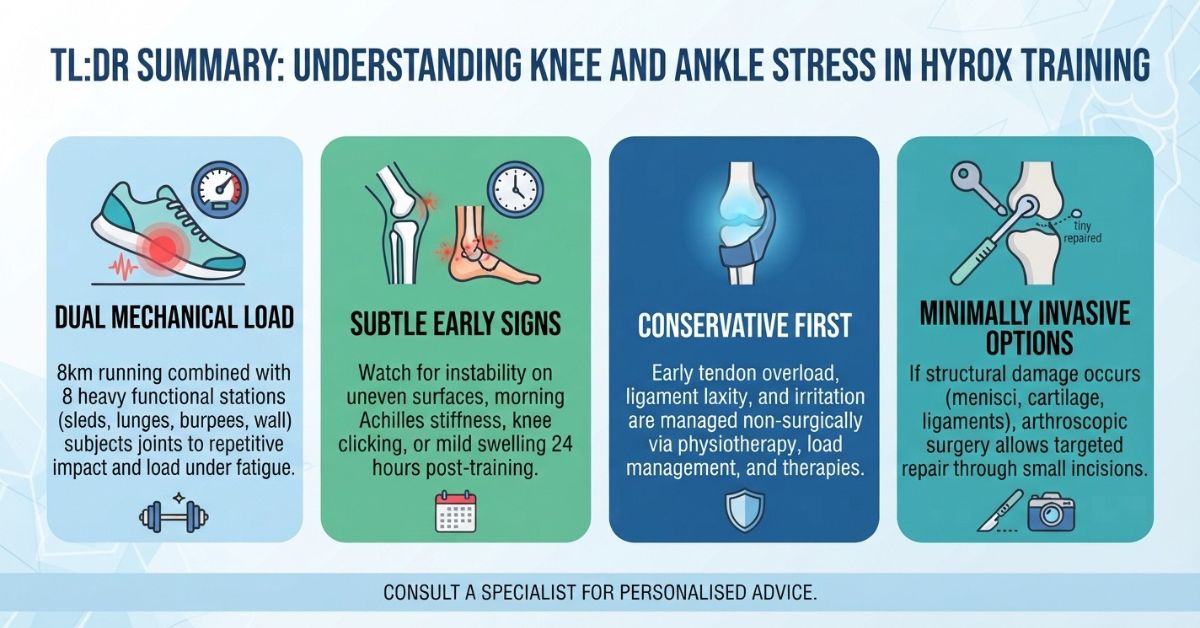
Click to expand infographic.
The Paradox Of Hybrid Fitness And HYROX Training
Across Singapore, hybrid fitness competitions such as HYROX have attracted thousands of participants—from seasoned runners to working professionals seeking structured, goal-oriented training. Unlike traditional endurance races or isolated gym workouts, HYROX alternates eight one-kilometre runs with eight functional exercise stations, including heavy sled pushes and pulls, burpee broad jumps, rowing, farmer’s carries, weighted sandbag lunges, and wall balls.
While hybrid training builds cardiovascular capacity and muscular endurance, it also exposes the lower limbs to a distinct biomechanical challenge. Every running stride places forces equivalent to three to five times a person’s body weight across the knee and ankle joints. In a HYROX setting, athletes transition immediately from high-rep impact running into heavy squats, deep lunges, and explosive jumps while muscles are already fatigued—reducing muscular shock absorption and transferring higher mechanical loads directly onto joint cartilage, tendons, and ligaments.
Dr Kevin Koo, Senior Consultant Orthopaedic Surgeon at The Bone & Joint Centre (BJC), routinely evaluates recreational athletes, runners, and hybrid fitness participants experiencing lower-limb wear and tear. Having previously served as Director of the Foot and Ankle Service at Singapore General Hospital and completed subspecialty fellowship training in sports and dance injuries in the United Kingdom, Dr Koo helps active individuals identify and manage cumulative joint overload early so they can continue training safely.

Powered by Find by 365Asia


[SG] Featured Doctor- Dr Kevin Koo
Orthopaedic Surgeon & Sports Injury Specialist
"HYROX challenges the lower limbs in two ways at once: kilometres of repetitive running impact paired with heavy functional movements performed under fatigue. When athletes push through early ankle instability or knee swelling between training blocks, minor tissue overload can quietly progress into structural tendon, meniscus, or cartilage injury."
- Dr Kevin Koo, Senior Consultant Orthopaedic Surgeon, The Bone & Joint Centre
How HYROX Training And Cumulative Stress Affect The Lower Limb
The ankle and knee perform distinct mechanical functions during running and weighted functional stations. Understanding how repetitive load accumulates across both joints helps athletes distinguish normal post-training muscle soreness from early structural stress.
| Joint & Biomechanical Role | How HYROX & Hybrid Training Builds Up Stress | Early Warning Signs (Often Ignored) | What Happens If Left Untreated |
The Ankle (Your Shock Absorber & Force Transfer Base) | Eight kilometres of cumulative running impact, explosive landings during burpee broad jumps, heavy calf loading during sled pushes, and previous ankle sprains that stretched lateral ligaments without complete balance rehabilitation. | • Feeling unstable on stairs, kerbs, or uneven ground • Morning stiffness along the Achilles tendon or heel • Dull ache along the outer ankle after run-station intervals | Chronic Ankle Instability & Tendinopathy—leading to recurrent ankle sprains, cartilage bruising (osteochondral lesions), Achilles degeneration, and early ankle arthritis. |
The Knee (Your Pivot & Power Hinge) | High-repetition deep knee flexion under load during sandbag lunges and wall balls, abrupt transitions from running to heavy sled resistance, and hip or gluteal fatigue shifting excess shearing force onto the patellofemoral joint and meniscus. | • Clicking, catching, or brief “locking” sensations • Mild joint swelling or tightness 24 hours after a session • Sharp pain around the kneecap when descending stairs or squatting | Degenerative Meniscus Tears & Patellofemoral Cartilage Wear—accelerating joint surface breakdown and restricting both training and daily walking. |
The Modern Recovery Spectrum: Matching Treatment To Stress Level
Consulting an orthopaedic specialist does not automatically mean undergoing surgery. In sports and joint orthopaedics, management is matched to the biological stage of tissue stress, prioritising conservative, joint-preserving care whenever structurally appropriate.
Stage 1: Early Overload (Inflammation And Micro-Strain)
When clinical examination and diagnostic imaging indicate tendon inflammation (such as Achilles or patellar tendinopathy), mild ligament laxity, or early cartilage irritation without full-thickness structural tears, non-surgical management forms the primary approach:
- Targeted Physiotherapy & Load Modification: Strengthening the kinetic chain—including the glutes, quadriceps, calves, and intrinsic foot muscles—improves load absorption during fatigued running and lunges while temporarily adjusting training volume to let irritated tissues settle.
- Gait, Footwear & Movement Assessment: Evaluating running biomechanics and selecting footwear that balances cushioning for running with lateral stability for sled pushes and wall balls helps reduce asymmetrical joint strain.
- Non-Invasive & Regenerative Adjuncts: Depending on the clinical diagnosis, treatments such as Extracorporeal Shockwave Therapy (ESWT) or Platelet-Rich Plasma (PRP) injections may be considered alongside structured rehabilitation to support tendon and soft-tissue recovery.
Stage 2: Structural Damage (Torn Ligaments, Meniscus, Or Cartilage)
If mechanical symptoms such as persistent knee locking, recurrent ankle giving-way, or confirmed structural tears fail to improve with structured conservative therapy, surgical options may be discussed:
- Minimally Invasive (Arthroscopic) Surgery: Using a miniature fibre-optic camera and precision instruments inserted through small keyhole incisions, surgeons can repair chronically stretched lateral ankle ligaments (such as an arthroscopic Broström-Gould procedure) or trim and repair damaged knee meniscal tissue and focal cartilage defects. Minimally invasive techniques minimise disruption to surrounding healthy muscle and soft tissue, supporting a structured return to daily mobility and sport.
4-Point Joint Longevity Check For Hybrid Athletes
Separate High-Impact And Heavy-Load Days Where Possible: Pairing maximum-effort distance runs with heavy weighted lunges in every session compounds lower-limb stress. Rotate intense hybrid simulations with low-impact aerobic conditioning such as cycling, swimming, or SkiErg intervals.
Respect Post-Workout Joint Swelling: Unlike general thigh or calf muscle tightness, localised puffiness around the knee cap or outer ankle signals internal joint irritation. Treat swelling as a cue to deload and evaluate rather than pushing through a race taper.
Rebuild Balance After Any Ankle Roll: Even a minor ankle twist during a trail run or jump compromises proprioception—the joint’s balance and position sensors—increasing the risk of repeat sprains under fatigue unless dedicated single-leg balance work is completed.
Seek Diagnostic Clarity Early: A clinical orthopaedic examination, supported by targeted ultrasound or MRI when clinically indicated, identifies whether discomfort stems from treatable tendon overload or an underlying structural tear.
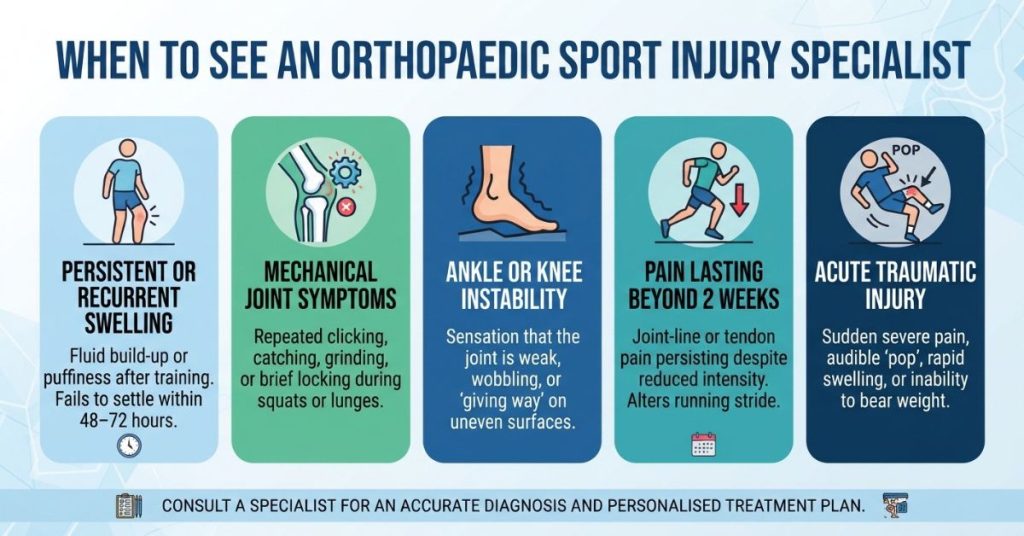
When To See An Orthopaedic Sport Injury Specialist
While temporary muscle soreness (delayed onset muscle soreness, or DOMS) is expected after demanding hybrid workouts, certain clinical signs warrant evaluation by an orthopaedic specialist to prevent minor overload from progressing into long-term joint damage.
Consider scheduling an assessment if you notice:
- Persistent Or Recurrent Swelling: Fluid build-up or puffiness around the knee or ankle that appears after training sessions and fails to settle within 48 to 72 hours of rest and elevation.
- Mechanical Joint Symptoms: Repeated clicking, catching, grinding, or brief locking of the knee during squats, lunges, or daily stair climbing, which may indicate a meniscal tear or loose cartilage fragment.
- Ankle Or Knee Instability: A sensation that the joint is weak, wobbling, or “giving way” on uneven pavements or during lateral movements.
- Pain Lasting Beyond Two Weeks: Joint-line or tendon pain that persists for more than two weeks despite reducing training intensity, or pain that forces you to alter your running stride.
- Acute Traumatic Injury: Sudden severe pain, an audible “pop,” rapid swelling, or inability to bear weight following a fall, awkward jump landing, or heavy lift.
Our Preferred Doctor You Can Consider For Investigation And Treatment Of Sports Injuries
Dr Kevin Koo is a Senior Consultant Orthopaedic Surgeon practising at The Bone & Joint Centre, located at Mount Elizabeth Medical Centre (Orchard). His clinical practice encompasses minimally invasive foot, ankle, and knee surgery, sports injury management, and joint preservation. He is accredited across major Integrated Shield Plan insurer panels in Singapore, including Prudential, Great Eastern, Singlife, and HSBC Life. Dr Koo is also himself a HYROX athelete.
Articles Reviewed By Dr Kevin Koo

Get An Appointment For A Consultation With A Sports Injury Orthopaedic Specialist
Not sure if your post-training knee or ankle ache is normal workout fatigue or an early sign of cumulative joint stress? Click the button below to schedule a consultation.
Find A Doctor
Verified Healthcare Professionals
We connect you with a network of qualified and experienced doctors who specialise in chronic health conditions, health screening, and longevity.
Trusted Information Source
We pride ourselves on providing accurate, up-to-date, and evidence-based information about each disease, its prevention, and treatment.
Privacy and Security
Your health information and personal data are paramount to us. We will protect your privacy throughout the booking process and beyond.
Convenience at Your Fingertips
Our user-friendly platform allows you to find and book appointments 24/7 from the comfort of your home.
Additional Resources
Frequently Asked Questions (FAQs)
1. Is It Safe To Continue HYROX Training With Mild Knee Or Ankle Pain?
It depends on the location and behaviour of the discomfort. Generalised muscle fatigue in the thighs or calves that eases within 48 hours is a normal response to training. However, sharp pain directly over the joint line, tendon stiffness that worsens during a run, or discomfort that causes you to limp or alter your squat depth should not be ignored. Continuing high-impact running or weighted lunges through joint pain can turn manageable tissue inflammation into a meniscus tear or stress injury. Modifying high-impact stations and seeking a clinical evaluation is advisable if symptoms persist beyond two weeks.
2. What Non-Surgical Treatments Are Available For Chronic Ankle Instability Or Achilles Tendon Pain?
Most cases of early Achilles tendinopathy and mild ankle ligament laxity respond well to structured non-surgical care. Management typically begins with targeted physiotherapy focusing on eccentric calf strengthening, peroneal muscle conditioning, and proprioceptive balance training to stabilise the ankle during running and sled pushes. Supportive footwear, temporary activity modification, and non-invasive modalities such as Extracorporeal Shockwave Therapy (ESWT) or Platelet-Rich Plasma (PRP) injections may also be discussed depending on ultrasound or MRI findings.
3. How Does Minimally Invasive Arthroscopic Surgery Support Recovery For Structural Knee Or Ankle Injuries?
When imaging confirms a structural issue—such as a displaced meniscus tear, focal cartilage lesion, or chronically torn lateral ankle ligaments that continue to give way despite rehabilitation—arthroscopic (keyhole) surgery allows the surgeon to repair or address the damaged tissue through small incisions using a miniature camera. Because surrounding healthy muscles and tendons are preserved rather than widely incised, patients generally experience less post-operative soft-tissue trauma, allowing structured physiotherapy and progressive weight-bearing to begin earlier under medical guidance.