

Elbow Pain: Understanding Tennis Elbow And Golfer’s Elbow – The Big Story

Elbow Pain: Understanding Tennis Elbow And Golfer's Elbow
TL;DR: Managing Elbow Pain - Understanding Tennis Elbow, Golfer’s Elbow, And Modern Treatment Pathways
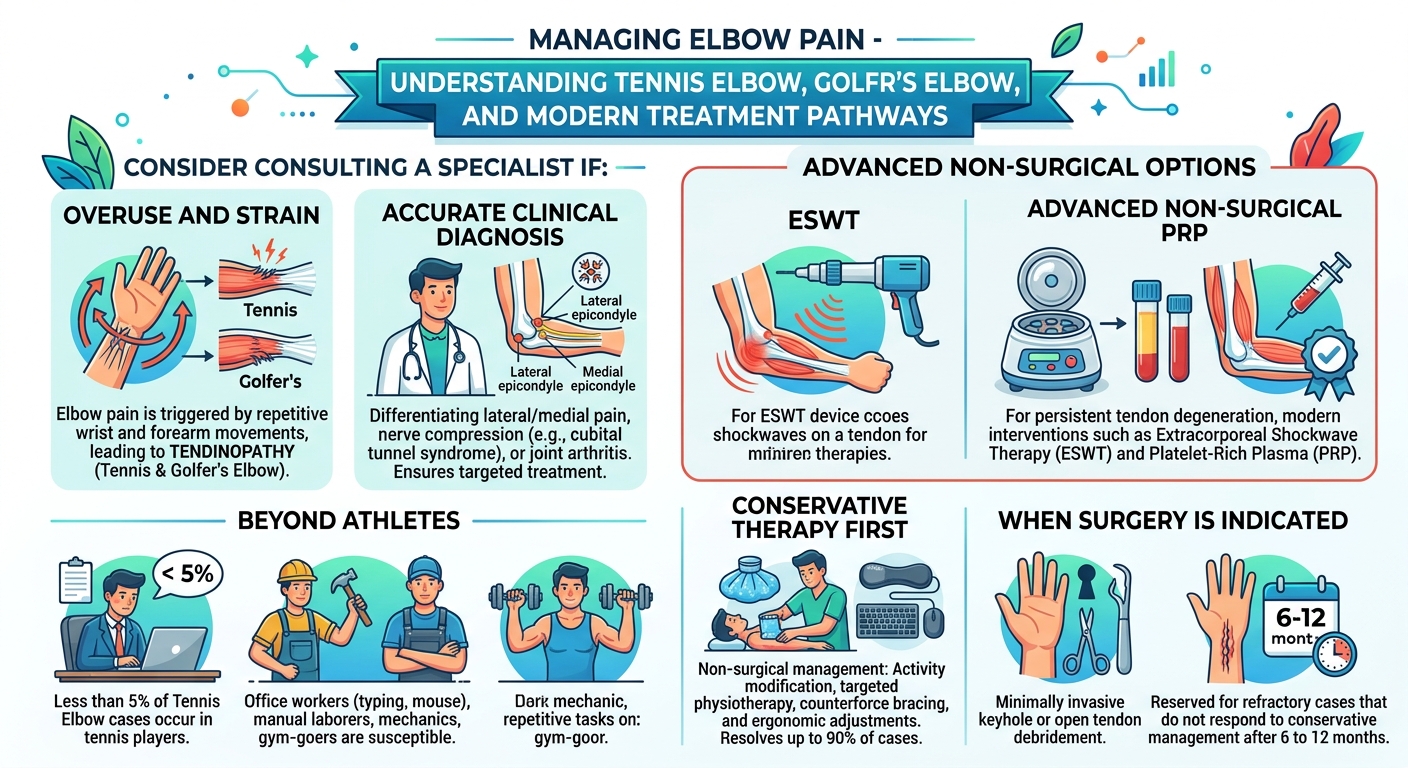
- Overuse And Repetitive Strain: Elbow pain is most commonly triggered by repetitive wrist and forearm movements, leading to tendinopathy—commonly known as Tennis Elbow (lateral epicondylitis) or Golfer’s Elbow (medial epicondylitis).
- Beyond Athletes: Less than 5% of Tennis Elbow cases occur in tennis players. Office workers, manual labourers, mechanics, and gym-goers are equally susceptible due to repetitive mouse use, typing, or heavy lifting.
- Accurate Clinical Diagnosis: Differentiating lateral elbow pain, medial elbow pain, nerve compression (such as cubital tunnel syndrome), or joint arthritis ensures targeted treatment and prevents chronic tendon degradation.
- Conservative Therapy First: Non-surgical management—including activity modification, targeted physiotherapy, counterforce bracing, and ergonomic adjustments—resolves up to 90% of cases.
- Advanced Non-Surgical Options: For persistent tendon degeneration, modern non-surgical interventions such as Extracorporeal Shockwave Therapy (ESWT) and Platelet-Rich Plasma (PRP) therapy offer evidence-based relief.
- When Surgery Is Indicated: Minimally invasive keyhole or open tendon debridement is reserved for refractory cases that do not respond to conservative management after 6 to 12 months.
Click to expand infographic.
Understanding Elbow Pain: Lateral vs. Medial Tendinopathy
The elbow joint functions as a hinge joint connecting the upper arm bone (humerus) with the two forearm bones (radius and ulna). Movements of the wrist and fingers are driven by tendons that originate at two prominent bony points on either side of the elbow:
- Lateral Epicondyle: The outer bump of the elbow.
- Medial Epicondyle: The inner bump of the elbow.
When repetitive stress causes micro-tears and degenerative changes in these tendon attachments, localised elbow pain and functional impairment result.
| Condition | Common Name | Affected Tendon / Muscle | Location Of Pain | Typical Triggers |
| Lateral Epicondylitis | Tennis Elbow | Extensor Carpi Radialis Brevis (ECRB) | Outer side of elbow | Typing, mouse work, tennis backhand, screwdriver use |
| Medial Epicondylitis | Golfer’s Elbow | Flexor-Pronator Tendon Origin | Inner side of elbow | Golf swing, heavy pulling, carrying bags, weightlifting |


What Are The Causes And Risk Factors For Elbow Pain?
Elbow tendon conditions are primarily micro-traumatic wear-and-tear conditions rather than acute inflammatory conditions. Repetitive forearm strain leads to tendon degeneration, characterised by collagen breakdown and altered vascularity at the tendon origin.
Common Risk Factors Include:
- Repetitive Occupational Tasks: Prolonged computer mouse usage, keyboard typing, plumbing, carpentry, or painting.
- Sports And Leisure Activities: Racquet sports, golf, rock climbing, or heavy resistance training with sub-optimal technique.
- Age Factor: Most commonly diagnosed in adults aged 30 to 55 years.
- Ergonomic Strain: Poor workstation setup causing sustained wrist extension or forearm tension.
What Are The Symptoms And Warning Signs?
Recognising early symptoms prevents chronic tendon degeneration and functional restriction:
- Tennis Elbow Symptoms: Pain and tenderness on the outer elbow, weakened grip strength, and aggravation when turning a doorknob, shaking hands, or holding a coffee cup.
- Golfer’s Elbow Symptoms: Pain and tenderness along the inner elbow radiating down the inner forearm, stiffness when making a fist, and pain when flexing the wrist inwards.
- Nerve Compression (Cubital Tunnel Syndrome): Numbness, tingling, or a “pins and needles” sensation in the ring and little fingers, often accompanied by hand dexterity weakness.
Clinical Diagnosis Of Elbow Pain
A structured clinical evaluation by a medical professional or orthopaedic specialist is essential to pinpoint the source of pain and rule out referred pain from the neck (cervical radiculopathy).
Physical Examination: Specific resistance tests (e.g., Cozen’s test for Tennis Elbow, Golf-arm test for Golfer’s Elbow) isolate precise tendon tenderness.
Diagnostic Ultrasound: Visualises tendon thickness, micro-tears, neo-vascularisation, and calcifications in real-time.
Magnetic Resonance Imaging (MRI): Recommended for severe or chronic pain to assess the extent of tendon tears, ligament stability, or intra-articular pathology.
X-Rays: Used to rule out bone spurs, joint arthritis, or loose bodies within the elbow joint.
Find Out: What Is Medical Imaging – X-Ray, Ultrasound, CT, MRI & PET Scan?
What Are The Treatment Options For Elbow Pain?
Treatment for elbow pain follows a step-wise approach aimed at relieving pain, supporting tendon healing, and restoring forearm function.
1. Conservative First-Line Care
- Rest And Activity Modification: Temporarily reducing repetitive forearm movements that strain the affected tendon.
- Ergonomic Adjustments: Re-organising computer equipment, utilising vertical mice, and providing wrist support to reduce extensor tension.
- Targeted Physiotherapy: Progressive eccentric strengthening exercises and soft tissue therapy to stimulate tendon remodeling.
- Counterforce Bracing: Applying an elbow strap below the joint to redistribute mechanical load away from the tendon insertion point.
2. Advanced Non-Surgical Options
- Extracorporeal Shockwave Therapy (ESWT): Acoustic waves applied to the tendon to stimulate micro-circulation and cellular regeneration.
- Platelet-Rich Plasma (PRP) Therapy: Autologous blood plasma rich in growth factors injected under ultrasound guidance directly into the degenerative tendon region to promote natural repair.
3. Surgical Intervention
For chronic cases where persistent pain and functional restriction persist after 6 to 12 months of structured non-surgical care, surgical tendon debridement may be evaluated.
- Procedure: The degenerated, non-healing tendon tissue is excised, and the remaining healthy tendon structure is anchored to the bone.
- Technique: Performed either through traditional open surgery or minimally invasive arthroscopic (keyhole) techniques.
Our Preferred Doctor You Can Consider For Elbow Conditions
Dr Bryan Wang is a fellowship-trained Senior Consultant Orthopaedic Surgeon at Beacon Orthopaedics with over 20 years of experience. Sub-specialising in upper limb reconstruction, he offers advanced minimally invasive arthroscopic treatments for complex shoulder and elbow conditions to reduce patient downtime and accelerate functional recovery.
Articles Reviewed By Dr Bryan Wang
Can a rotator cuff tear heal without surgery?
- December 1, 2025
Bicep Tendonitis Treatment Options In Singapore
- November 21, 2025
Trigger Finger Splint And Other Treatment Options In Singapore
- November 21, 2025
Is My Finger Stiffness Trigger Finger?
- November 20, 2025
Find A Doctor
Verified Healthcare Professionals
We connect you with a network of qualified and experienced doctors who specialise in chronic health conditions, health screening, and longevity.
Trusted Information Source
We pride ourselves on providing accurate, up-to-date, and evidence-based information about each disease, its prevention, and treatment.
Privacy and Security
Your health information and personal data are paramount to us. We will protect your privacy throughout the booking process and beyond.
Convenience at Your Fingertips
Our user-friendly platform allows you to find and book appointments 24/7 from the comfort of your home.
Additional Resources
- 365Asia List of Top Orthopaedic Specialists In Singapore For Elbow And Shoulder Arthroscopy
- 365Asia List of Best Orthopaedic Specialist In Singapore
When Should You See An Orthopaedic Specialist For Elbow Pain?
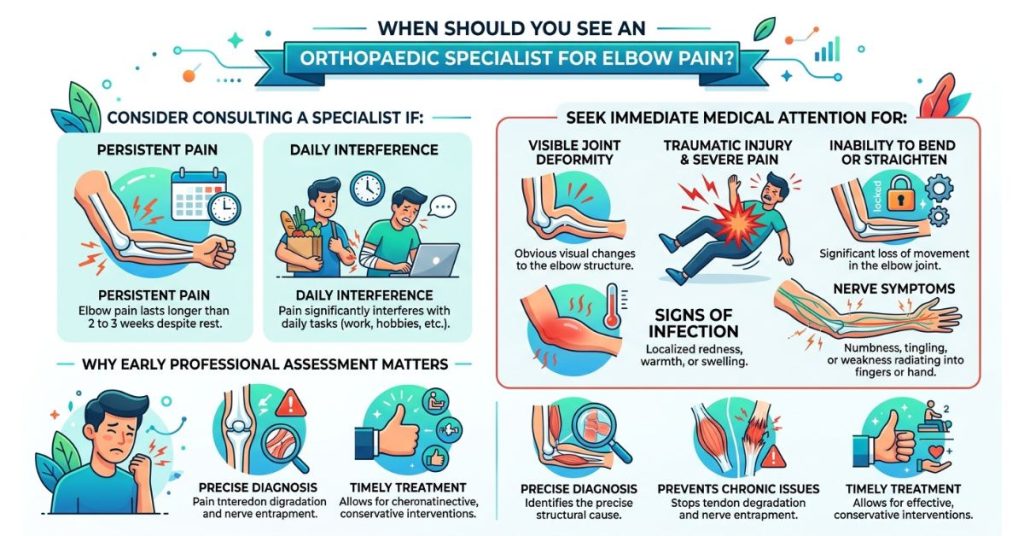
Persistent or worsening symptoms warrant prompt evaluation by an orthopaedic specialist. You should consider seeking a specialist consultation if you experience elbow pain that lasts longer than two to three weeks despite rest, or if the pain significantly interferes with daily tasks.
Immediate medical attention is recommended if there is visible joint deformity, sudden severe pain following a traumatic injury, inability to bend or straighten the elbow, signs of infection such as localised redness or warmth, or accompanying nerve symptoms like numbness, tingling, or weakness radiating into the fingers or hand.
Early professional assessment helps identify the precise structural cause, preventing chronic tendon degradation or nerve entrapment and allowing for timely, conservative intervention.
Frequently Asked Questions About Elbow Pain
Can Tennis Elbow or Golfer’s Elbow Heal Without Surgery?
Yes, the vast majority of elbow tendinopathy cases resolve with conservative treatments, including activity modification, structured physiotherapy, and targeted non-surgical therapies.
Are Corticosteroid Injections Recommended For Elbow Pain?
Corticosteroid injections may provide temporary short-term pain relief. However, repeated injections are generally restricted as evidence indicates they may weaken tendon collagen structure over time.
How Soon Can One Resume Sports Or Exercise After Treatment?
Return to sports is gradual and depends on individual rehabilitation progress. Activities are typically resumed once basic forearm strength is restored and functional movements are completely pain-free.