


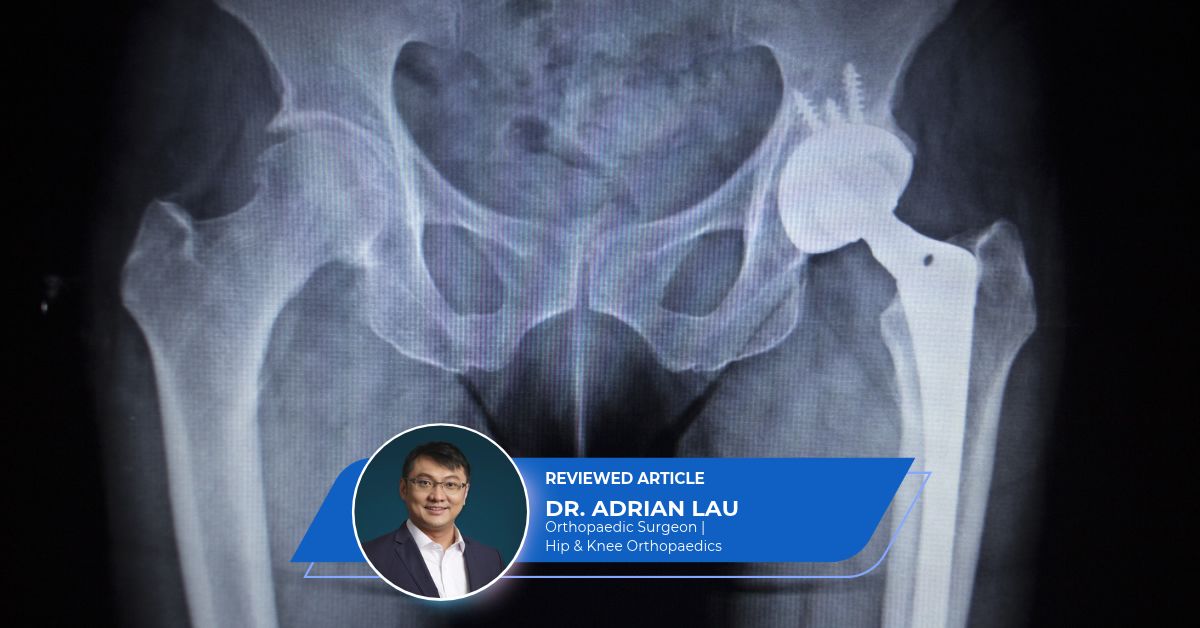
What Is Hip Revision Surgery?
A primary total hip replacement is one of the most successful surgeries in modern medicine. However, artificial joint components do not last forever. Revision hip surgery (or revision hip arthroplasty) is a secondary procedure performed to remove and replace an artificial hip implant that has worn out, loosened, become infected, or failed over time.
While primary hip surgery involves replacing natural worn cartilage, revision surgery involves carefully extracting old metal or ceramic implants from surrounding bone and securing new, specialised revision components in their place.
Read about how to choose the hip implant that is right for you.
What Are The Main Reasons Artificial Hip Implants Fail?
Artificial hip implants fail due to aseptic loosening, component wear, prosthetic joint infection, or recurrent dislocation and joint instability.
1. Aseptic Loosening (Non-Infectious Bone Breakdown)
Aseptic loosening is the most common reason for hip revision surgery after 15 to 20 years. Over millions of steps, microscopic wear particles from the implant liner accumulate in the joint space. The body’s immune system tries to absorb these micro-particles, triggering an inflammatory reaction called osteolysis (bone resorption). As the bone around the stem or cup thins out, the implant loses its solid anchorage and begins to wobble.
2. Mechanical Squeaking, Clicking, or Component Wear
- Squeaking: Most commonly associated with older ceramic-on-ceramic implants. Squeaking occurs when joint lubrication thins or when minor edge-loading causes microscopic friction between ceramic surfaces. While not always dangerous, persistent squeaking should be evaluated.
- Clicking or Grinding: Indicates that a plastic liner has worn thin, allowing the hard metal or ceramic ball to rub directly against the outer metal cup.
3. Prosthetic Joint Infection (PJI)
Bacteria can attach to the artificial metal or plastic surfaces of an implant, forming a protective barrier called a biofilm. Because blood cannot flow through artificial metal, the body’s immune cells and oral antibiotics cannot reach the bacteria directly. Infections require specialised medical care, often involving a two-stage revision surgery to clear the infection permanently. Signs of infection could include persistent pain, delayed wound healing, prolonged drainage from the wound, and sudden onset of fever with joint pain.
4. Recurrent Dislocation & Joint Instability
Dislocation refers to the dissociation of the femoral stem and ball from the acetabular liner. Dislocations are immediately painful, and patients are usually unable to bear weight and will require immediate medical attention. There are various causes of hip dislocations, and treatment will depend on the reason for dislocation. Malpositioned implants may require hip revision to reduce the risk of recurrent instability.
Key Warning Signs You Need A Specialist Second Opinion
If you have had a hip replacement in the past and experience any of the following symptoms, an orthopaedic evaluation is recommended:
- New Pain After Years of Comfort: Pain in the groin, thigh, or buttock when standing up or taking your first few steps.
- Audible Squeaking or Grinding: High-pitched squeaking or grinding sensations during walking or hip rotation.
- Feeling Of Instability: A feeling that the hip is “giving way” or slipping out of place.
- Leg Length Discrepancy: Noticing that the operated leg suddenly feels shorter or uneven.
- Signs of Infection: Unexplained warmth, redness, swelling, or fluid drainage near the old surgical scar, accompanied by fever or chills.
Primary Surgery vs. Revision Surgery Comparison
What To Expect During A Revision Evaluation
Diagnosing a failing hip implant requires a thorough, systematic approach:
- Specialised Imaging: X-rays and high-resolution CT scans evaluate bone loss, implant positioning, and subtle signs of loosening around the metal stem.
- Inflammatory Blood Tests: Blood tests checking Erythrocyte Sedimentation Rate (ESR) and C-Reactive Protein (CRP) rule out silent joint infections.
- Joint Fluid Aspiration: If an infection is suspected, a small fluid sample is drawn from the hip joint under ultrasound guidance and sent to a lab for bacterial culture.
Frequently Asked Questions
Yes. While revision surgery is technically more demanding than a first-time hip replacement, modern surgical techniques, specialised custom revision implants, and advanced bone-grafting materials yield excellent, long-term outcomes in restoring mobility.
While an artificial hip can technically be revised more than once, every procedure requires careful handling of the native bone. This is why getting a precise, durable primary or secondary revision fix from an experienced specialist is essential to preserve your natural bone stock for life.
Recovery from revision hip surgery takes slightly longer than a primary joint replacement because bone grafting or specialised hardware may be required. While primary surgery patients often walk unassisted within 2 to 3 weeks, revision patients usually use a walking stick or frame for 4 to 6 weeks to allow the new bone-implant interface to stabilise safely. Full recovery to normal activities will require physiotherapy and strengthening and will usually take several months.
Schedule An Appointment With A Surgeon With Expertise In Hip Implant Revision Surgery
If you would like to consult an expert hip surgeon on your implant revision options, contact us via the button below for assistance to schedule an appointment.
Contact MedicalTravel.asia
This medical content has been reviewed by Dr Adrian Lau, a double-fellowship-trained Specialist Orthopaedic Surgeon with extensive expertise in complex hip and knee replacements, joint revision surgery, and sports-related lower limb injuries. He performs primary & complex hip and knee replacements, partial knee replacements, direct anterior approach hip replacements, revision arthroplasty, arthroscopic knee surgery, and treats periprosthetic fractures.
Back To: Health365 Comprehensive Guide To Hip Osteoarthritis
All content on this site is informative only and is not intended to be a substitute for professional medical advice, diagnosis, or treatment, and should never be relied upon for specific medical advice. If you are experiencing a medical emergency, call 995 immediately or go to the nearest Accident & Emergency department.
health365.sg is a member of 365Asia.